Question: I really really need this answered, Please help me SD means Standard deviation Background info t PROCEDURE that is pooled.... To make statistical inference (hypo.
I really really need this answered, Please help me
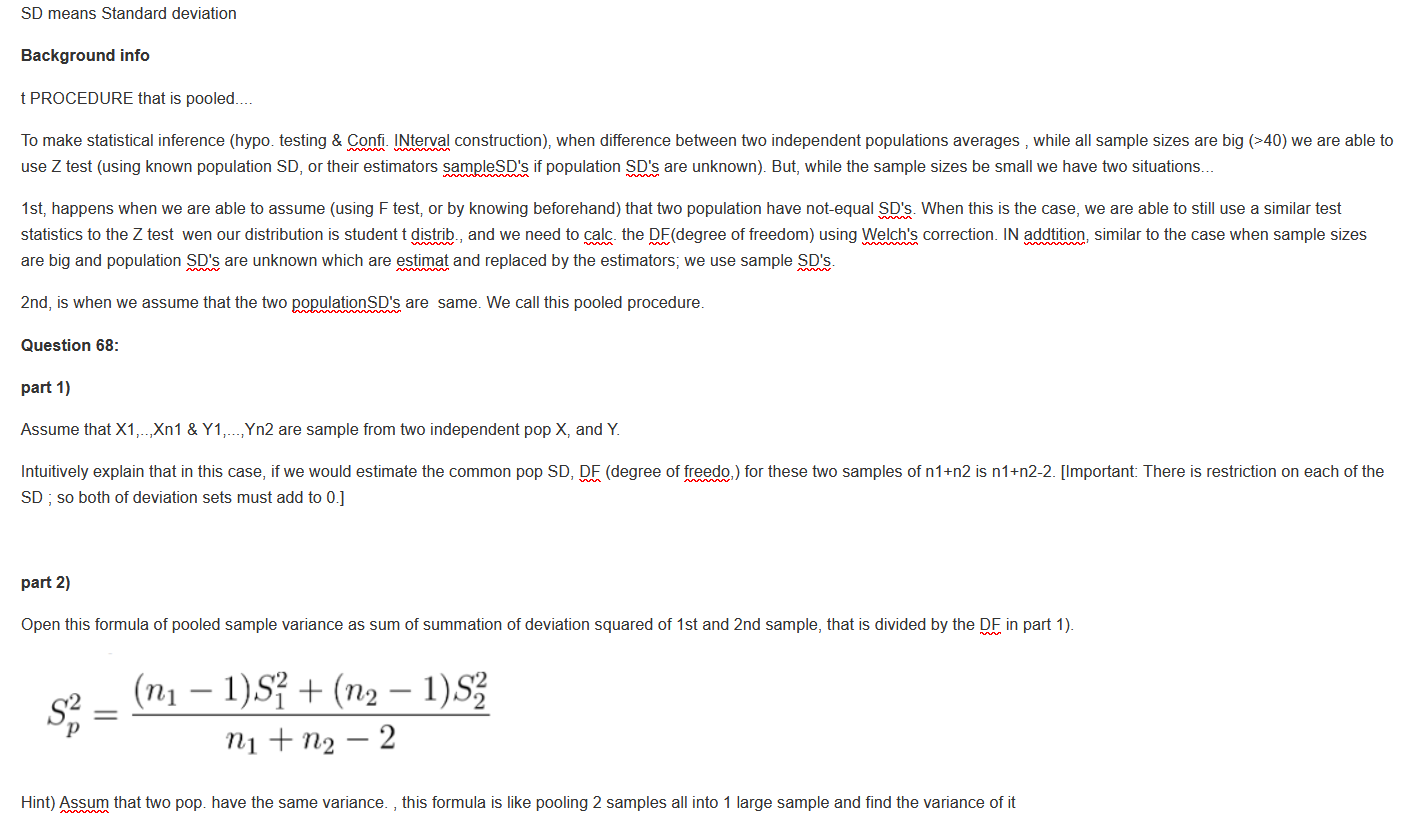
SD means Standard deviation Background info t PROCEDURE that is pooled.... To make statistical inference (hypo. testing & Confi. INterval construction), when difference between two independent populations averages, while all sample sizes are big >40) we are able to use Z test (using known population SD, or their estimators sampleSD's if population SD's are unknown). But, while the sample sizes be small we have two situations... 1st, happens when we are able to assume (using F test, or by knowing beforehand) that two population have not-equal SD's. When this is the case, we are able to still use a similar test statistics to the Z test wen our distribution is student t distrib., and we need to calc. the DF(degree of freedom) using Welch's correction. In addtition, similar to the case when sample sizes are big and population SD's are unknown which are estimat and replaced by the estimators, we use sample SD's. 2nd, is when we assume that the two population SD's are same. We call this pooled procedure. Question 68: part 1) Assume that X1,..,Xn1 & Y1,..., Yn2 are sample from two independent pop X, and Y. Intuitively explain that in this case, if we would estimate the common pop SD, DF (degree of freedo) for these two samples of n1+n2 is n1+n2-2. [Important: There is restriction on each of the SD ; so both of deviation sets must add to 0.] part 2) Open this formula of pooled sample variance as sum of summation of deviation squared of 1st and 2nd sample, that is divided by the DF in part 1). S2 (n 1)S} + (n2 1)S3 nu + n2 2 Hint) Assum that two pop. have the same variance., this formula is like pooling 2 samples all into 1 large sample and find the variance of it SD means Standard deviation Background info t PROCEDURE that is pooled.... To make statistical inference (hypo. testing & Confi. INterval construction), when difference between two independent populations averages, while all sample sizes are big >40) we are able to use Z test (using known population SD, or their estimators sampleSD's if population SD's are unknown). But, while the sample sizes be small we have two situations... 1st, happens when we are able to assume (using F test, or by knowing beforehand) that two population have not-equal SD's. When this is the case, we are able to still use a similar test statistics to the Z test wen our distribution is student t distrib., and we need to calc. the DF(degree of freedom) using Welch's correction. In addtition, similar to the case when sample sizes are big and population SD's are unknown which are estimat and replaced by the estimators, we use sample SD's. 2nd, is when we assume that the two population SD's are same. We call this pooled procedure. Question 68: part 1) Assume that X1,..,Xn1 & Y1,..., Yn2 are sample from two independent pop X, and Y. Intuitively explain that in this case, if we would estimate the common pop SD, DF (degree of freedo) for these two samples of n1+n2 is n1+n2-2. [Important: There is restriction on each of the SD ; so both of deviation sets must add to 0.] part 2) Open this formula of pooled sample variance as sum of summation of deviation squared of 1st and 2nd sample, that is divided by the DF in part 1). S2 (n 1)S} + (n2 1)S3 nu + n2 2 Hint) Assum that two pop. have the same variance., this formula is like pooling 2 samples all into 1 large sample and find the variance of it









 Study Help