







Question: (I) Though the independent variable t of the function X(t) in the ODE (1) is stipulated to range in the interval I, we expect
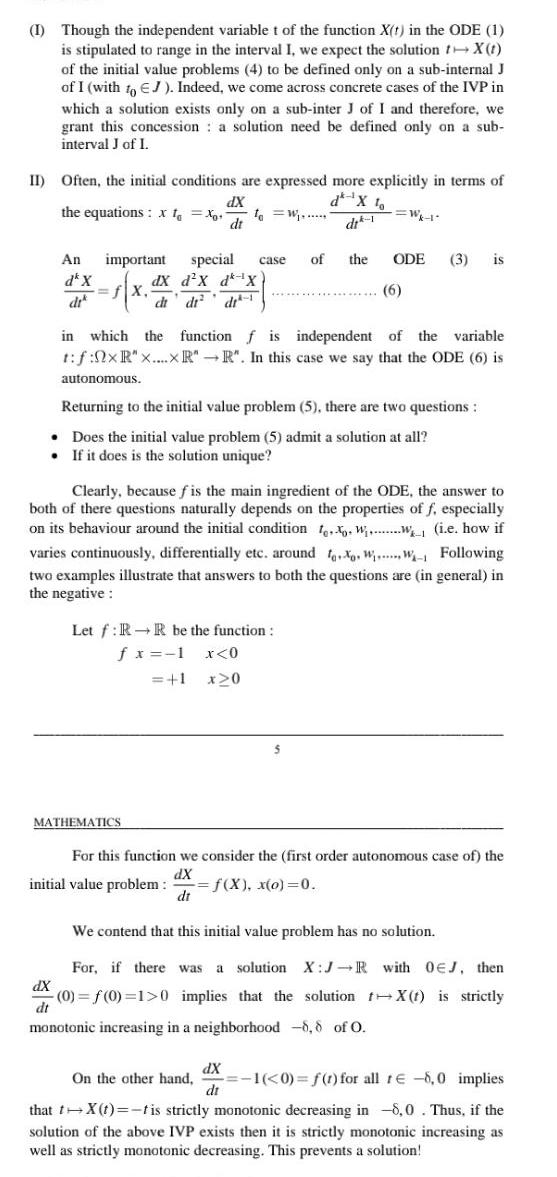
(I) Though the independent variable t of the function X(t) in the ODE (1) is stipulated to range in the interval I, we expect the solution X(t) of the initial value problems (4) to be defined only on a sub-internal J of I (with to EJ). Indeed, we come across concrete cases of the IVP in which a solution exists only on a sub-inter J of I and therefore, we grant this concession a solution need be defined only on a sub- interval J of I. II) Often, the initial conditions are expressed more explicitly in terms of dX the equations: x = x- dt d-X 1 dr-1 =W- An important special case of the ODE (3) is dkX dx d'x dx fx. (6) dr dt dr dr in which the function f is independent of the variable t:f:0xRx....XR"R". In this case we say that the ODE (6) is autonomous. Returning to the initial value problem (5), there are two questions: Does the initial value problem (5) admit a solution at all? If it does is the solution unique? Clearly, because f is the main ingredient of the ODE, the answer to both of there questions naturally depends on the properties of f, especially on its behaviour around the initial condition to. WW varies continuously, differentially etc. around fx. WW (i.e. how if Following two examples illustrate that answers to both the questions are (in general) in the negative : Let f R R be the function: fx=-1x 0 implies that the solution X(t) is strictly monotonic increasing in a neighborhood -8,8 of O. dX di On the other hand, -=-1(
Step by Step Solution
There are 3 Steps involved in it

Get step-by-step solutions from verified subject matter experts
 Study Help