







Question: Problem 3 Sometimes complex behavior can arise when a system contains multiple reactions. Depending on the properties of the system, a reactor can exhibit stable
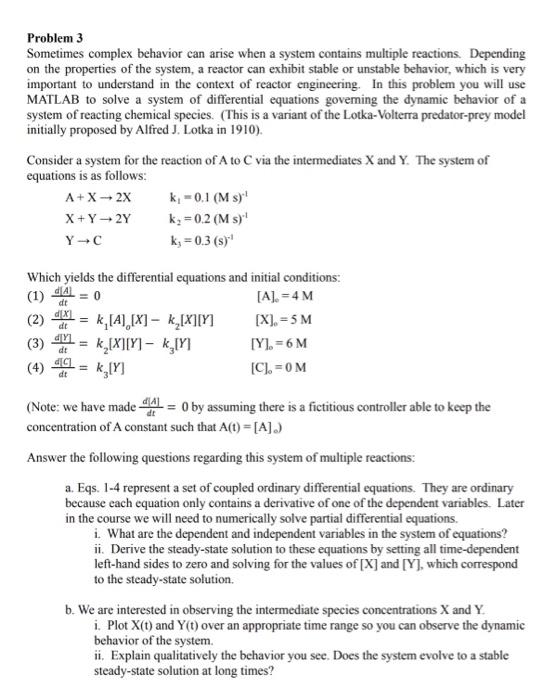
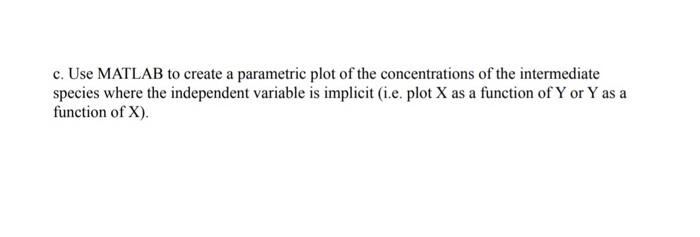
Problem 3 Sometimes complex behavior can arise when a system contains multiple reactions. Depending on the properties of the system, a reactor can exhibit stable or unstable behavior, which is very important to understand in the context of reactor engineering. In this problem you will use MATLAB to solve a system of differential equations goveming the dynamic behavior of a system of reacting chemical species. (This is a variant of the Lotka-Volterra predator-prey model initially proposed by Alfred J. Lotka in 1910). Consider a system for the reaction of A to C via the intermediates X and Y. The system of equations is as follows: A+ X - 2x k, -0.1 (M$)' X+Y2Y ke=0.2 (Ms) YC ks = 0.3 (s)' = 0 dt = Which yields the differential equations and initial conditions: (1) [A]. = 4M (2) dx k, [4],[x] k,[X]TY [X]. = 5 M k_[X][Y) - k_1 [Y). - 6 M dal (4) ky[Y] [C].=0M dt (3) JY dt dt (Note: we have made 10 = 0 by assuming there is a fictitious controller able to keep the concentration of A constant such that A(t) = [A].) Answer the following questions regarding this system of multiple reactions: a. Eqs. 1-4 represent a set of coupled ordinary differential equations. They are ordinary because each equation only contains a derivative of one of the dependent variables. Later in the course we will need to numerically solve partial differential equations. i. What are the dependent and independent variables in the system of equations? ii. Derive the steady-state solution to these equations by setting all time-dependent left-hand sides to zero and solving for the values of [X] and [Y], which correspond to the steady-state solution b. We are interested in observing the intermediate species concentrations X and Y. i. Plot X(t) and y(t) over an appropriate time range so you can observe the dynamic behavior of the system ii. Explain qualitatively the behavior you see. Does the system evolve to a stable steady-state solution at long times? c. Use MATLAB to create a parametric plot of the concentrations of the intermediate species where the independent variable is implicit (i.e. plot X as a function of Yor Y as a function of X)
Step by Step Solution
There are 3 Steps involved in it

Get step-by-step solutions from verified subject matter experts
 Study Help