







Question: I want DPCM code using MATLAB show me all the steps as typed text and picture from the MATLAB Note: dont solve using free hand
I want DPCM code using MATLAB
show me all the steps as typed text and picture from the MATLAB
Note: dont solve using free hand please
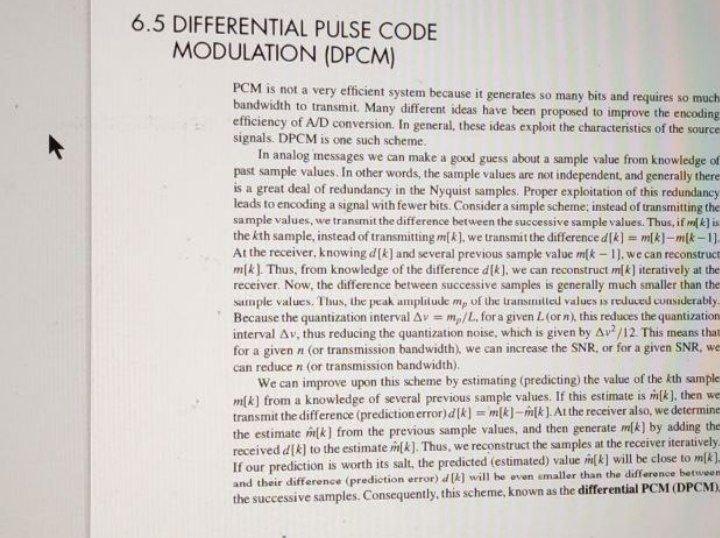
PCM is not a very efficient system because it generates so many bits and requires so much bandwidth to transmit. Many different ideas have been proposed to improve the encoding efficiency of A/D conversion. In general, these ideas exploit the characteristics of the source signals. DPCM is one such scheme. In analog messages we can make a good guess about a sample value from knowledge of past sample values. In other words, the sample values are not independent, and generally there is a great deal of redundancy in the Nyquist samples. Proper exploitation of this redundancy leads to encoding a signal with fewer bits. Consider a simple scherne: instead of trinsmitting the sample values, we transmit the difference berween the sucsessive sample values. Thus, if m[k] is the k th sample, instead of transmitting m[k], we transmit the difference d[k]=m[k]m[k1] At the receiver, knowing d[k] and several previous sample value m[k1], we can reconstruct m[k]. Thus, from knowledge of the difference d[k]. we can reconstruct m[k] iteratively at the receiver. Now, the difference between successive samples is generally much smaller than the sumple values. Thus, the peak amplitude mp of the transmilled values is reduest cuasiderably. Because the quantization interval v=m2/L. for a given L (or n ), this reduces the quantization interval v, thus reducing the quantization noise, which is given by v2/12. This means that for a given n (or transmission bandwidth), we can increase the SNR, or for a given SNR, we can reduce n (or transmission bandwidth). We can improve upon this sheme by estimating (predicting) the value of the kth sample m[k] from a knowledge of several previous sample values. If this estimate is m[k]. then we transmit the difference (predictionerror) d[k]=m[k]m^[k]. At the receiver also, we determine the estimate m^[k] from the previous sample values, and then generate m[k] by adding the received d[k] to the estimate m[k]. Thus, we reconstruct the samples at the receiver iteratively. If our prediction is worth its salt, the predicted (estimated) value m[k] will be close to m[k]. and their differencet (prediotion error) d[k] will be owen smaller than the difference between the successive samples. Consequently, this scheme, known as the differential PCM (DPCM)
Step by Step Solution
There are 3 Steps involved in it

Get step-by-step solutions from verified subject matter experts
 Study Help