







Question: For fluid flow in pipes, friction is described by a dimensionless number, the Fanning friction factor f. The Fanning friction factor is dependent on
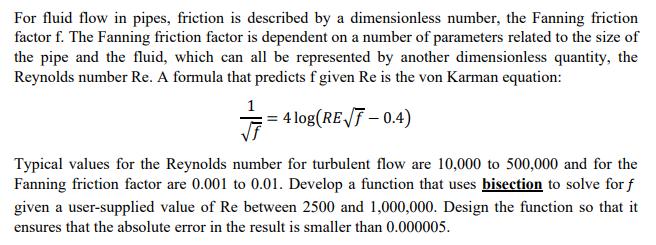
For fluid flow in pipes, friction is described by a dimensionless number, the Fanning friction factor f. The Fanning friction factor is dependent on a number of parameters related to the size of the pipe and the fluid, which can all be represented by another dimensionless quantity, the Reynolds number Re. A formula that predicts f given Re is the von Karman equation: 1 = 4 log(REF-0.4) Typical values for the Reynolds number for turbulent flow are 10,000 to 500,000 and for the Fanning friction factor are 0.001 to 0.01. Develop a function that uses bisection to solve for f given a user-supplied value of Re between 2500 and 1,000,000. Design the function so that it ensures that the absolute error in the result is smaller than 0.000005. For fluid flow in pipes, friction is described by a dimensionless number, the Fanning friction factor f. The Fanning friction factor is dependent on a number of parameters related to the size of the pipe and the fluid, which can all be represented by another dimensionless quantity, the Reynolds number Re. A formula that predicts f given Re is the von Karman equation: 1 = 4 log(REF-0.4) Typical values for the Reynolds number for turbulent flow are 10,000 to 500,000 and for the Fanning friction factor are 0.001 to 0.01. Develop a function that uses bisection to solve for f given a user-supplied value of Re between 2500 and 1,000,000. Design the function so that it ensures that the absolute error in the result is smaller than 0.000005.
Step by Step Solution
3.47 Rating (144 Votes )
There are 3 Steps involved in it
Sol Giv... View full answer

Get step-by-step solutions from verified subject matter experts
 Study Help