Question: i want the answer to 10-19 and conclusion answer question 10-9 CASE 10-2 The Smart Car IR atZssummamrtecr aorf w2.0u0,6d, bDeaoi mffleerreCdh tryostlesraiaeninnotuhnecuedn ittehda tstthaetecsothem
i want the answer to 10-19 and conclusion
answer question 10-9
CASE 10-2 The Smart Car
IR atZssummamrtecr aorf w2.0u0,6d, bDeaoi mffleerreCdh tryostlesraiaeninnotuhnecuedn ittehda tstthaetecsothem -following year. Launched in Europe in 1998, the diminutive Smart had never turned a profit for its parent company. When Dieter Zetsche became DaimlerChrysler's CEO at the beginning of 2006, the Smart car issue was one of his top pnonties. At the time of the announcement, the Smart saga had been 15 years m the making. In 1991, Nicolas Hayek, chairman of Swatch, announced plans to develop a battery-powered "Swatch car" in conjunction with Volkswagen. At the time, Hayek said his goal was to build "an ecologically inoffensive, high-quality city car for two people" that would sell for about 86,400. The Swatchmobile concept was based on Hayek's conviction that consumers become emotion-ally attached to cars just as they do to watches. Like the Swatch, the Swatchmobile (officially named "Smart") was designed to be afford-able, durable, and stylish. Early on, Hayek noted that safety would be another key selling point, declaring, "This car will have the crash security of a Mercedes." Composite exterior panels mounted on a cage-like body frame would allots owners to change colors by switching panels. Further, Hayek envisioned a car that emitted almost no pollutants, thanks to its elec-tric engine. The car would also offer gasoline-powered operation, using a highly efficient, miniaturized engine capable of achieving speeds of 80 miles per hour. Hayek predicted that worldwide sales would reach 1 million units, with the United States accounting for about half the market. Then, in 1993, the alliance with Volkswagen was dissolved. In the spring of 1994, Hayek announced that he had lined up a new joint venture partner. The Mercedes-Benz unit of Daimler-Benz AG would invest 750 million Deutsche marks in a new factory in Hambach-Saargemuend, France. In November 1998, after several months of
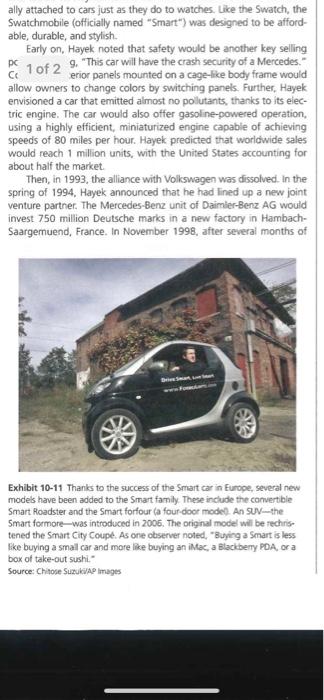
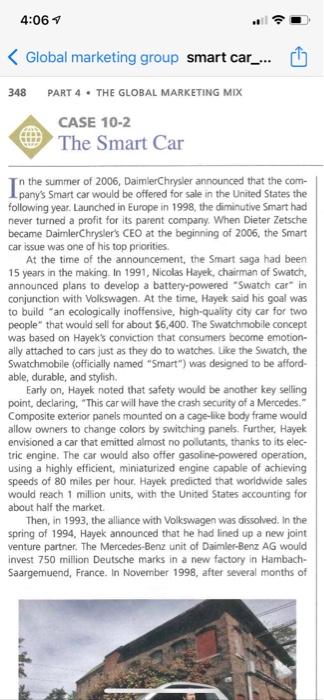
Exhibit 10-11 Thanks to the success of the Smart car in Europe, several new models have been add. to the Smart family. These include the convertible Smart Roadster and the Smart forfour (a four-door model). An SWthe Smart formorewas introduc. in 2006. The original model will be rechris-tened the Smart City Coupe. As one observer noted, "Buying a Smart is less like buying a small car and more like buying an iMac, a Blackberry PDA. or a box of take-out sushi." Source: Chitose SuzukVAP images
production delays and repeated cost overruns, Hayek sold Swatch's remaining 19 percent stake in the venture, officially known as Micro Compact Car GmBH (MCC), to Mercedes. A spokesman indicated that Mercedes' refusal to pursue the hybrid gasoline/battery engine was the reason Swatch withdrew from the project. The decision by Mercedes executives to take full control of the venture was consistent with its strategy for leveraging its engineer-ing skills and broadening the company's appeal beyond the luxury segment of the automobile market. As Mercedes chairman Helmut Werner said, "With the new car, Mercedes wants to combine ecology, emotion, and intellect." Approximately 80 percent of the Smart's parts are components and modules engineered by and sourced from out-side suppliers and subcontractors known as "system partners." The decision to locate the assembly plant in France disappointed German labor unions, but Mercedes executives expected to save 500 marks per car. The reason: French workers are on the job 275 days per year, while German workers average only 242 days; also, overall labor costs are 40 percent lower in France than in Germany. MCC claims that at Smart Vile, as the factory is known, only 7.5 hours are required to complete a vehicle-25 percent less time than that required by the world's best automakers. The first 3 hours of the process are performed by systems partners. A Canadian company, Magna International, starts by welding the structural com-ponents, which are then painted by Eisenmann, a German company. Both operations are performed outside the central assembly hall; a conveyer then transports the body into the main hall. There, VDO, another German company, installs the instrument panel. At this point, modules and parts manufactured by Krupp-Hoesch, Bosch, Dynamit Nobel, and Ymos are delivered for assembly by MCC employees. To encourage integration of MCC employees and system partners and to underscore the need for quality, both groups share a common dining room overlooking the main assembly hall. The Smart City Coupe officially went on sale in Europe in October 1998. In an effort to create a distinct brand identity, a separate dealer network was established for Smart. In retrospect, this decision turned out to be an expensive one Sales got off to a slow start amid con-cerns about the vehicle's stability. That problem was solved with a sophisticated electronics package that monitors wheel slippage. Late-night TV comedians gave the odd-looking car no respect and referred to it as "a motorized ski boot" and "a backpack on wheels." The sales picture was brightest in the United Kingdom; the brisk sales pace in Britain was especially noteworthy because MCC was building only left-hand-drive models the United Kingdom is the only coun-try in Europe in which right-hand-drive cars are the norm). Industry observers noted that Brits' affection for the Austin Mini, a tiny vehicle that first appeared in the 1960s, appeared to have been extended to the Smart. Despite this success, MCC reduced its annual sales target from 130,000 to 100,000. Robert Eaton, joint chairman of DaimlerChrysler, went on record as being skeptical of the vehicle's future. In an inter-view with Automotive News, he said, "It's possible we'll conclude that it's a good idea but one whose time simply hasn't come." In 2000, amid growing interest in the brand, the Smart exceeded its revised sales target. Wolf-Garten GmbH & Company, a German gardening equipment company, initiated a program to convert the Smart to a lawn mower suitable for use on golf courses. Both convert-ible and diesel-engine editions were added to the product line.
In 2001, executives at DaimlerChrysler initiated a program to research the U.S. market to determine prospects for the Smart. The announcement came as Americans were facing steep increases in gasoline prices. Between 2001 and 2006, several other small cars in the $10,000 to $14,000 range were introduced in the U.S. market, including the Chevrolet Aveo (manufactured by Daewoo), the Toyota Tads, and the Honda Fit. In addition, Toyota had successfully launched the Scion, and BMW's new Mini was also proving to be hugely popu-lar with U.S. drivers.
"The Smart brand is capable of sustainable profitability, and it will be profitable in 2007 and beyond. We are working on a cost basis that is almost 50 percent lower than it used to be. The production time at the Hambach plant in France and the assembly time for the new car are 20 percent shorter than with its predecessor." -Ulrich Walker, chairman and CEO, Daimler Northeast Asia; president and CEO, Smart
One challenge in bringing the Smart across the Atlantic was the euro's strength relative to the dollar. To further complicate matters, the DaimlerChrysler merger ended with the sale of Chrysler to a pri-vate equity group. Going forward, Smart was under the ownership of Daimler AG. Moreover, distribution and promotion were critical to a successful U.S launch. Auto racing legend Roger Penske, chief executive of Penske Automotive Group, decided to gamble on the Smart. He snapped up the rights to serve as the sole U.S. distributor for the tiny car. Penske had assembled the second-largest auto retailing group in the United States by selling luxury cars and imports. The network included more than 300 franchised dealers in the United States and Europe. Penske's team set the goal of selling 16,000 Smart cars in the first year; as gasoline prices rose to $4 per gallon, the minicar's appeal seemed obvious. The company sold 24,622 cars in 2008. In 2010, as gasoline prices moderated, car buyers began gravi-tating back toward large vehicles. Smart's sales fell from 14,595 cars in 2009 to 5,927 in 2010. Early in 2011, Penske Automotive Group announced that it was terminating its distribution agreement for the Smart and returning distribution to Mercedes-Benz USA. A company spokesperson attributed the move to a change in organizational struc-ture for the Smart brand in Germany. Meanwhile, Smart USA and the Strawberry Frog advertising agency launched a social media initiative to leverage the exploding popularity of Facebook and Twitter. The brand's Twitter handle is smartcarusa; followers are reminded that "Smart is against dumb, mindless consumption." Sample tactics include "The Great Dumb Trade-In" and retweets of owner comments about their vehicles.
Today, Smart USA's page on Facebook has more than 100,000 "likes." The company has also mobilized street teams and produced viral videos. Scott Goodson, the founder of Strawberry Frog, sums up the brand this way: "The Smart can is about living a flexible, agile life. Less is more." Asked how she would measure the success of the "Against Dumb" movement, Kim McGill, Smart's vice president of marketing and advertising, said:
If it makes people just think about it, that will be a success.... We need to get people thinking of buying not for that one time, but buying for what we need most of the time. If we can get more people talking in that direction, it will be nothing but positive for this brand.
To learn more about the Smart, visit www.smartusa.com.
Discussion Questions 010-19. Evaluate Smart USA's social media strategy. Discuss what ad-ditional channels or tactics you would recommend.
product Compac that Me was the The venture ing 348 PART 4 . THE GLOBAL MARKETING MIX CASE 10-2 The Smart Car , pany's Smart car would be offered for sale in the United States the following year. Launched in Europe in 1998, the diminutive Smart had never turned a profit for its parent company. When Dieter Zetsche became DaimlerChrysler's CEO at the beginning of 2006, the Smart car issue was one of his top priorities At the time of the announcement, the Smart saga had been 15 years in the making. In 1991, Nicolas Hayek, chairman of Swatch, announced plans to develop a battery powered Swatch car in conjunction with Volkswagen. At the time, Hayek sad his goal was to build an ecologically inoffensive, high-quality city car for two people that would sell for about 56,400. The Swatch mobile concept was based on Hayek's conviction that consumers become emotion- ally attached to cars just as they do to watches. Lite the Swatch, the Swatchmobile (officially named "Smart") was designed to be afford able, durable, and stylish Early on, Hayek noted that safety would be another key selling point, declaring. This car will have the crash security of a Mercedes. Composite exterior panels mounted on a cage-like body frame would allow owners to change colors by switching parsels. Further Hayek envisioned a car that emitted almost no pollutants, thanks to its elec tric engine. The car would also offer gasoline-powered operation, using a highly efficient, miniaturized engine capable of achieving speeds of 80 miles per hour. Hayek predicted that worldwide sales would reach 1 milion units, with the United States accounting for about half the market Then, in 1993, the alliance with Volkswagen was dissolved in the spring of 1994, Hayek announced that he had lined up a new joint venture partner The Mercedes-Benz unit of Daimler-Benz AG would Invest 750 million Deutsche marks in a new factory in Hambach Saargemuend, France. In November 1998, after several months of segment Werner: emotion are com side sup decision Labor un per car while are 40 MCS 7.5 hou than the of the company ponents Both op conveye another modules Nobel, a encoura unders room o The 1998. In network out to b cerns at sophistic night TV to it as sales pic Dace in only left try in EU Observer that first the Sma Des 130,000 went on view wit s ago in 24 Exhibit 10-11 Thanks to the success of the Smart car in Europe, models have been added to the Smart family. These indude the convertible Start Roadster and the Start forfour la four-door model A SU Smart formone-was introduced in 2006. The original mode will be red tened the Smart City Coupe. As one observer notedying a Seat less Skeboying a small car and more buying an eca Ben PA or a box of take-out sushi Source: Chito Simages gardenir Smart to ble and he com Bates the mart had Zetsche ne Smart ad been Swatch car" in poal was for two concept motion- atch the afford y selling teedes e would Hayek its elec seration chieving de sales ating for d. In the ew joint Swould ambach- Onths of production delays and repeated cost overruns, Hayek sold Swatch's remaining 19 percent stake in the venture officially known as Micro Compact Car GMBH (MCC), to Mercedes. A spokesman indicated that Mercedes' refusal to pursue the hybrid gasoline battery engine was the reason Swatch withdrew from the project. The decision by Mercedes executives to take control of the venture was consistent with its strategy for leveraging its engineer ing skills and broadening the company's appeal beyond the luxury segment of the automobile market. As Mercedes chairman Helmut Werner said, "With the new car. Mercedes wants to combine ecology emotion, and intellect. Approximately 80 percent of the Smart's parts are components and modules engineered by and sourced from out side suppliers and subcontractors known as "system partners. The decision to locate the assembly plant in France disappointed German Labor unions, but Mercedes executives expected to save 500 mars per car. The reason French workers are on the job 275 days per year While German workers average only 242 days, also overall labor costs are 40 percent lower in France than in Germany MCC claims that at Smart Ville, as the factory is known, only 7.5 hours are required to complete a vehide-25 percent less time than that required by the world's best automakers. The first 3 hours of the process are performed by Systems partners. A Canadian company, Magna International, starts by welding the structural com ponents, which are then painted by Eisenmann, a German company Both operations are performed outside the central assembly Hall conveyer then transports the body into the main hall. There, VDO another German company installs the instrumentpanel. At this point modules and parts manufactured by Krupp-Hoech Bosch, Dynamit Nobel, and Ymos are delivered for assembly by MCC employees. To encourage integration of MCC employees and system partners and to underscore the need for quality, both groups share a common dining room overlooking the main assembly hall The Smart City Coupe officially went on sale in Europe in October 1998. In an effort to create a distinct brand identity a separate dealer network was established for Smart In retrospect, this decision turned out to be an expensive one. Sales got off to a slow start amid con cerns about the vehicle's stability. That problem was solved with a sophisticated electronics package that monitors Wheel slippage. Late night TV comedians gave the odd-looking car no respect and referred to it as a motorized ski boot" and "a backpack on wheels. The sales picture was brightest in the United Kingdom, the brisk sales pace in Britain was especially noteworthy because MCC was building only left-hand-drive models (the United Kingdom is the only coun- try in Europe in which right-hand-drive cars are the norm Industry observers noted that Brits' affection for the Austin Mint a tiny vehicle that first appeared in the 1960s, appeared to have been extended to the Smart Despite this success, MCC reduced its annual sales target from 130,000 to 100,000. Robert Eaton, joint chairman of DaimlerChrysler went on record as being skeptical of the vehide's future. In an inter view with Automotive News, he said, "it's possible we'l conclude that it's a good idea but one whose time simply become in 2000, amid growing interest in the brand the Smart exceeded its revised sales target. Wolf-Garten GmbH & Company a German Gardening equipment company, initiated a program to convert the Smart to a lawn mower suitable for use on golf courses. Both convert- ible and diesel-engine editions were added to the product line artible the less ora CHAPTER 10.BR Toc "lik vira In 2001, executives at DaimlerChrysler initiated a program to research the U.S. market to determine prospects for the Smart. The announcement came as Americans were facing steep increases in gasoline prices. Between 2001 and 2006, several other small cars in the $10,000 to $14,000 range were introduced in the U.S. market. including the Chevrolet Aveo (manufactured by Daewool the Toyota Yaris, and the Honda Fit. In addition, Toyota had successfully launched the Scion, and BMW's new Mini was also proving to be hugely popu- lar with U.S. drivers bra is n Du anc "The Smart brand is capable of sustainable profitability, and it will be profitable in 2007 and beyond. We are working on a cost basis that is almost 50 percent lower than it used to be The production time at the Hambach plant in France and the assembly time for the new car are 20 percent shorter than with its predecessor -Ulrich Walker, chairman and CEO, Daimles Northeast Asia, president and CEO, Smart To Di 10 10 10- 010 One challenge in bringing the Smart across the Atlantic was the euro's strength relative to the dollar. To further complicate matters, the DaimlerChrysler merger ended with the sale of Chrysler to a pri- vate equity group. Going forward, Smart was under the ownership of Daimler AG. Moreover, distribution and promotion were critical to a Successful U.S. launch Auto racing legend Roger Penske, chief executive of Fenske Automotive Group, decided to gamble on the Smart. He snapped up the rights to serve as the sole U.S. distributor for the tiny car. Penske had assembled the second-largest auto retaing group in the United States by seling luxury cars and imports. The network included more than 300 franchised dealers in the United States and Europe. Penske's team set the goal of selling 16,000 Smart cars in the first year, as gasoline prices tose to $4 per gallon, the minicar's appeal seemed obvious. The company sold 24,622 cars in 2008. In 2010, as gasoline prices moderated, car buyers began gravi tating back toward large vehicles. Smart's sales fell from 14,595 cars in 2009 to 5,927 in 2010. Early in 2011, Penske Automotive Group announced that it was terminating its distribution agreement for the Smart and returning distribution to Mercedes-Benz USA A company spokesperson attributed the move to a change in organizational struc- ture for the Smart brand in Germany Meanwhile, Smart USA and the Strawberry Frog advertising agency launched a social media initiative to leverage the exploding popularity of Facebook and Twitter. The brands Twitter handle is e Smartcarusa; followers are reminded that "Smart is against dumb, mindless consumption." Sample tactics indude "The Great Dumb Trade-In" and retweets of owner comments about their vehicles. sou The Sma Part w Stoll Berr 200 Nos Be Sma DI 14 Tow 34 Oun The Sma Mus M Whi 199 Whe ana ER 10. BRAND AND PRODUCT DECISIONS IN GLOBAL MARKETING 349 to Today, Smart USA's page on Facebook has more than 100.000 The "likes." The company has also mobilized street teams and produced sin viral videos "sin Scott Goodson, the founder of Strawberry Frog, sums up the ket, brand this way: "The Smart car is about living a fleuble, agile life. Less ota is more." Asked how she would measure the success of the "Against ched Dumb" movement, Kim McGill, Smart's vice president of marketing pu- and advertising, said: If it makes people just think about it, that will be a success.... and We need to get people thinking of buying not for that one time, but buying for what we need most of the time. If we can be. get more people talking in that direction, it will be nothing but the positive for this brand than To learn more about the Smart, visit www.smartusa.com or." Discussion Questions sia, mart 10-16. What is Smart's competitive advantage? Brand promise? Positioning? 10-17. How does the Smart compare to the Honde Element, Scion the 10. Kia Soul, or Fiat 500? Are these models targeting the Cers, same consumers as the Smart? In view of the success of these pri- brands, do you think the Smart's U.S. launch is too late? Pof 10-18. As noted in the case, Penske Automotive Group is no longer to a the distributor for Smart USA. How will this affect Smart's fortunes in the United States? aske 10-19. Evaluate Smart USA's social media strategy. Discuss what ad up ditional channels or tactics you would recommend SourcesVanessa Furmans and Matthew Does Smart Gets Tuneup." hore The Wall Street Joumal January 11, 20121.p.34 Max Rare Penske, Daimler End ke's Start Minicar Deal The Wall Street Joumal Grey 15, 2011, p. 83. Eleftheria as Parpis, Smart USA Refuels Brand." Adweek November 24, 2010 Elaine Wong Why Smart (the Car Wants Americans to Be Against Dumb. Forbes.com med Stoll Smart Cara Shrewd Move?The Wall Street Journal Oune 27, 2007). A Bernard Simon, "Daimler Weighs Smart U.S. Appeal Financial Times (March 28 avi- 2006. p. 21: "Smart Shows Redesigned ForTwo. The Wall Street Journal Online cars November 10, 2006, Neal E. Boudette and Stephen Power "W Chrysler's Move Be Smart? The Wall Street Journal lune 24/25, 2006). A Dan McCosh Get oup Smart Buyers Try to up the Queue, The New York Times (March 19, 2004) the DI: Nicholas Foulkes, Smart Set Gets Even Smarter Financial Times February eany 14-15, 2004, p. W10: Wei Pinkston and Scott Mile DamlerChrysler Steers ruc- Toward Smart' Debut in US. The Wall Streerut 20, 2001), pp. B1 84. Scott Miles Daimler May Roll Out Tiny Car Here The Wall Street Journal Clune 9. 2001), p. 31; MilitarlerChrysler Smart Car My Ma New Use sing The Wall Street Journal (February 15, 2001, pp.31. Haig Smolan "Carmakers Sling Smart Move.Financial Times Ouly 1, 1997). p. 12. William Taylor Message and Muscles An Interview with Swatch Titan Nicolas Hayekanand Business Review mb, March-April 1993), pp99-110, Kevin Helios Movement Can Wristwatch Whiz Switch Swatch Cachet to an Automobile? The Wall Street Journal March 4 1994), pp. A1, A3, Ferdinand Prozman of the Wistant the Road A Swatch on cles. Wheels. The New York Times March 4, 1994, p. ske ited amb 4:067