







Question: ( i ) Why is it sometimes not possible use a constant U - value in heat exchanger design where large temperature gradients exist? 1
i Why is it sometimes not possible use a constant Uvalue in heat exchanger
design where large temperature gradients exist?
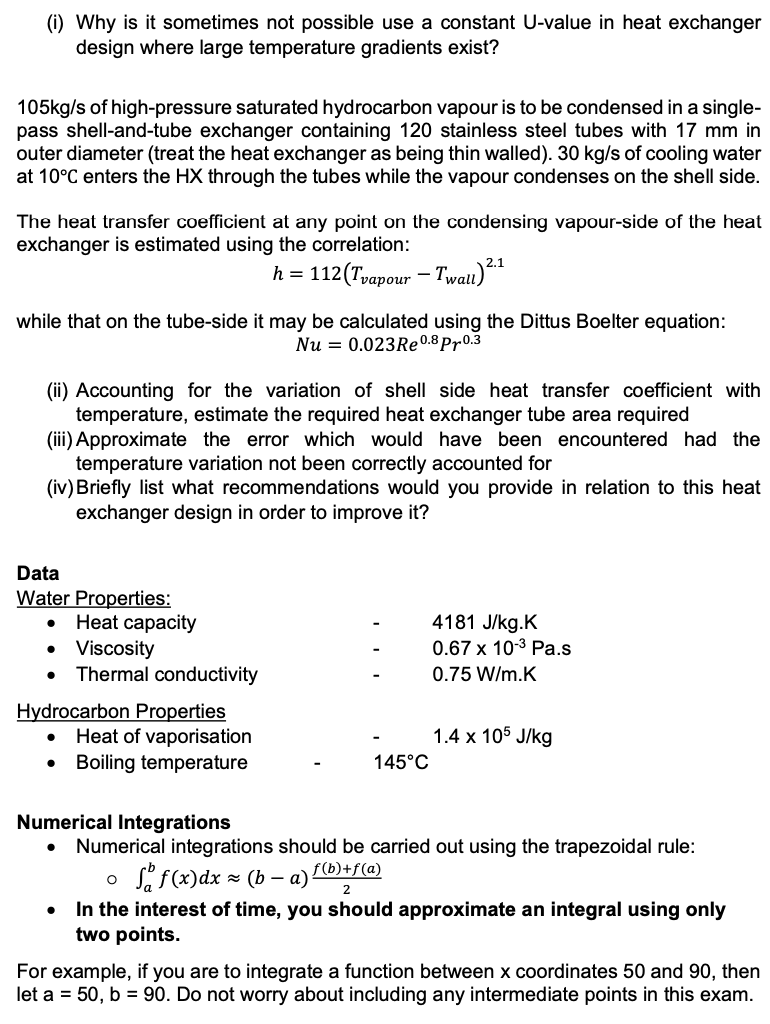
of highpressure saturated hydrocarbon vapour is to be condensed in a single
pass shellandtube exchanger containing stainless steel tubes with in
outer diameter treat the heat exchanger as being thin walled of cooling water
at enters the through the tubes while the vapour condenses on the shell side.
The heat transfer coefficient at any point on the condensing vapourside of the heat
exchanger is estimated using the correlation:
while that on the tubeside it may be calculated using the Dittus Boelter equation:
ii Accounting for the variation of shell side heat transfer coefficient with
temperature, estimate the required heat exchanger tube area required
iii Approximate the error which would have been encountered had the
temperature variation not been correctly accounted for
ivBriefly list what recommendations would you provide in relation to this heat
exchanger design in order to improve it
Data
Water Properties:
Heat capacity
Viscosity
Thermal conductivity
Hydrocarbon Properties
Heat of vaporisation
Boiling temperature
Numerical Integrations
Numerical integrations should be carried out using the trapezoidal rule:
~~
In the interest of time, you should approximate an integral using only
two points.
For example, if you are to integrate a function between coordinates and then
let Do not worry about including any intermediate points in this exam.
Step by Step Solution
There are 3 Steps involved in it
1 Expert Approved Answer
Step: 1 Unlock

Question Has Been Solved by an Expert!
Get step-by-step solutions from verified subject matter experts
Step: 2 Unlock
Step: 3 Unlock
 Study Help