







Question: I will vote your Answer Definitely please give me Right answer of my question The Kruskal-Wallis Test Suppose that we have independent random samples of
I will vote your Answer Definitely please give me Right answer of my question
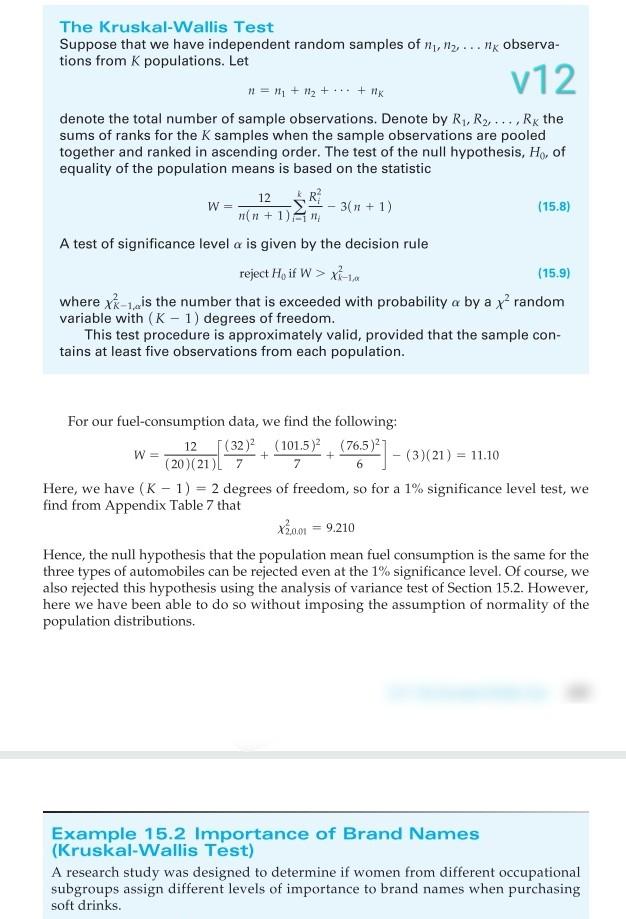
The Kruskal-Wallis Test Suppose that we have independent random samples of ni, Ny... nx observa- tions from K populations. Let V12 11 = " + 12 + ... + x denote the total number of sample observations. Denote by R1, R2, ..., Rx the sums of ranks for the K samples when the sample observations are pooled together and ranked in ascending order. The test of the null hypothesis, Hoof equality of the population means is based on the statistic KR 3(n + 1) (15.8) ( n + 1 12 W= A test of significance level a is given by the decision rule (15.9) reject Hy if W > x-1, where Xx-wis the number that is exceeded with probability a by a x? random variable with (K-1) degrees of freedom. This test procedure is approximately valid, provided that the sample con- tains at least five observations from each population. 12 (7651?] For our fuel-consumption data, we find the following: (32)2 (101.5) (76.5)27 W= (3)(21) = 11.10 (20)(21) 7 Here, we have (K-1) = 2 degrees of freedom, so for a 1% significance level test, we find from Appendix Table 7 that X200 = 9.210 Hence, the null hypothesis that the population mean fuel consumption is the same for the three types of automobiles can be rejected even at the 1% significance level. Of course, we also rejected this hypothesis using the analysis of variance test of Section 15.2. However, here we have been able to do so without imposing the assumption of normality of the population distributions. Example 15.2 Importance of Brand Names (Kruskal-Wallis Test) A research study was designed to determine if women from different occupational subgroups assign different levels of importance to brand names when purchasing soft drinksStep by Step Solution
There are 3 Steps involved in it
1 Expert Approved Answer
Step: 1 Unlock

Question Has Been Solved by an Expert!
Get step-by-step solutions from verified subject matter experts
Step: 2 Unlock
Step: 3 Unlock
 Study Help