







Question: I would rate if your answer is helpful, the answer is in red as an aid for you to explain, please try! Q12. We know
I would rate if your answer is helpful, the answer is in red as an aid for you to explain, please try!
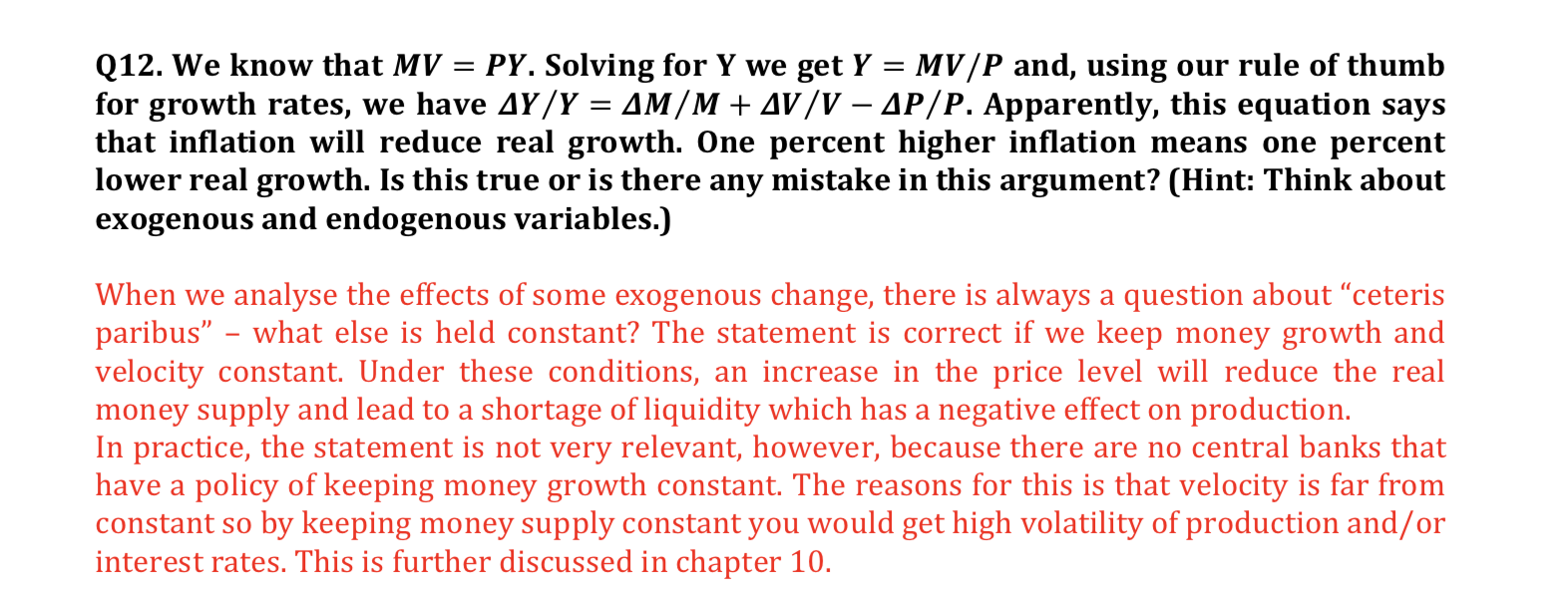
Q12. We know that M V = PY. Solving for Y we get Y = M V/P and, using our rule of thumb for growth rates, we have AY/ Y = AM / M + AV/ V AP/ P. Apparently, this equation says that ination will reduce real growth. One percent higher ination means one percent lower real growth. Is this true or is there any mistake in this argument? (Hint: Think about exogenous and endogenous variables.) When we analyse the effects of some exogenous change, there is always a question about \"ceteris paribus" what else is held constant? The statement is correct if we keep money growth and velocity constant. Under these conditions, an increase in the price level will reduce the real money supply and lead to a shortage of liquidity which has a negative effect on production. In practice, the statement is not very relevant, however, because there are no central banks that have a policy of keeping money growth constant. The reasons for this is that velocity is far from constant so by keeping money supply constant you would get high volatility of production and/ or interest rates. This is further discussed in chapter 10
Step by Step Solution
There are 3 Steps involved in it

Get step-by-step solutions from verified subject matter experts
 Study Help