







Question: ID: B Name: 10. Constructive interference occurs A. when waves are out of phase. D. in the formation of a tall, rogue wave. B. if
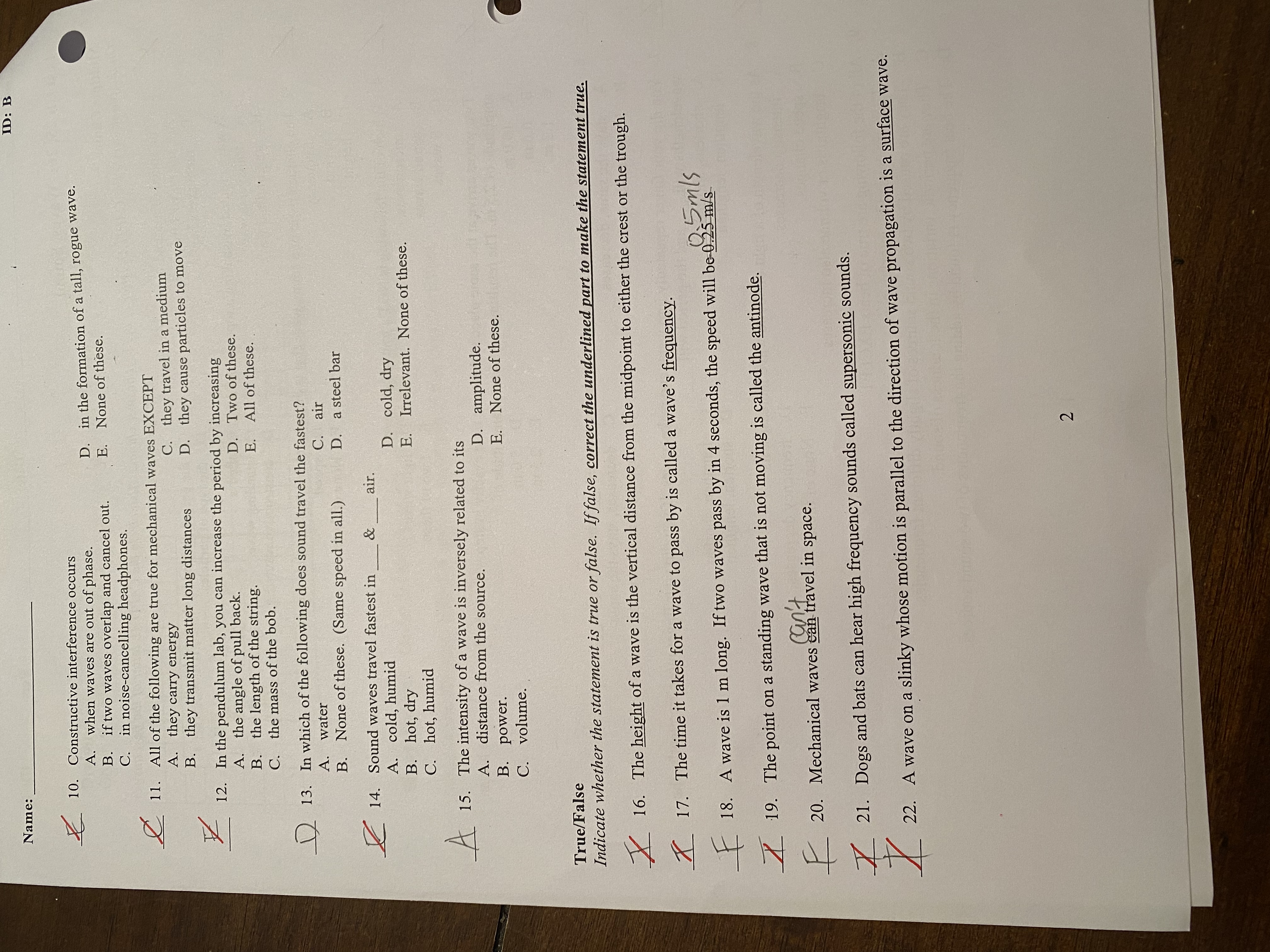
ID: B Name: 10. Constructive interference occurs A. when waves are out of phase. D. in the formation of a tall, rogue wave. B. if two waves overlap and cancel out. E. None of these. . in noise-cancelling headphones. C 11. All of the following are true for mechanical waves EXCEPT A. they carry energy C. they travel in a medium B. they transmit matter long distances D. they cause particles to move 12. In the pendulum lab, you can increase the period by increasing A. the angle of pull back. D. Two of these. B. the length of the string. E. All of these. C. the mass of the bob. 13. In which of the following does sound travel the fastest? A. water C. air B. None of these. (Same speed in all.) D. a steel bar 14. Sound waves travel fastest in & air. A. cold, humid D. cold, dry B. hot, dry E. Irrelevant. None of these. C. hot, humid A 15. The intensity of a wave is inversely related to its A. distance from the source. D. amplitude. B. power. E. None of these. C. volume. True/False Indicate whether the statement is true or false. If false, correct the underlined part to make the statement true. 16. The height of a wave is the vertical distance from the midpoint to either the crest or the trough. X 17. The time it takes for a wave to pass by is called a wave's frequency. 2:5mls 18. A wave is 1 m long. If two waves pass by in 4 seconds, the speed will be-0.25 m/s X 19. The point on a standing wave that is not moving is called the antinode. 20. Mechanical waves can travel in space. AN to 21. Dogs and bats can hear high frequency sounds called supersonic sounds. 22. A wave on a slinky whose motion is parallel to the direction of wave propagation is a surface wave. 2
Step by Step Solution
There are 3 Steps involved in it

Get step-by-step solutions from verified subject matter experts
 Study Help