



Question: Identify and describe in detail two demand based and two supply-based strategies for aggregate planning with examples? the answer should be based on these points
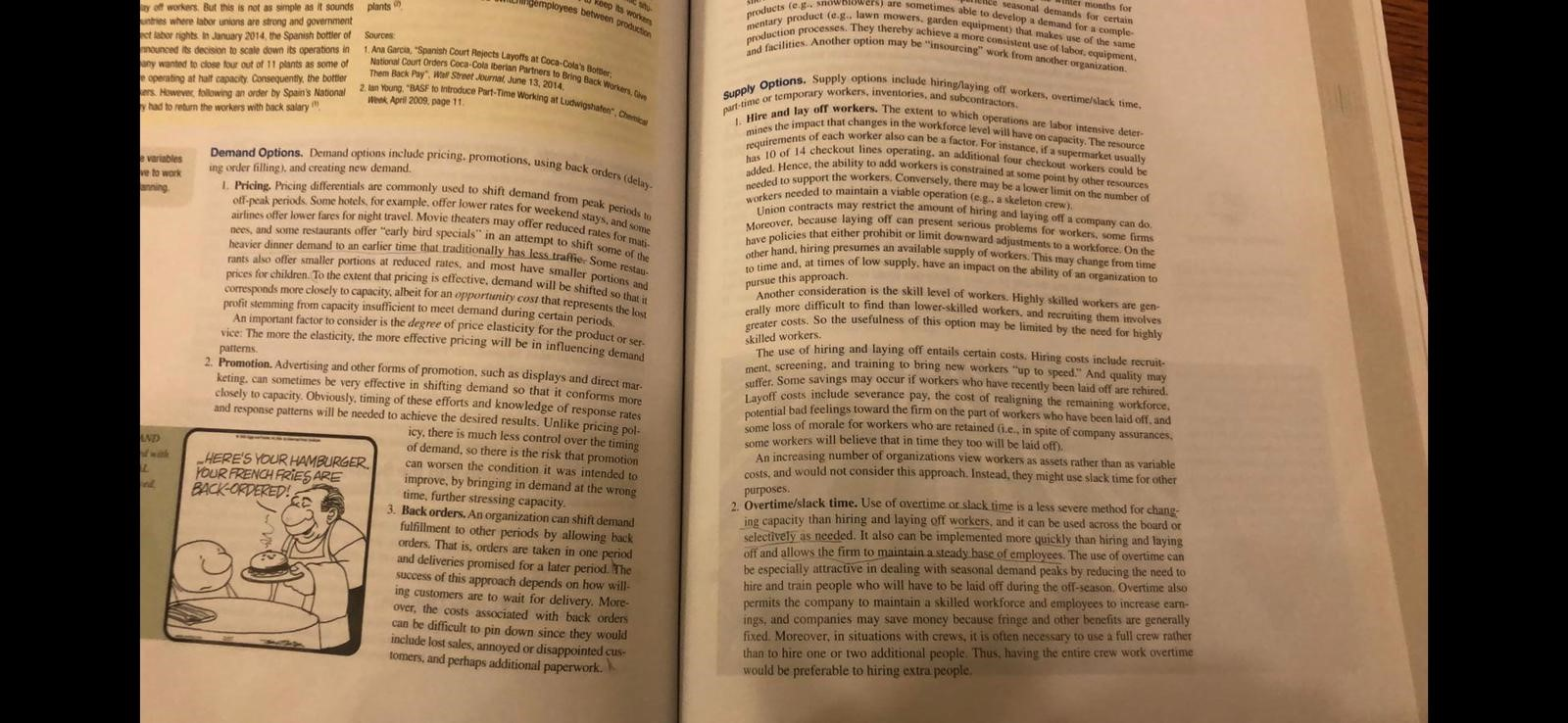 Identify and describe in detail two demand based and two supply-based strategies for aggregate planning with examples?
the answer should be based on these points down below + examples should be provided on each point
the two demand based :
1.Pricing
2.Promotion
The supply based (only 2 is needed is you can choose any 2 of the points) :
1.Hire and lay off workers
2.Overtime/ slack time
3.part-time workers
4.Inventories
employees between production Keep la wa months for ce seasonal demands for certain Them Back Pay". Wal Street Journal, June 13, 2014 products (eg snowblowers are sometimes able to develop a demand for a comple- mentary product (e.g.. lawn mowers. garden equipments that makes use of the same production processes. They thereby achieve a more consistent use of labor, equipment nounced its decision to scale down its operations in 1. Ana Garcia, Spanish Court Rejects Layoffs at Coca-Cola'n Boer and facilities. Another option may be insourcing work from another organization National Court Orders Coca-Cola Iberian Partners to Bring Back Workers zlan Young, "BASF to introduce Part-Time Working at Ludwigshafen Cher Supply Options. Supply options include hiring/laying off workers, overtime/slack time, part-time or temporary workers, inventories, and subcontractors 1. Hire and lay off workers. The extent to which operations are labor intensive detet mines the impact that changes in the workforce level will have on capacity. The resource Demand Options. Demand options include pricing, promotions, using back orders (delay requirements of each worker also can be a factor. For instance, if a supermarket usually has 10 of 14 checkout lines operating, an additional four checkout workers could be Pricing. Pricing differentials are commonly used to shift demand from peak periods to needed to support the workers Conversely, there may be a lower limit on the number of added. Hence, the ability to add workers is constrained at some point by other resources off peak periods. Some hotels, for example, offer lower rates for weekend stays, and some workers needed to maintain a viable operation (e.g. a skeleton crew). airlines offer lower fares for night travel. Movie theaters may offer reduced rates formati Union contracts may restrict the amount of hiring and laying off a company can do. mees, and some restaurants offer "early bird specials in an attempt to shift some of the Moreover, because laying off can present serious problems for workers, some firms carlier time that traditionally has less traffier Some restau have policies that either prohibit or limit downward adjustments to a workforce. On the rants also offer smaller portions at reduced rates, and most have smaller portions and other hand, hiring presumes an available supply of workers. This may change from time prices for children. To the extent that pricing is etfective, demand will be shifted so that it to time and, at times of low supply, have an impact on the ability of an organization to corresponds more closely to capacity, albeit for an opportunity cost that represents the lost Another consideration is the skill level of workers. Highly skilled workers are gen- greater costs. So the usefulness of this option may be limited by the need for highly ay of workers. But this is not as simple as it sounds plants tres where labor unions are strong and government retabo rights in January 2014, the Spanish bottle of Sources any wanted to close four out of 11 plants as some of operating at half capacity. Consequently, the botter ars. However, following an order by Spain's National had to return the workers with back salary Week April 2009, page 11 variables e to work ing order filling), and creating new demand. anning heavier dinner demand to pursue this approach skilled workers. LP 2 profit stemming from capacity insufficient to meet demand during certain periods. An important factor to consider is the degree of price elasticity for the product or ser vice: The more the elasticity, the more effective pricing will be in influencing demand patterns 2. Promotion. Advertising and other forms of promotion, such as displays and direct mar. keting, can sometimes be very effective in shifting demand so that it conforms more closely to capacity. Obviously, timing of these efforts and knowledge of response rates and response patterns will be needed to achieve the desired results. Unlike pricing pol- icy, there is much less control over the timing of demand, so there is the risk that promotion HERE'S YOUR HAMBURGER. can worsen the condition it it was intended to YOUR FRENCH FRIES ARE improve, by bringing in demand at the wrong BACK-ORDERED! time, further stressing capacity 3. Back orders. An organization can shift demand fulfillment to other periods by allowing back orders. That is, orders are taken in one period and deliveries promised for a later period. The success this approach depends on how will- ing customers are to wait for delivery. More over, the costs associated with back orders can be difficult to pin down since they would include lost sales, annoyed or disappointed cus- tomers, and perhaps additional paperwork. The use of hiring and laying off entails certain costs. Hiring costs include recruit- ment, screening, and training to bring new workers "up to speed." And quality may suffer. Some savings may occur it workers who have recently been laid off are rehired. Layoff costs include severance pay, the cost of realigning the remaining workforce. potential bad feelings toward the firm on the part of workers who have been laid off, and some loss of morale for workers who are retained (i... in spite of company assurances, some workers will believe that in time they too will be laid off). An increasing number of organizations view workers as assets rather than as variable costs, and would not consider this approach. Instead, they might use slack time for other purposes. 2. Overtime/slack time. Use of overtime or slack time is a less severe method for chang- ing capacity than hiring and laying off workers, and it can be used across the board or selectively as needed. It also can be implemented more quickly than hiring and laying off and allows the firm to maintain a steady base of employees. The use of overtime can be especially attractive in dealing with seasonal demand peaks by reducing the need to hire and train people who will have to be laid off during the off-season. Overtime also permits the company to maintain a skilled workforce and employees to increase cam- ings, and companies may save money because fringe and other benefits are generally fixed. Moreover, in situations with crews, it is often necessary to use a full crew rather than to hire one or two additional people. Thus, having the entire crew work overtime would be preferable to hiring extra peopleStep by Step Solution
There are 3 Steps involved in it
1 Expert Approved Answer
Step: 1 Unlock

Question Has Been Solved by an Expert!
Get step-by-step solutions from verified subject matter experts
Step: 2 Unlock
Step: 3 Unlock