







Question: - Identify the ethical issue(s); - Identify and analyze the different courses of action to address the ethical issues(s) using facts from the case and
- Identify the ethical issue(s); 
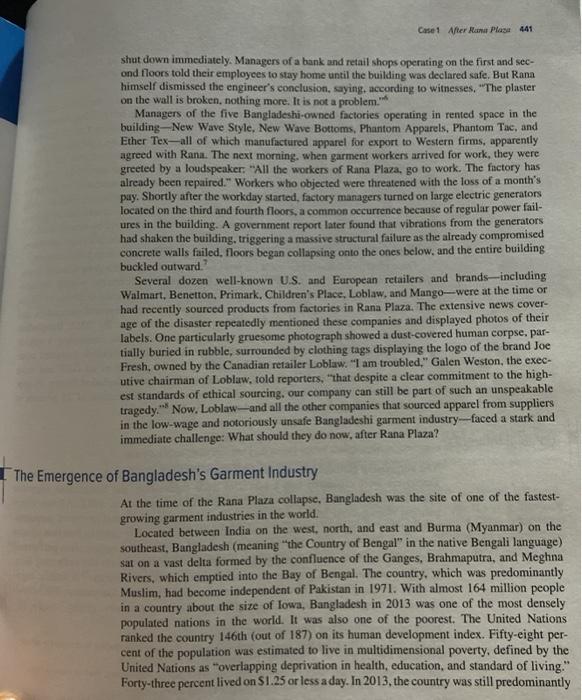
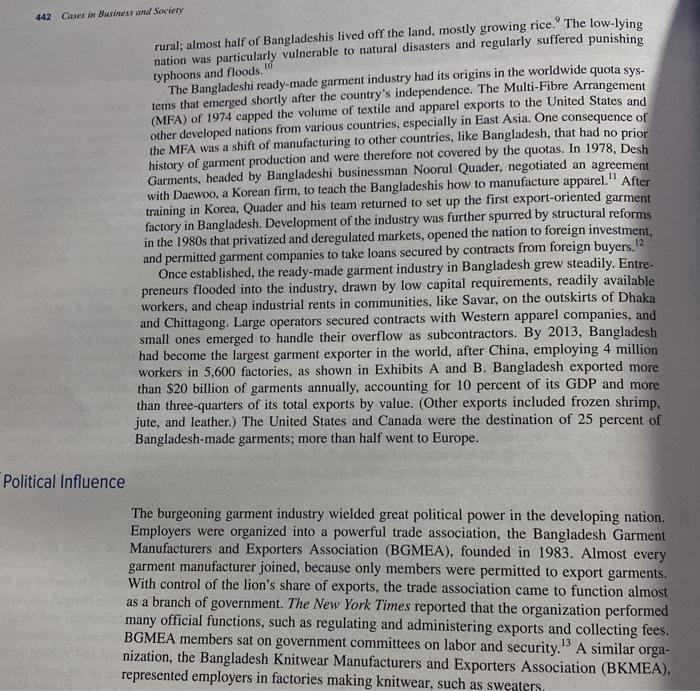
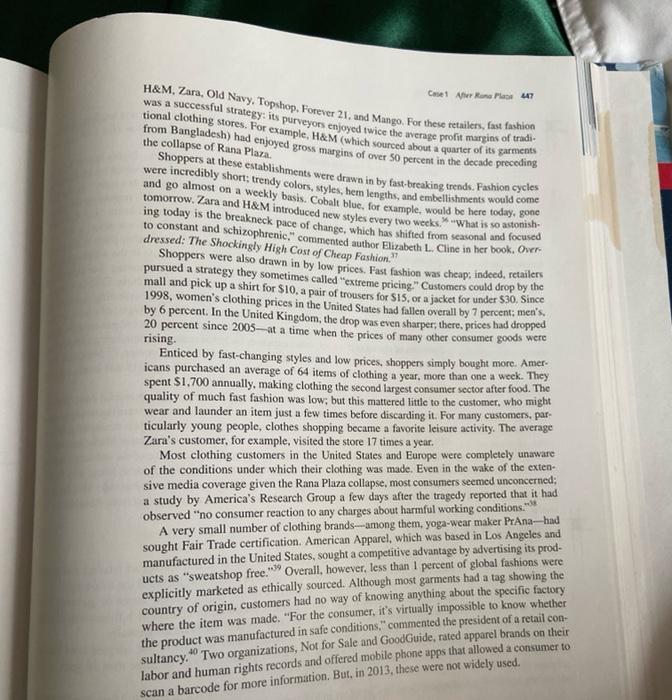
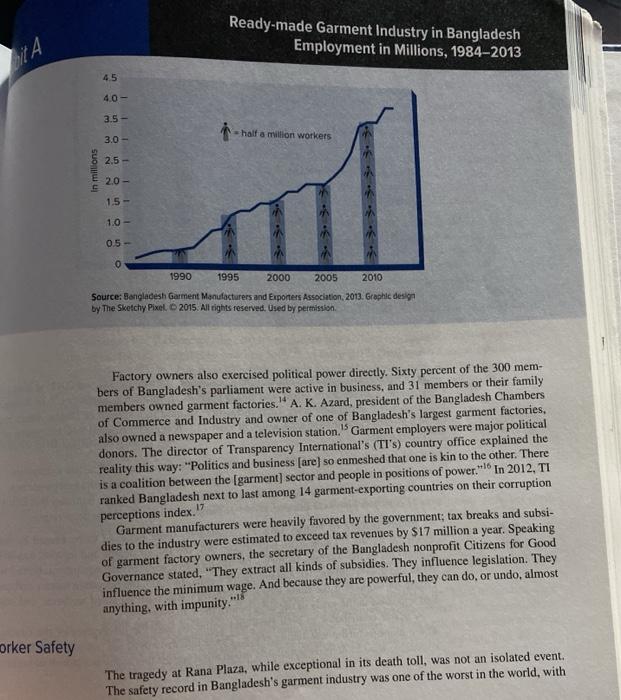
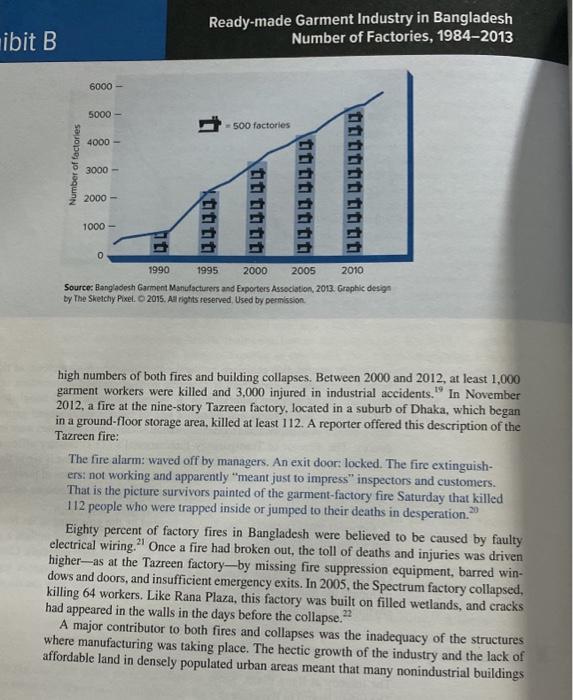
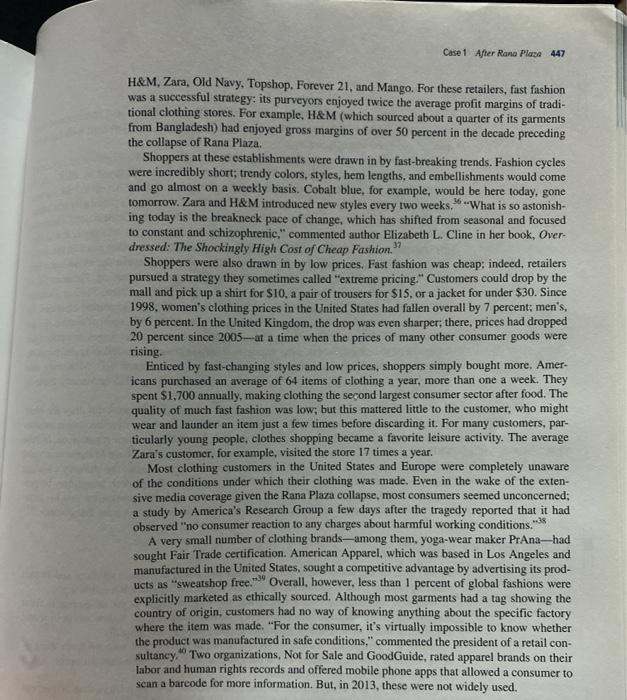
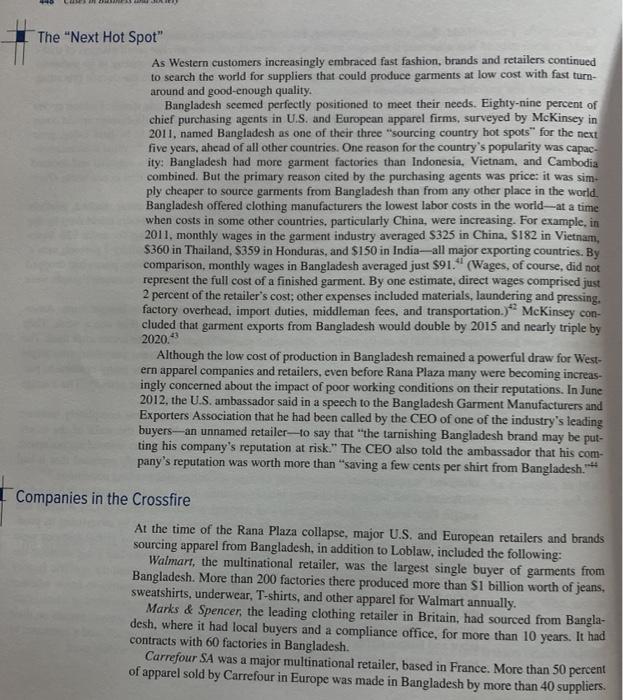
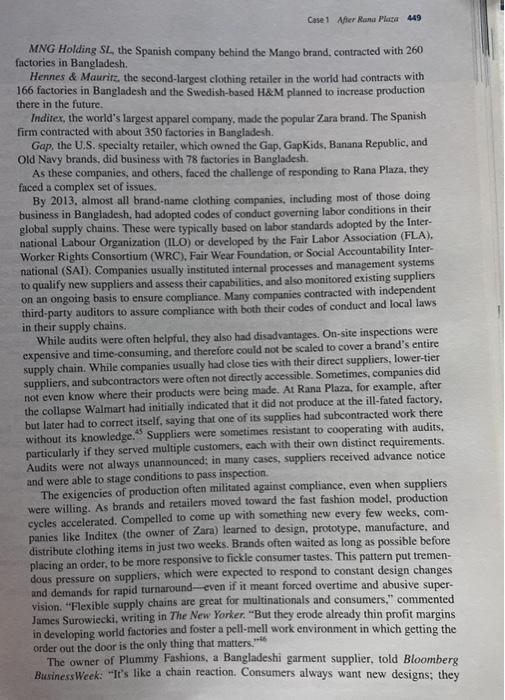
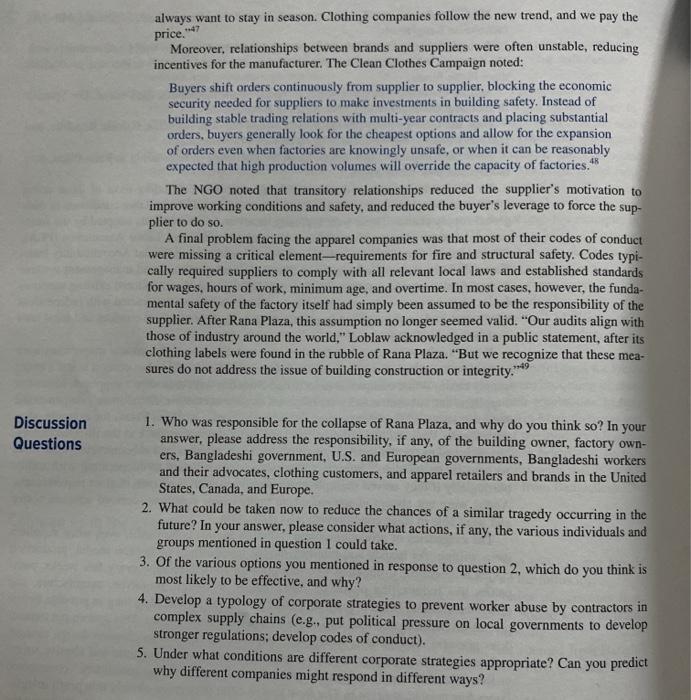
After Rana Plaza be Around nine in the morning on April 24, 2013, Rana Plaza, an eight-story building in Savar, Bangladesh, collapsed catastrophically in a hail of twisted concrete, steel bar, and sewing machinery. At the time, more than 3,000 garment workers were on duty in five separate factories, located on the building's third to eighth floors. Photographs of the scene showed hundreds of people-community members, workers from other nearby factories, and police and firefighters-furiously moving debris and pulling people out of rubble. When the rescue and recovery effort was finally suspended more than a week later, 1,134 workers, most of them women, had been found dead; 2,500 others had been hurt, many with amputations and severe head and back injuries. Most of the victims were under 30, and a fifth of them were teenagers. They had earned in the range of $38 to $102 a month.? It was the worst industrial disaster in the history of the global garment industry. The collapsed building was owned by Sohel Rana. Rana, 35, was described as a "gun-toting politician" who traveled by motorcycle, as untouchable as a mafia don, trailed by his own biker gang." In 2007, he had obtained the permit to build the plaza directly from the mayor of Savar, a political ally, bypassing the standard procedure. The building, which was partly situated on a drained swamp, was initially permitted for five stories; Rana illegally added three more floors between 2008 and 2012 and was in the process of constructing another when the structure collapsed. The architect later said the building had not been designed for industrial use. "If I had known that it was to be an industrial building, I would have taken other measures," he told an investigator. Analysis showed that the building was carrying almost six times more weight than it was designed to bear. Poor-quality concrete and steel used in construction and uneven settlement on saturated soils may also have contributed to the structural failure. The day before, workers reported that large cracks had opened up in the building's walls. An engineer called in to inspect the cracks told Rana that the building needed to be Case 1 After Run Plage 441 shut down immediately. Managers of a bank and retail shops operating on the first and sec- ond floors told their employees to stay home until the building was declared safe. But Rana himself dismissed the engineer's conclusion, saying, according to witnesses. "The plaster on the wall is broken, nothing more. It is not a problem." Managers of the five Bangladeshi-owned factories operating in rented space in the building-New Wave Style, New Wave Bottoms, Phantom Apparels, Phantom Tac, and Ether Tex-all of which manufactured apparel for export to Western firms, apparently agreed with Rana. The next morning, when garment workers arrived for work, they were greeted by a loudspeaker: "All the workers of Rana Plaza, go to work. The factory has already been repaired." Workers who objected were threatened with the loss of a month's pay. Shortly after the workday started, factory managers turned on large electric generators located on the third and fourth floors, a common occurrence because of regular power fail- ures in the building. A government report later found that vibrations from the generators had shaken the building, triggering a massive structural failure as the already compromised concrete walls failed, floors began collapsing onto the ones below, and the entire building buckled outward. Several dozen well-known U.S. and European retailers and brands - including Walmart, Benetton, Primark. Children's Place, Loblaw, and Mango-were at the time or had recently sourced products from factories in Rana Plaza. The extensive news cover- age of the disaster repeatedly mentioned these companies and displayed photos of their labels. One particularly gruesome photograph showed a dust-covered human corpse, par- tially buried in rubble, surrounded by clothing tags displaying the logo of the brand Joe Fresh, owned by the Canadian retailer Loblaw. "I am troubled," Galen Weston, the exec- utive chairman of Loblaw, told reporters, "that despite a clear commitment to the high- est standards of ethical sourcing, our company can still be part of such an unspeakable tragedy.*** Now. Loblaw-and all the other companies that sourced apparel from suppliers in the low-wage and notoriously unsafe Bangladeshi garment industry--faced a stark and immediate challenge: What should they do now, after Rana Plaza? The Emergence of Bangladesh's Garment Industry At the time of the Rana Plaza collapse, Bangladesh was the site of one of the fastest- growing garment industries in the world Located between India on the west. north, and east and Burma (Myanmar) on the southeast, Bangladesh (meaning the Country of Bengal" in the native Bengali language) sat on a vast delta formed by the confluence of the Ganges, Brahmaputra, and Meghna Rivers, which emptied into the Bay of Bengal. The country, which was predominantly Muslim, had become independent of Pakistan in 1971. With almost 164 million people in a country about the size of lowa, Bangladesh in 2013 was one of the most densely populated nations in the world. It was also one of the poorest. The United Nations ranked the country 146th (out of 187) on its human development index. Fifty-eight per- cent of the population was estimated to live in multidimensional poverty, defined by the United Nations as "overlapping deprivation in health, education, and standard of living." Forty-three percent lived on S1.25 or less a day. In 2013, the country was still predominantly 1o 442 Cases in Business and Society rural; almost half of Bangladeshis lived off the land, mostly growing rice. The low-lying nation was particularly vulnerable to natural disasters and regularly suffered punishing typhoons and floods. The Bangladeshi ready-made garment industry had its origins in the worldwide quota sys- tems that emerged shortly after the country's independence. The Multi-Fibre Arrangement (MFA) of 1974 capped the volume of textile and apparel exports to the United States and other developed nations from various countries, especially in East Asia. One consequence of the MFA was a shift of manufacturing to other countries, like Bangladesh, that had no prior history of garment production and were therefore not covered by the quotas. In 1978, Desh Garments, headed by Bangladeshi businessman Noorul Quader, negotiated an agreement with Daewoo, a Korean firm, to teach the Bangladeshis how to manufacture apparel." After training in Korea, Quader and his team returned to set up the first export-oriented garment factory in Bangladesh. Development of the industry was further spurred by structural reforms in the 1980s that privatized and deregulated markets, opened the nation to foreign investment, and permitted garment companies to take loans secured by contracts from foreign buyers. Once established, the ready-made garment industry in Bangladesh grew steadily. Entre- preneurs flooded into the industry, drawn by low capital requirements, readily available workers, and cheap industrial rents in communities, like Savar, on the outskirts of Dhaka and Chittagong. Large operators secured contracts with Western apparel companies, and small ones emerged to handle their overflow as subcontractors. By 2013, Bangladesh had become the largest garment exporter in the world, after China, employing 4 million workers in 5,600 factories, as shown in Exhibits A and B. Bangladesh exported more than $20 billion of garments annually, accounting for 10 percent of its GDP and more than three-quarters of its total exports by value. (Other exports included frozen shrimp. jute, and leather.) The United States and Canada were the destination of 25 percent of Bangladesh-made garments; more than half went to Europe. Political Influence The burgeoning garment industry wielded great political power in the developing nation. Employers were organized into a powerful trade association, the Bangladesh Garment Manufacturers and Exporters Association (BGMEA), founded in 1983. Almost every garment manufacturer joined, because only members were permitted to export garments. With control of the lion's share of exports, the trade association came to function almost as a branch of government. The New York Times reported that the organization performed many official functions, such as regulating and administering exports and collecting fees. BGMEA members sat on government committees on labor and security. A similar orga- nization, the Bangladesh Knitwear Manufacturers and Exporters Association (BKMEA), represented employers in factories making knitwear, such as sweaters Canet After Ron Place 447 H&M, Zara, Old Navy. Topshop, Forever 21, and Mango. For these retailers, fast fashion was a successful strategy: its purveyors enjoyed twice the average profit margins of tradi- tional clothing stores. For example, H&M (which sourced about a quarter of its garments from Bangladesh) had enjoyed gross margins of over 50 percent in the decade preceding Shoppers at these establishments were drawn in by fast-breaking trends. Fashion cycles the collapse of Rana Plaza were incredibly short: trendy colors, styles, hem lengths, and embellishments would come tomorrow. Zara and H&M introduced new styles every two weeks. "What is so astonisha ing today is the breakneck pace of change, which has shifted from sexsonal and focused to constant and schizophrenic." commented author Elizabeth L. Cline in her book. Over dressed: The Shockingly High Cost of Cheap Fashion." Shoppers were also drawn in by low prices. Fast fashion was cheap, indeed, retailers pursued a strategy they sometimes called "extreme pricing Customers could drop by the mall and pick up a shirt for $10. a pair of trousers for SIS, or a jacket for under 530. Since 1998, women's clothing prices in the United States had fallen overall by 7 percent; men's by 6 percent. In the United Kingdom, the drop was even sharper, there, prices had dropped 20 percent since 2005at a time when the prices of many other consumer goods were rising Enticed by fast-changing styles and low prices, shoppers simply bought more. Amer. icans purchased an average of 64 items of clothing a year, more than one a week. They spent $1,700 annually, making clothing the second largest consumer sector after food. The quality of much fast fashion was low, but this mattered little to the customer, who might wear and launder an item just a few times before discarding it. For many customers. par ticularly young people, clothes shopping became a favorite leisure activity. The average Zara's customer, for example, visited the store 17 times a year. Most clothing customers in the United States and Europe were completely unaware of the conditions under which their clothing was made. Even in the wake of the exten- sive media coverage given the Rana Plaza collapse, most consumers seemed unconcerned; a study by America's Research Group a few days after the tragedy reported that it had observed "no consumer reaction to any charges about harmful working conditions. **** A very small number of clothing brands among them, yoga-wear maker PrAna-had sought Fair Trade certification. American Apparel, which was based in Los Angeles and manufactured in the United States, sought a competitive advantage by advertising its prod- ucts as "sweatshop free." -39 Overall, however, less than I percent of global fashions were explicitly marketed as ethically sourced. Although most garments had a tag showing the country of origin, customers had no way of knowing anything about the specific factory where the item was made. "For the consumer, it's virtually impossible to know whether the product was manufactured in safe conditions, commented the president of a retail con- sultancy 40 Two organizations, Not for Sale and GoodGuide, rated apparel brands on their labor and human rights records and offered mobile phone apps that allowed a consumer to scan a barcode for more information. But, in 2013, these were not widely used. Ready-made Garment Industry in Bangladesh Employment in Millions, 19842013 4.5 40 - 3.5 - -half a million workers 3.0 - 2.5 - in millions 2.0 - 1.5 - 1.0 - 0.5 - 0 1990 1995 2000 2005 2010 Source: Bangladesh Garment Manufacturers and Exporters Association, 2013. Graphic design by The Sketchy Pixel 2015. All rights reserved. Used by permission Factory owners also exercised political power directly, Sixty percent of the 300 mem- bers of Bangladesh's parliament were active in business, and 31 members or their family members owned garment factories." A. K. Azard, president of the Bangladesh Chambers of Commerce and Industry and owner of one of Bangladesh's largest garment factories. also owned a newspaper and a television station Garment employers were major political donors. The director of Transparency International's (TI's) country office explained the reality this way: "Politics and business Care) so enmeshed that one is kin to the other. There is a coalition between the garment sector and people in positions of power. ** In 2012, TI ranked Bangladesh next to last among 14 garment-exporting countries on their corruption perceptions index. Garment manufacturers were heavily fuvored by the government; tax breaks and subsi- dies to the industry were estimated to exceed tax revenues by $17 million a year. Speaking of garment factory owners, the secretary of the Bangladesh nonprofit Citizens for Good Governance stated, "They extract all kinds of subsidies. They influence legislation. They influence the minimum wage. And because they are powerful, they can do, or undo, almost anything, with impunity. 17 orker Safety The tragedy at Rana Plaza, while exceptional in its death toll, was not an isolated event. The safety record in Bangladesh's garment industry was one of the worst in the world, with Ready-made Garment Industry in Bangladesh Number of Factories, 1984-2013 ibit B 6000 - 5000 - tu 500 factories 4000 - Number of factories 3000 - ti ti ti ti ti ti ti ti ti ti 2000 - ti ti ti ti ti ti 1000- tttt 0 1990 1995 2000 2005 2010 Source: Bangladesh Garment Manufacturers and Exporters Association, 2013. Graphic design by The Sketchy Pixel. 2015. All rights reserved. Used by permission high numbers of both fires and building collapses. Between 2000 and 2012, at least 1,000 garment workers were killed and 3,000 injured in industrial accidents. In November 2012, a fire at the nine-story Tazreen factory, located in a suburb of Dhaka, which began in a ground floor storage area, killed at least 112. A reporter offered this description of the Tazreen fire: The fire alarm: waved off by managers. An exit door: locked. The fire extinguish- ers: not working and apparently "meant just to impress" inspectors and customers. That is the picture survivors painted of the garment-factory fire Saturday that killed 112 people who were trapped inside or jumped to their deaths in desperation. Eighty percent of factory fires in Bangladesh were believed to be caused by faulty electrical wiring. Once a fire had broken out, the toll of deaths and injuries was driven higher--as at the Tazreen factory-by missing fire suppression equipment, barred win- dows and doors, and insufficient emergency exits. In 2005, the Spectrum factory collapsed, killing 64 workers. Like Rana Plaza, this factory was built on filled wetlands, and cracks had appeared in the walls in the days before the collapse. A major contributor to both fires and collapses was the inadequacy of the structures where manufacturing was taking place. The hectic growth of the industry and the lack of affordable land in densely populated urban areas meant that many nonindustrial buildings Case 1 Alter Rana Place 445 were repurposed for use as factories. A study by a European NGO, the Clean Clothes Campaign, noted: The rapid expansion of the industry has led to the conversion of many buildings. built for other purposes, into factories, often without the required permits. Other fac- tories have had extra floors added or have increased the workforce and machinery to levels beyond the safe capacity of the building. Many factories run day and night in order to meet production targets. The establishment of factories, or the conversions of other buildings into garment factories, has often been done as quickly and as cheaply as possible, resulting in widespread safety problems including faulty electri- cal circuits, unstable buildings, inadequate escape routes and unsafe equipment. The country's weak and often corrupt regulatory apparatus simply could not keep up. The director of Bangladesh's Housing and Building Research Institute said after the Rana Plaza disaster that the country's building codes were "good enough." but the problem was they were rarely enforced. An architect involved in drafting the codes commented, "Dhaka has limited space. Developers are in this market for money and want to squeeze as much as they can into any space. Yes, we have a law, but who is implementing it?"-24 Bangladesh law established occupational health and safety standards and gave govern- ment inspectors the right to shut down any factory that presented an imminent danger to human life. However, the country employed just 52 factory inspectors, and the maximum fine for noncompliance was just $309. In early 2013, Bangladesh's commerce minister offered this explanation: "The ready-made garments industry grew in Bangladesh all of a sudden, at a very high pace. The industry grew out of proportion compared to our facilities or our controlling capacities.27 Workers and Labor Rights Who were the workers toiling in these hastily converted factories? Eight-five percent were women, many of them immigrants from poor, rural areas to the major urban manufactur- ing districts around Dhaka and Chittagong. In a survey of garment workers in more than 40 factories, War on Want, a British NGO, found that almost nine in ten were between 18 and 32 years old. Just 22 percent had a high school degree. Many lived in "mess hous- ing." shared accommodations for single people that had sprung up near the factories. Ver- bal and sexual abuse in the workplace was common. The War on Want survey found that 73 percent of workers reported being sworn at by managers. Forty-five percent had been beaten, 43 percent hit in the face, and 30 percent sexually harassed. Wages in the industry were the lowest in the world. In 2013, the legal minimum wage in the garment industry was $37 a month. (The average monthly wage, including overtime, was higher-about $91.) A great majority of garment workers put in overtime; the War on Want survey found that only 14 percent of garment workers worked less than 40 hours a week, and 80 percent started work at 9 a.m. and left the factory between 8 and 10 p.m. 446 Cases in Business and Society at night. Although conditions were often brutal, the garment industry offered one of the few socially acceptable jobs for women in the predominantly Muslim country. Many women sought jobs in the garment sector, preferring work as a sewing machine operator to domestic or farm labor. And, although low, wages for women in the garment industry were 14 percent higher than wages for women with comparable schooling and experience in other industries. The Bangladesh constitution guaranteed the right to join unions. If 30 percent or more of the workers in a factory joined a union, the employer was required to recognize and bargain with it, if more than one union was present, an election would be held to deter- mine the workers' bargaining representative. As a practical matter, however, these rights were routinely ignored by factory owners and their political allies. The Ministry of Labor informed employers of the names of workers applying for union registrations; they were usually promptly fired. Worker strikes and protests were routinely met by riot police. The U.S. State Department concluded in a review of human rights in Bangladesh that although the law provided the right of citizens to form associations, "government action makes] it nearly impossible to form new trade unions in many sectors, for example, in the ready- made garment industry). A labor union called the Bangladesh Garment and Industrial Workers' Federation (BGIWF) had organized committees in some factories and had participated in a successful campaign in 2010 to raise the minimum wage, but by 2013 had not succeeded in negoti- ating a single union contract. BGIWF's leaders had been persecuted, harassed, and even murdered. In 2012, the federation's president. Aminul Islam, disappeared from Savar (the industrial suburb of Dhaka where Rana Plaza was located), where he had been organizing workers. Four days later, his dead body was found, showing signs of torture. Garment man- ufacturers were believed to have colluded with the NSI (National Security Intelligence, the military intelligence agency) in his death. After the Rana Plaza tragedy, Islam's succes- sor as president of the BGIWF noted. "With collective bargaining power, tragedies like Rana Plaza would not happen, since owners would not be able to force workers to work in unsafe conditions." Nongovernmental organizations that sought to advocate for worker rights were also harassed. The Bangladesh Center for Worker Solidarity (BCWS), for example, an NGO run by former garment workers, was regularly monitored by intelligence agencies and sub- jected to government restrictions that impeded its work. The Rise of Fast Fashion The rapid growth of the ready-made garment industry in Bangladesh in the decade before the Rana Plaza tragedy was intimately connected to retailing trends in the West, and in particular to the rise of "fast fashion." Fast fashion referred to a garment retailing strategy characterized by low prices, high volume, and rapid turnover of inventory and styles. "Leading fast fashion brands included Case 1 After Rano Plasa 447 H&M, Zara, Old Navy. Topshop. Forever 21, and Mango. For these retailers, fast fashion was a successful strategy: its purveyors enjoyed twice the average profit margins of tradi- tional clothing stores. For example, H&M (which sourced about a quarter of its garments from Bangladesh) had enjoyed gross margins of over 50 percent in the decade preceding the collapse of Rana Plaza. Shoppers at these establishments were drawn in by fast-breaking trends. Fashion cycles were incredibly short: trendy colors, styles, hem lengths, and embellishments would come and go almost on a weekly basis. Cobalt blue, for example, would be here today, gone tomorrow. Zara and H&M introduced new styles every two weeks. What is so astonish- ing today is the breakneck pace of change, which has shifted from seasonal and focused to constant and schizophrenic," commented author Elizabeth L. Cline in her book, Over- dressed: The Shockingly High Cost of Cheap Fashion. Shoppers were also drawn in by low prices. Fast fashion was cheap: indeed, retailers pursued a strategy they sometimes called "extreme pricing." Customers could drop by the mall and pick up a shirt for $10, a pair of trousers for $15, or a jacket for under $30. Since 1998, women's clothing prices in the United States had fallen overall by 7 percent; men's by 6 percent. In the United Kingdom, the drop was even sharper, there, prices had dropped 20 percent since 2005-at a time when the prices of many other consumer goods were rising Enticed by fast-changing styles and low prices, shoppers simply bought more. Amer- icans purchased an average of 64 items of clothing a year, more than one a week. They spent $1,700 annually, making clothing the second largest consumer sector after food. The quality of much fast fashion was low; but this mattered little to the customer, who might wear and launder an item just a few times before discarding it. For many customers, par- ticularly young people, clothes shopping became a favorite leisure activity. The average Zara's customer, for example, visited the store 17 times a year. Most clothing customers in the United States and Europe were completely unaware of the conditions under which their clothing was made. Even in the wake of the exten- sive media coverage given the Rana Plaza collapse, most consumers seemed unconcerned; a study by America's Research Group a few days after the tragedy reported that it had observed "no consumer reaction to any charges about harmful working conditions." A very small number of clothing brands among them, yoga-wear maker PrAna-had sought Fair Trade certification. American Apparel, which was based in Los Angeles and manufactured in the United States, sought a competitive advantage by advertising its prod- ucts as "sweatshop free. Overall, however, less than 1 percent of global fashions were explicitly marketed as ethically sourced. Although most garments had a tag showing the country of origin, customers had no way of knowing anything about the specific factory where the item was made. For the consumer, it's virtually impossible to know whether the product was manufactured in safe conditions," commented the president of a retail con sultancy. Two organizations, Not for Sale and GoodGuide, rated apparel brands on their labor and human rights records and offered mobile phone apps that allowed a consumer to sean a barcode for more information. But, in 2013, these were not widely used. The "Next Hot Spot" As Western customers increasingly embraced fast fashion, brands and retailers continued to search the world for suppliers that could produce garments at low cost with fast turn- around and good-enough quality. Bangladesh seemed perfectly positioned to meet their needs. Eighty-nine percent of chief purchasing agents in U.S. and European apparel firms, surveyed by McKinsey in 2011. named Bangladesh as one of their three "sourcing country hot spots for the next five years, ahead of all other countries. One reason for the country's popularity was capac- ity: Bangladesh had more garment factories than Indonesia, Vietnam, and Cambodia combined. But the primary reason cited by the purchasing agents was price: it was sim- ply cheaper to source garments from Bangladesh than from any other place in the world. Bangladesh offered clothing manufacturers the lowest labor costs in the world-at a time when costs in some other countries, particularly China, were increasing. For example, in 2011, monthly wages in the garment industry averaged $325 in China, S182 in Vietnam, $360 in Thailand, S359 in Honduras, and $150 in Indiaall major exporting countries. By comparison, monthly wages in Bangladesh averaged just $91."" (Wages, of course, did not represent the full cost of a finished garment. By one estimate, direct wages comprised just 2 percent of the retailer's cost; other expenses included materials, laundering and pressing, factory overhead, import duties, middleman fees, and transportation.)" McKinsey con- cluded that garment exports from Bangladesh would double by 2015 and nearly triple by 2020, Although the low cost of production in Bangladesh remained a powerful draw for West- ern apparel companies and retailers, even before Rana Plaza many were becoming increas- ingly concerned about the impact of poor working conditions on their reputations. In June 2012, the U.S. ambassador said in a speech to the Bangladesh Garment Manufacturers and Exporters Association that he had been called by the CEO of one of the industry's leading buyers-an unnamed retailer--to say that "the tarnishing Bangladesh brand may be put- ting his company's reputation at risk." The CEO also told the ambassador that his com- pany's reputation was worth more than "saving a few cents per shirt from Bangladesh." Companies in the Crossfire At the time of the Rana Plaza collapse, major U.S. and European retailers and brands sourcing apparel from Bangladesh, in addition to Loblaw, included the following: Walmart, the multinational retailer, was the largest single buyer of garments from Bangladesh. More than 200 factories there produced more than $1 billion worth of jeans, sweatshirts, underwear, T-shirts, and other apparel for Walmart annually. Marks & Spencer, the leading clothing retailer in Britain, had sourced from Bangla- desh, where it had local buyers and a compliance office, for more than 10 years. It had contracts with 60 factories in Bangladesh. Carrefour SA was a major multinational retailer, based in France. More than 50 percent of apparel sold by Carrefour in Europe was made in Bangladesh by more than 40 suppliers. Case 1 Afler Rana Plasa 449 MNG Holding SL the Spanish company behind the Mango brand, contracted with 260 factories in Bangladesh. Hennes & Mauritz , the second-largest clothing retailer in the world had contracts with 166 factories in Bangladesh and the Swedish-based H&M planned to increase production there in the future. Inditex, the world's largest apparel company, made the popular Zara brand. The Spanish firm contracted with about 350 factories in Bangladesh. Gap, the U.S. specialty retailer, which owned the Gap, GapKids, Banana Republic, and Old Navy brands, did business with 78 factories in Bangladesh. As these companies, and others, faced the challenge of responding to Rana Plaza, they faced a complex set of issues. By 2013, almost all brand-name clothing companies, including most of those doing business in Bangladesh, had adopted codes of conduct governing labor conditions in their global supply chains. These were typically based on labor standards adopted by the Inter- national Labour Organization (ILO) or developed by the Fair Labor Association (FLA). Worker Rights Consortium (WRC). Fair Wear Foundation, or Social Accountability Inter- national (SAI). Companies usually instituted internal processes and management systems to qualify new suppliers and assess their capabilities, and also monitored existing suppliers on an ongoing basis to ensure compliance. Many companies contracted with independent third-party auditors to assure compliance with both their codes of conduct and local laws in their supply chains. While audits were often helpful, they also had disadvantages. On-site inspections were expensive and time-consuming, and therefore could not be scaled to cover a brand's entire supply chain. While companies usually had close ties with their direct suppliers, lower-tier suppliers, and subcontractors were often not directly accessible. Sometimes, companies did not even know where their products were being made. At Rana Plaza, for example, after the collapse Walmart had initially indicated that it did not produce at the ill-fated factory. but later had to correct itself, saying that one of its supplies had subcontracted work there without its knowledge. Suppliers were sometimes resistant to cooperating with audits, particularly if they served multiple customers, each with their own distinct requirements. Audits were not always unannounced: in many cases, suppliers received advance notice and were able to stage conditions to pass inspection The exigencies of production often militated against compliance, even when suppliers were willing. As brands and retailers moved toward the fast fashion model, production cycles accelerated. Compelled to come up with something new every few weeks, com- panies like Inditex (the owner of Zara) learned to design. prototype, manufacture, and distribute clothing items in just two weeks. Brands often waited as long as possible before placing an order to be more responsive to fickle consumer tastes. This pattern put tremen- dous pressure on suppliers, which were expected to respond to constant design changes and demands for rapid turnaround---even if it meant forced overtime and abusive super- vision. "Flexible supply chains are great for multinationals and consumers," commented James Surowiecki, writing in The New Yorker. "But they erode already thin profit margins in developing world factories and foster a pell-mell work environment in which getting the order out the door is the only thing that matters.nl The owner of Plummy Fashions, a Bangladeshi garment supplier, told Bloomberg BusinessWeek: "It's like a chain reaction. Consumers always want new designs, they always want to stay in season. Clothing companies follow the new trend, and we pay the price. Moreover, relationships between brands and suppliers were often unstable, reducing incentives for the manufacturer. The Clean Clothes Campaign noted: Buyers shift orders continuously from supplier to supplier, blocking the economic security needed for suppliers to make investments in building safety. Instead of building stable trading relations with multi-year contracts and placing substantial orders, buyers generally look for the cheapest options and allow for the expansion of orders even when factories are knowingly unsafe, or when it can be reasonably expected that high production volumes will override the capacity of factories." The NGO noted that transitory relationships reduced the supplier's motivation to improve working conditions and safety, and reduced the buyer's leverage to force the sup- plier to do so. A final problem facing the apparel companies was that most of their codes of conduct were missing a critical element-requirements for fire and structural safety. Codes typi- cally required suppliers to comply with all relevant local laws and established standards for wages, hours of work, minimum age, and overtime. In most cases, however, the funda- mental safety of the factory itself had simply been assumed to be the responsibility of the supplier. After Rana Plaza, this assumption no longer seemed valid. "Our audits align with those of industry around the world." Loblaw acknowledged in a public statement, after its clothing labels were found in the rubble of Rana Plaza. "But we recognize that these mea- sures do not address the issue of building construction or integrity." 49 Discussion Questions 1. Who was responsible for the collapse of Rana Plaza, and why do you think so? In your answer, please address the responsibility, if any, of the building owner, factory own- ers, Bangladeshi government, U.S. and European governments, Bangladeshi workers and their advocates, clothing customers, and apparel retailers and brands in the United States, Canada, and Europe. 2. What could be taken now to reduce the chances of a similar tragedy occurring in the future? In your answer, please consider what actions, if any, the various individuals and groups mentioned in question I could take. 3. Of the various options you mentioned in response to question 2, which do you think is most likely to be effective, and why? 4. Develop a typology of corporate strategies to prevent worker abuse by contractors in complex supply chains (e.g., put political pressure on local governments to develop stronger regulations; develop codes of conduct). 5. Under what conditions are different corporate strategies appropriate? Can you predict why different companies might respond in different ways - Identify and analyze the different courses of action to address the ethical issues(s) using facts from the case and course concepts, including the ethical theories (ie: utilitarianism, deontology, etc.);
Step by Step Solution
There are 3 Steps involved in it
1 Expert Approved Answer
Step: 1 Unlock

Question Has Been Solved by an Expert!
Get step-by-step solutions from verified subject matter experts
Step: 2 Unlock
Step: 3 Unlock
 Study Help