



Question: Identify the kind of error and then post the answer below The following extract contains fifteen underlined words/groups of words, representing different kinds of errors,
Identify the kind of error and then post the answer below
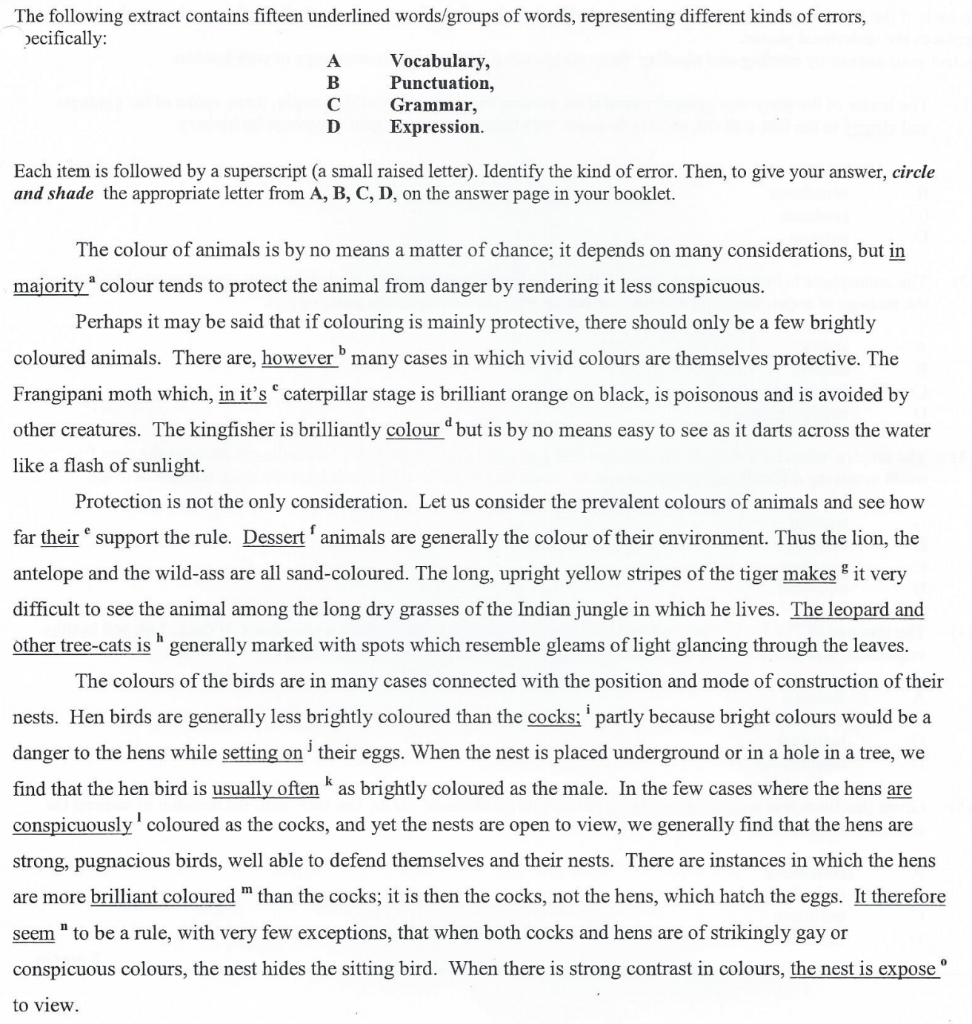
The following extract contains fifteen underlined words/groups of words, representing different kinds of errors, pecifically: A Vocabulary, B Punctuation, Grammar, D Expression. Each item is followed by a superscript (a small raised letter). Identify the kind of error. Then, to give your answer, circle and shade the appropriate letter from A, B, C, D, on the answer page in your booklet. b The colour of animals is by no means a matter of chance; it depends on many considerations, but in majority colour tends to protect the animal from danger by rendering it less conspicuous. Perhaps it may be said that if colouring is mainly protective, there should only be a few brightly coloured animals. There are, however many cases in which vivid colours are themselves protective. The Frangipani moth which, in it's caterpillar stage is brilliant orange on black, is poisonous and is avoided by other creatures. The kingfisher is brilliantly colour but is by no means easy to see as it darts across the water like a flash of sunlight. Protection is not the only consideration. Let us consider the prevalent colours of animals and see how far their support the rule. Dessert animals are generally the colour of their environment. Thus the lion, the antelope and the wild-ass are all sand-coloured. The long, upright yellow stripes of the tiger makes it very difficult to see the animal among the long dry grasses of the Indian jungle in which he lives. The leopard and other tree-cats is generally marked with spots which resemble gleams of light glancing through the leaves. The colours of the birds are in many cases connected with the position and mode of construction of their nests. Hen birds are generally less brightly coloured than the cocks; ' partly because bright colours would be a danger to the hens while setting on their eggs. When the nest is placed underground or in a hole in a tree, we find that the hen bird is usually often as brightly coloured as the male. In the few cases where the hens are conspicuously' coloured as the cocks, and yet the nests are open to view, we generally find that the hens are strong, pugnacious birds, well able to defend themselves and their nests. There are instances in which the hens are more brilliant coloured than the cocks; it is then the cocks, not the hens, which hatch the eggs. It therefore seem to be a rule, with very few exceptions, that when both cocks and hens are of strikingly gay or conspicuous colours, the nest hides the sitting bird. When there is strong contrast in colours, the nest is expose 0 to viewStep by Step Solution
There are 3 Steps involved in it
1 Expert Approved Answer
Step: 1 Unlock

Question Has Been Solved by an Expert!
Get step-by-step solutions from verified subject matter experts
Step: 2 Unlock
Step: 3 Unlock