







Question: Identify which choices would be considered descriptive statistics and which would be considered inferential statistics. a. Of 500 randomly selected people in New York City,
Identify which choices would be considered descriptive statistics and which would be considered inferential statistics.
a. Of 500 randomly selected people in New York City, 210 people had O+ blood.
b. "42 percent of the people in New York City have O+ blood." Is the statement descriptive statistics or inferential statistics?
c. "58 percent of the people of New York City do not have type O+ blood." Is the statement descriptive statistics or inferential statistics?
d. "42 percent of all people living in New York State have type O+ blood." Is the statement descriptive statistics or inferential statistics?
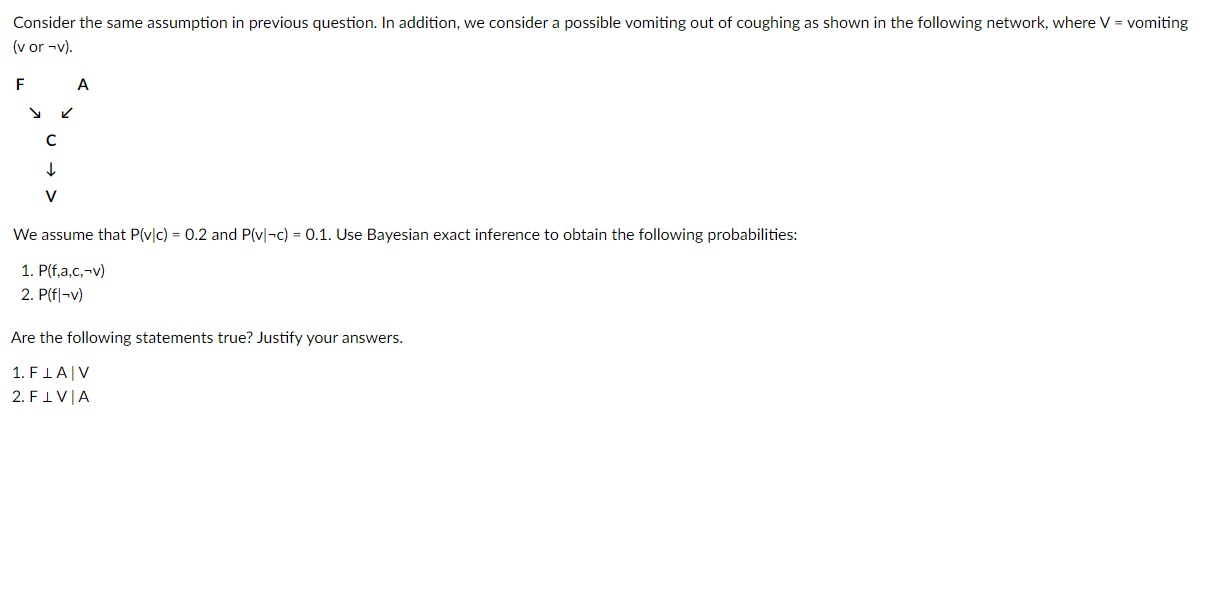
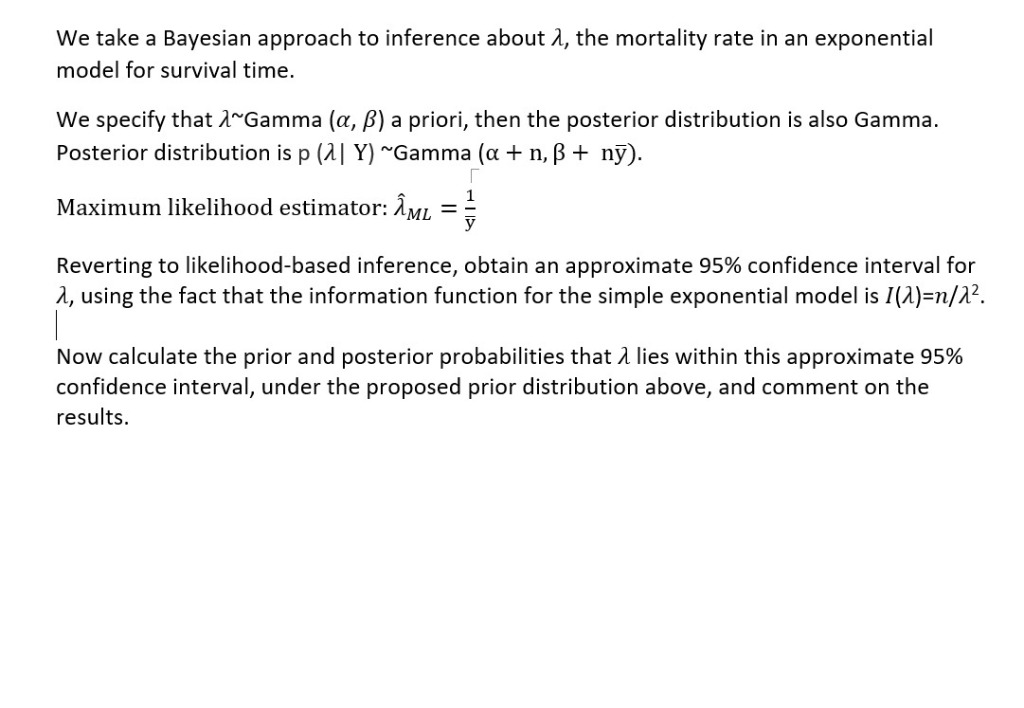
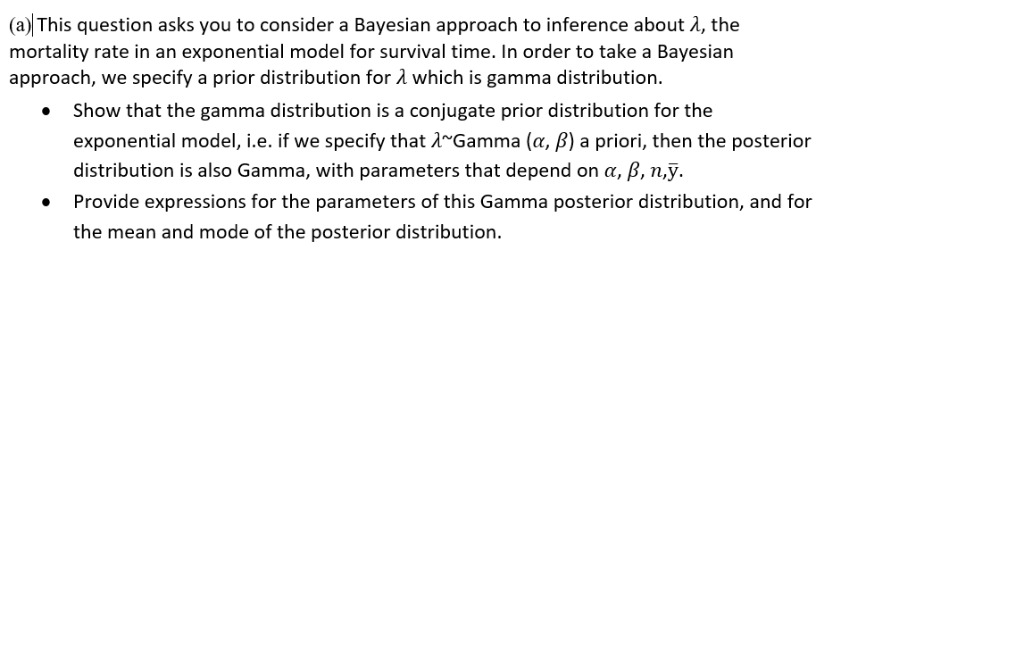
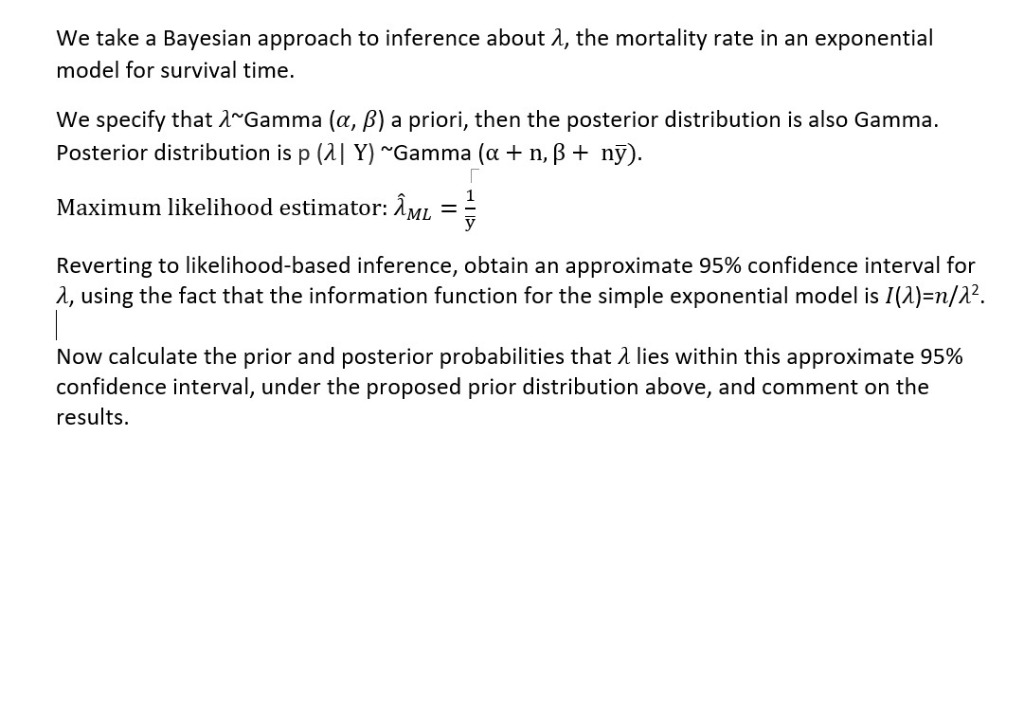
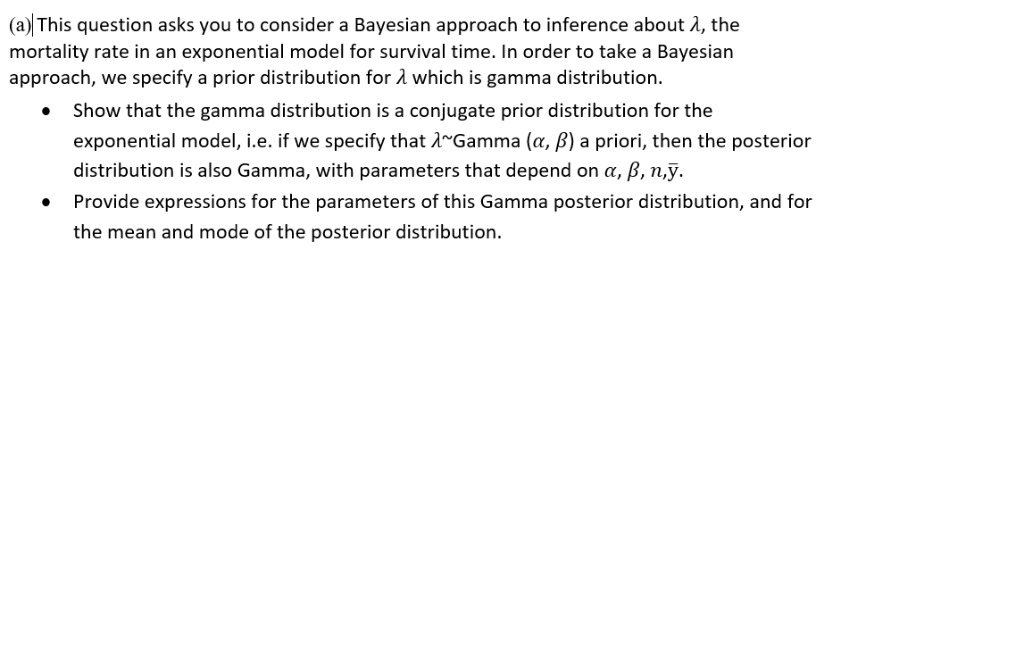
Consider the same assumption in previous question. In addition, we consider a possible vomiting out of coughing as shown in the following network. where V = vomiting [v or -v). We assume that P(v|c) = 0.2 and P(v|-c) = 0.1. Use Bayesian exact inference to obtain the following probabilities: 1. Ptf,a,c,-v) 2. Plflv) Are the following statements true? Justify your answers. 1.F__A|V 2.F__V|A We take a Bayesian approach to inference about A, the mortality rate in an exponential model for survival time. We specify that FGamma (a, ,8) a priori, then the posterior distribution is also Gamma. Posterior distribution is p ([1] Y) "Gamma (a + n, B + n37). | Maximum likelihood estimator: 1m. = % Reverting to likelihood-based inference, obtain an approximate 95% confidence interval for A, using the fact that the information function for the simple exponential model is {MFR/3.2. Now calculate the prior and posterior probabilities that it lies within this approximate 95% confidence interval, under the proposed prior distribution above, and comment on the results. (a)| This question asks you to consider a Bayesian approach to inference about .1, the mortality rate in an exponential model for survival time. In order to take a Bayesian approach, we specify a prior distribution for A which is gamma distribution. I Show that the gamma distribution is a conjugate prior distribution for the exponential model, i.e. if we specify that 1"\"Gamma (a, ,3} a priori, then the posterior distribution is also Gamma, with parameters that depend on a, [3,113. o Provide expressions for the parameters of this Gamma posterior distribution, and for the mean and mode of the posterior distribution
Step by Step Solution
There are 3 Steps involved in it

Get step-by-step solutions from verified subject matter experts
 Study Help