







Question: If an employer wants to commit to processes that highlight the role of effective collaboration and teamwork, how could the process of workflow design play
If an employer wants to commit to processes that highlight the role of effective collaboration and teamwork, how could the process of workflow design play out and how might the results be different than if the organization was committing to processes that were aimed at promoting individual autonomy?
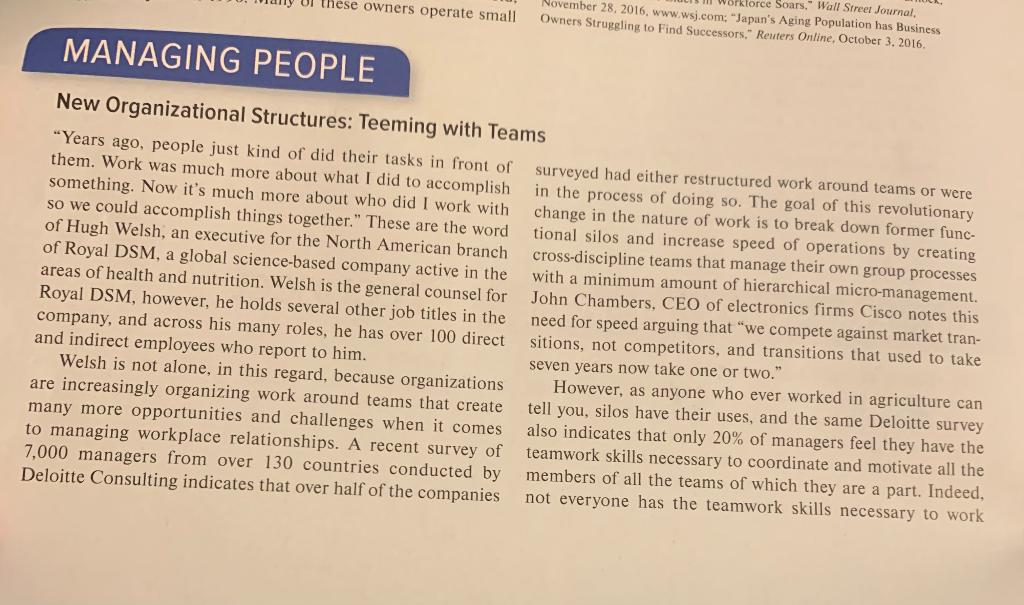
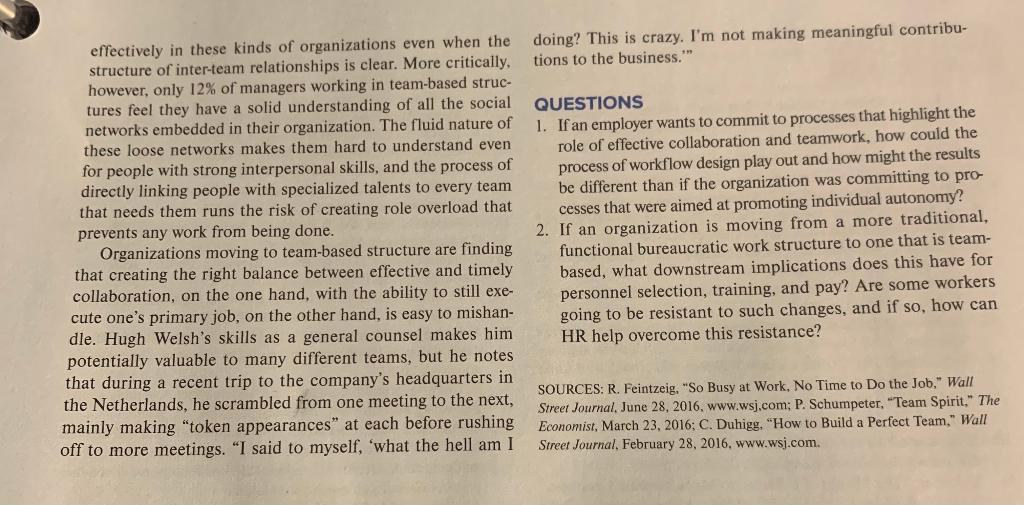
Ul these owners operate small Worklorce Soars." Wall Street Journal, ovember 28, 2016. www.wsj.com: "Japan's Aging Population has Business Owners Struggling to Find Successors," Reuters Online, October 3, 2016. MANAGING PEOPLE New Organizational Structures: Teeming with Teams "Years ago, people just kind of did their tasks in front of surveyed had either restructured work around teams or were them. Work was much more about what I did to accomplish in the process of doing so. The goal of this revolutionary something. Now it's much more about who did I work with change in the nature of work is to break down former func- so we could accomplish things together." These are the word tional silos and increase speed of operations by creating of Hugh Welsh, an executive for the North American branch cross-discipline teams that manage their own group processes of Royal DSM, a global science-based company active in the with a minimum amount of hierarchical micro-management. areas of health and nutrition. Welsh is the general counsel for John Chambers, CEO of electronics firms Cisco notes this Royal DSM, however, he holds several other job titles in the need for speed arguing that we compete against market tran- company, and across his many roles, he has over 100 direct sitions, not competitors, and transitions that used to take and indirect employees who report to him. seven years now take one or two." Welsh is not alone, in this regard, because organizations However, as anyone who ever worked in agriculture can are increasingly organizing work around teams that create tell you, silos have their uses, and the same Deloitte survey many more opportunities and challenges when it comes also indicates that only 20% of managers feel they have the to managing workplace relationships. A recent survey of teamwork skills necessary to coordinate and motivate all the 7,000 managers from over 130 countries conducted by members of all the teams of which they are a part. Indeed, Deloitte Consulting indicates that over half of the companies not everyone has the teamwork skills necessary to work doing? This is crazy. I'm not making meaningful contribu- tions to the business." effectively in these kinds of organizations even when the structure of inter-team relationships is clear. More critically, however, only 12% of managers working in team-based struc- tures feel they have a solid understanding of all the social networks embedded in their organization. The fluid nature of these loose networks makes them hard to understand even for people with strong interpersonal skills, and the process of directly linking people with specialized talents to every team that needs them runs the risk of creating role overload that prevents any work from being done. Organizations moving to team-based structure are finding that creating the right balance between effective and timely collaboration, on the one hand, with the ability to still exe- cute one's primary job, on the other hand, is easy to mishan- dle. Hugh Welsh's skills as a general counsel makes him potentially valuable to many different teams, but he notes that during a recent trip to the company's headquarters in the Netherlands, he scrambled from one meeting to the next, mainly making "token appearances" at each before rushing off to more meetings. "I said to myself, 'what the hell am I QUESTIONS 1. If an employer wants to commit to processes that highlight the role of effective collaboration and teamwork, how could the process of workflow design play out and how might the results be different than if the organization was committing to pro- cesses that were aimed at promoting individual autonomy? 2. If an organization is moving from a more traditional, functional bureaucratic work structure to one that is team- based, what downstream implications does this have for personnel selection, training, and pay? Are some workers going to be resistant to such changes, and if so, how can HR help overcome this resistance? SOURCES: R. Feintzeig. "So Busy at Work, No Time to Do the Job," Wall Street Journal, June 28, 2016, www.wsj.com; P. Schumpeter, "Team Spirit." The Economist, March 23, 2016: C. Duhigg. "How to Build a Perfect Team," Wall Street Journal, February 28, 2016, www.wsj.comStep by Step Solution
There are 3 Steps involved in it
1 Expert Approved Answer
Step: 1 Unlock

Question Has Been Solved by an Expert!
Get step-by-step solutions from verified subject matter experts
Step: 2 Unlock
Step: 3 Unlock
 Study Help