







Question: If image is too small for you, right click image > open image in new tab Buffer size is B packets Outgoing link of rate
If image is too small for you, right click image > open image in new tab
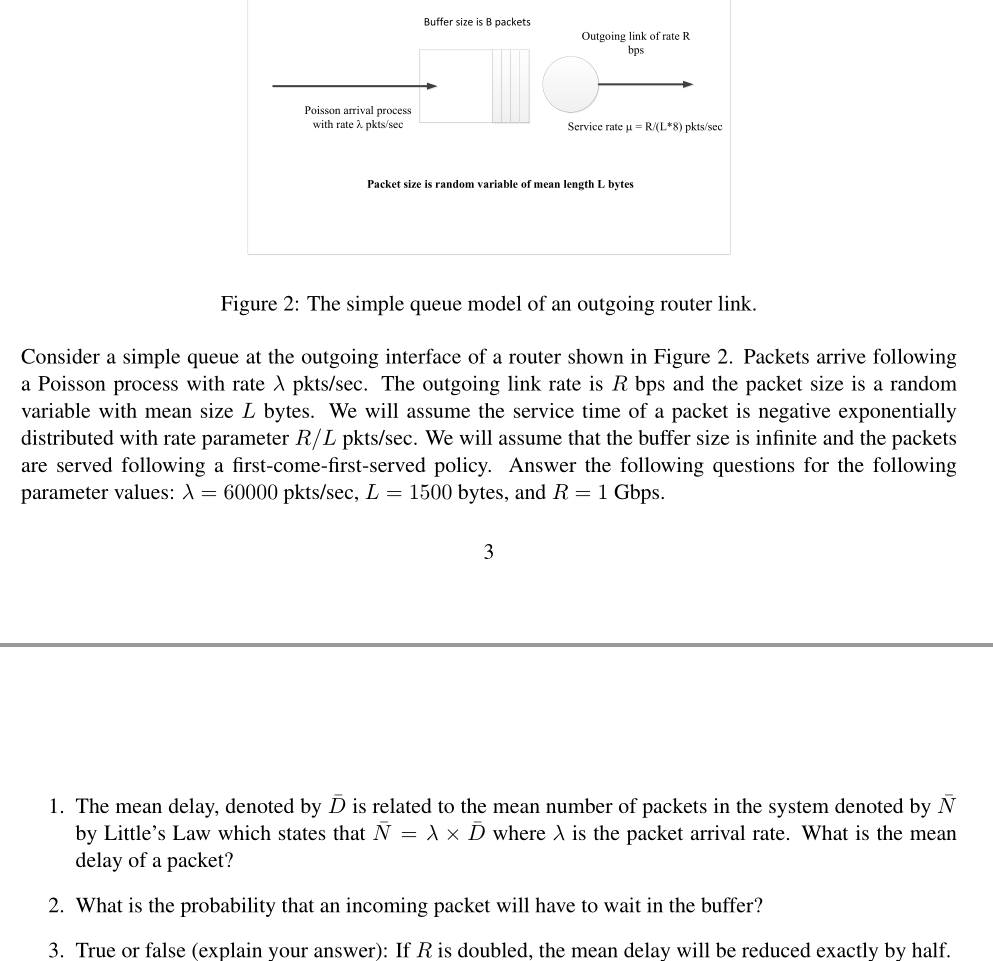
Buffer size is B packets Outgoing link of rate R bps Poisson arrival process with rate pkts/sec Service rate = R/(Leg) pkts/sec | Packet size is random variable of mean length L bytes Figure 2: The simple queue model of an outgoing router link. Consider a simple queue at the outgoing interface of a router shown in Figure 2. Packets arrive following a Poisson process with rate pkts sec. The outgoing link rate is R bps and the packet size is a random variable with mean size L bytes. We will assume the service time of a packet is negative exponentially distributed with rate parameter R/L pkts/sec. We will assume that the buffer size is infinite and the packets are served following a first-come-first-served policy. Answer the following questions for the following parameter values:A-60000 pkts/sec, L = 1500 bytes, and R = 1 Gbps. 1. The mean delay, denoted by D is related to the mean number of packets in the system denoted by N by Little's Law which states that N = x D where is the packet arrival rate, what is the mean delay of a packet? 2. What is the probability that an incoming packet will have to wait in the buffer? 3. True or false (explain your answer): If R is doubled, the mean delay will be reduced exactly by half Buffer size is B packets Outgoing link of rate R bps Poisson arrival process with rate pkts/sec Service rate = R/(Leg) pkts/sec | Packet size is random variable of mean length L bytes Figure 2: The simple queue model of an outgoing router link. Consider a simple queue at the outgoing interface of a router shown in Figure 2. Packets arrive following a Poisson process with rate pkts sec. The outgoing link rate is R bps and the packet size is a random variable with mean size L bytes. We will assume the service time of a packet is negative exponentially distributed with rate parameter R/L pkts/sec. We will assume that the buffer size is infinite and the packets are served following a first-come-first-served policy. Answer the following questions for the following parameter values:A-60000 pkts/sec, L = 1500 bytes, and R = 1 Gbps. 1. The mean delay, denoted by D is related to the mean number of packets in the system denoted by N by Little's Law which states that N = x D where is the packet arrival rate, what is the mean delay of a packet? 2. What is the probability that an incoming packet will have to wait in the buffer? 3. True or false (explain your answer): If R is doubled, the mean delay will be reduced exactly by half
Step by Step Solution
There are 3 Steps involved in it

Get step-by-step solutions from verified subject matter experts
 Study Help