







Question: If question b is a t test i need the degree of freedom Haimere hypothesis it for the difference of population proportions Espanol Based on
If question b is a t test i need the degree of freedom
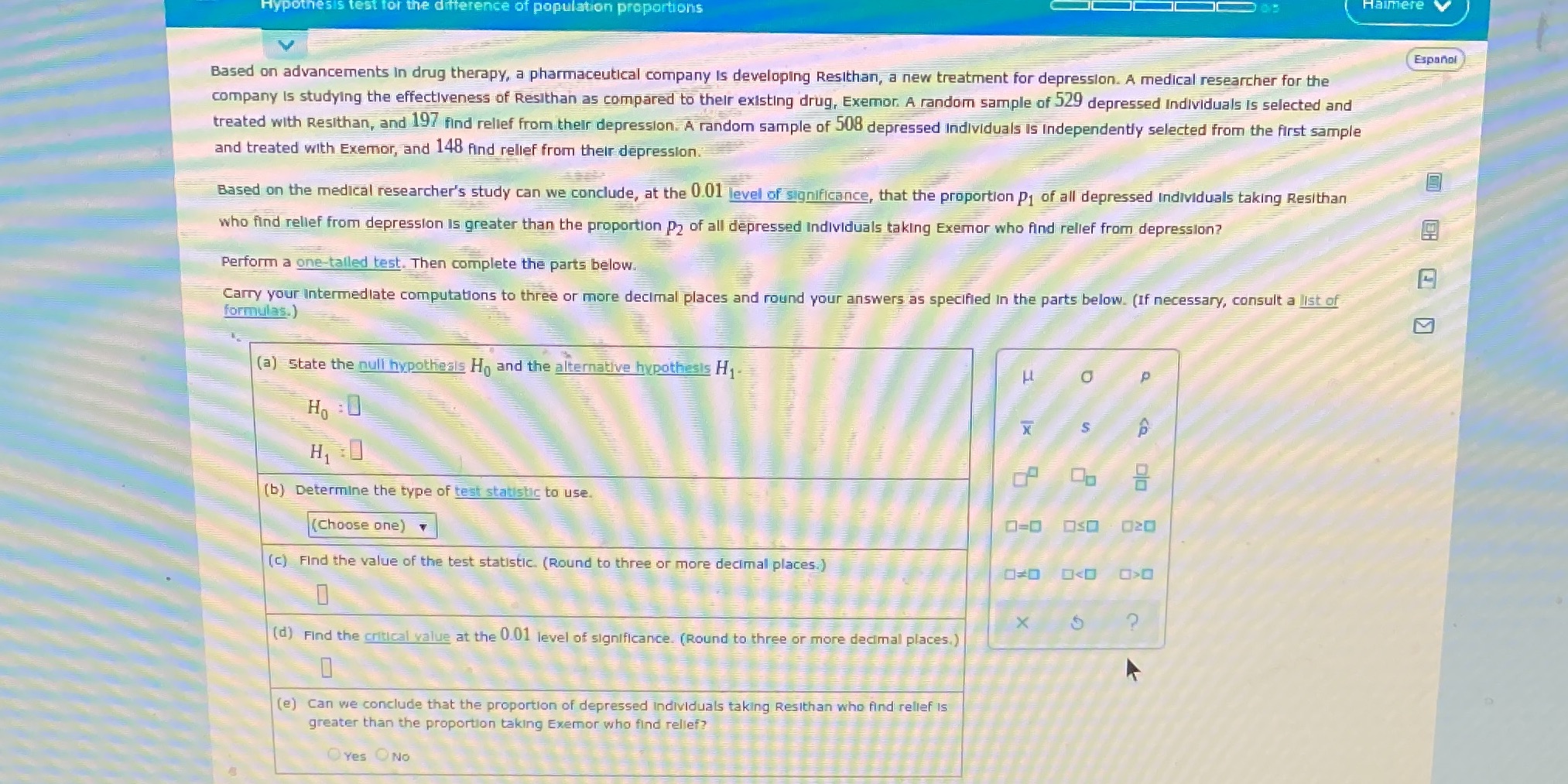
Haimere hypothesis it for the difference of population proportions Espanol Based on advancements In drug therapy, a pharmaceutical company Is developing Resithan, a new treatment for depression. A medical researcher for the company Is studying the effectiveness of Resithan as compared to their existing drug, Exemor, A random sample of 329 depressed Individuals Is selected and treated with Resithan, and 19/ find relief from their depression. A random sample of 508 depressed Individuals Is Independently selected from the first sample and treated with Exemor, and 148 find relief from their depression. Based on the medical researcher's study can we conclude, at the 0.Ul level of significance, that the proportion P, of all depressed Individuals taking Resithan who find relief from depression Is greater than the proportion Py of all depressed Individuals taking Exemor who find relief from depression? Perform a one-talled test. Then complete the parts below. Carry your Intermediate computations to three or more decimal places and round your answers as specified In the parts below. (If necessary, consult a list of formulas.) M (a) State the null hypothesis Ho and the alternative hypothesis H, X S (b) Determine the type of test statistic to use. (Choose one) 0-0 030 020 (c) Find the value of the test statistic. (Round to three or more decimal places.) X 5 (d) Find the critical value at the 0.01 level of significance. (Round to three or more decimal places. 0 (e) Can we conclude that the proportion of depressed individuals taking Resithan who find relief is greater than the proportion taking Exemor who find relief? Yes NO
Step by Step Solution
There are 3 Steps involved in it

Get step-by-step solutions from verified subject matter experts
 Study Help