





Question: If we are going to use data from this year to predict unemployment next year, why not use this year's unemployment to predict next year's
If we are going to use data from this year to
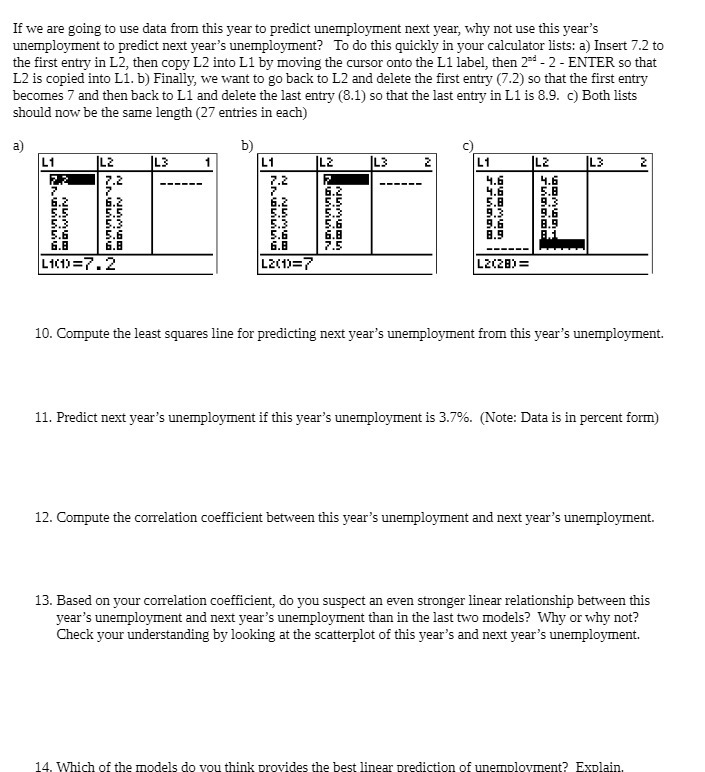
If we are going to use data from this year to predict unemployment next year, why not use this year's unemployment to predict next year's unemployment? To do this quickly in your calculator lists: a) Insert 7.2 to the first entry in L2, then copy L2 into L1 by moving the cursor onto the L1 label, then 2" - 2 - ENTER so that L2 is copied into L1. b) Finally, we want to go back to L2 and delete the first entry (7.2) so that the first entry becomes 7 and then back to L1 and delete the last entry (8.1) so that the last entry in L1 is 8.9. c) Both lists should now be the same length (27 entries in each) a) L1 L2 IL3 L1 LZ L3 L1 |LZ IL3 a inwinry L1(1)=7.2 L2()=7 L2(28)= 10. Compute the least squares line for predicting next year's unemployment from this year's unemployment. 11. Predict next year's unemployment if this year's unemployment is 3.7%. (Note: Data is in percent form) 12. Compute the correlation coefficient between this year's unemployment and next year's unemployment. 13. Based on your correlation coefficient, do you suspect an even stronger linear relationship between this year's unemployment and next year's unemployment than in the last two models? Why or why not? Check your understanding by looking at the scatterplot of this year's and next year's unemployment. 1. Which of the

Step by Step Solution

There are 3 Steps involved in it

1 Expert Approved Answer
Step: 1 Unlock blur-text-image

Question Has Been Solved by an Expert!

Get step-by-step solutions from verified subject matter experts

Step: 2 Unlock
Step: 3 Unlock

Students Have Also Explored These Related Mathematics Questions!