





Question: If we run a simulation model of an M/M/5 queue 20 times and compute the average time a customer spends in the system for each
If we run a simulation model of an M/M/5 queue 20

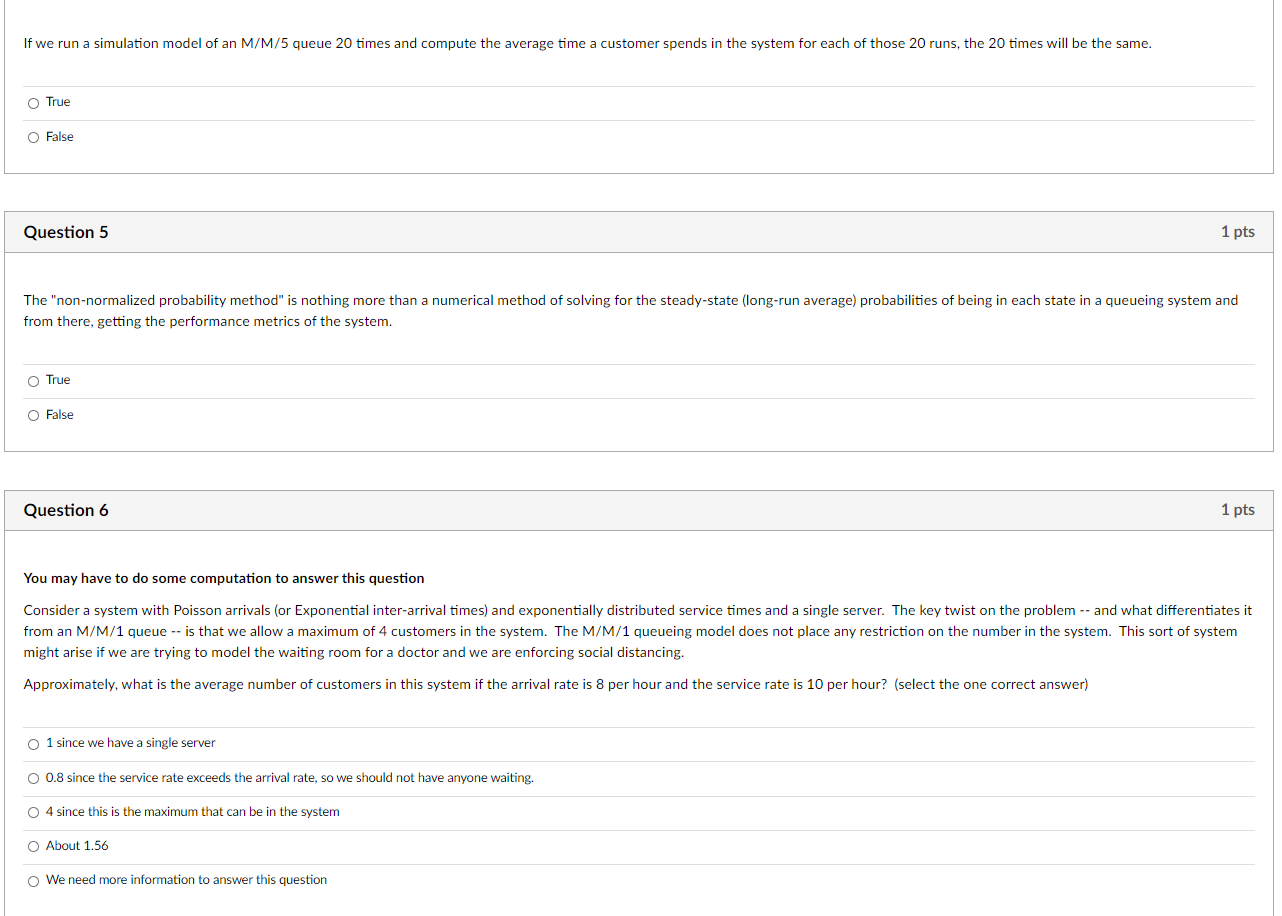
If we run a simulation model of an M/M/5 queue 20 times and compute the average time a customer spends in the system for each of those 20 runs, the 20 times will be the same. O True O False Question 5 1 pts The "non-normalized probability method" is nothing more than a numerical method of solving for the steady-state (long-run average) probabilities of being in each state in a queueing system and from there, getting the performance metrics of the system. O True O False Question 6 1 pts You may have to do some computation to answer this question Consider a system with Poisson arrivals (or Exponential inter-arrival times) and exponentially distributed service times and a single server. The key twist on the problem -- and what differentiates it from an M/M/1 queue -- is that we allow a maximum of 4 customers in the system. The M/M/1 queueing model does not place any restriction on the number in the system. This sort of system might arise if we are trying to model the waiting room for a doctor and we are enforcing social distancing. Approximately, what is the average number of customers in this system if the arrival rate is 8 per hour and the service rate is 10 per hour? (select the one correct answer) 1 since we have a single server 0.8 since the service rate exceeds the arrival rate, so we should not have anyone waiting. 4 since this is the maximum that can be in the system About 1.56 We need more information to answer this

Step by Step Solution

There are 3 Steps involved in it

1 Expert Approved Answer
Step: 1 Unlock blur-text-image

Question Has Been Solved by an Expert!

Get step-by-step solutions from verified subject matter experts

Step: 2 Unlock
Step: 3 Unlock

Students Have Also Explored These Related General Management Questions!