







Question: If you are having issues seeing the image, right click and open in new tab. Risky Cash Flows The Bartram-Pulley Company (BPC) must decide between
If you are having issues seeing the image, right click and open in new tab.
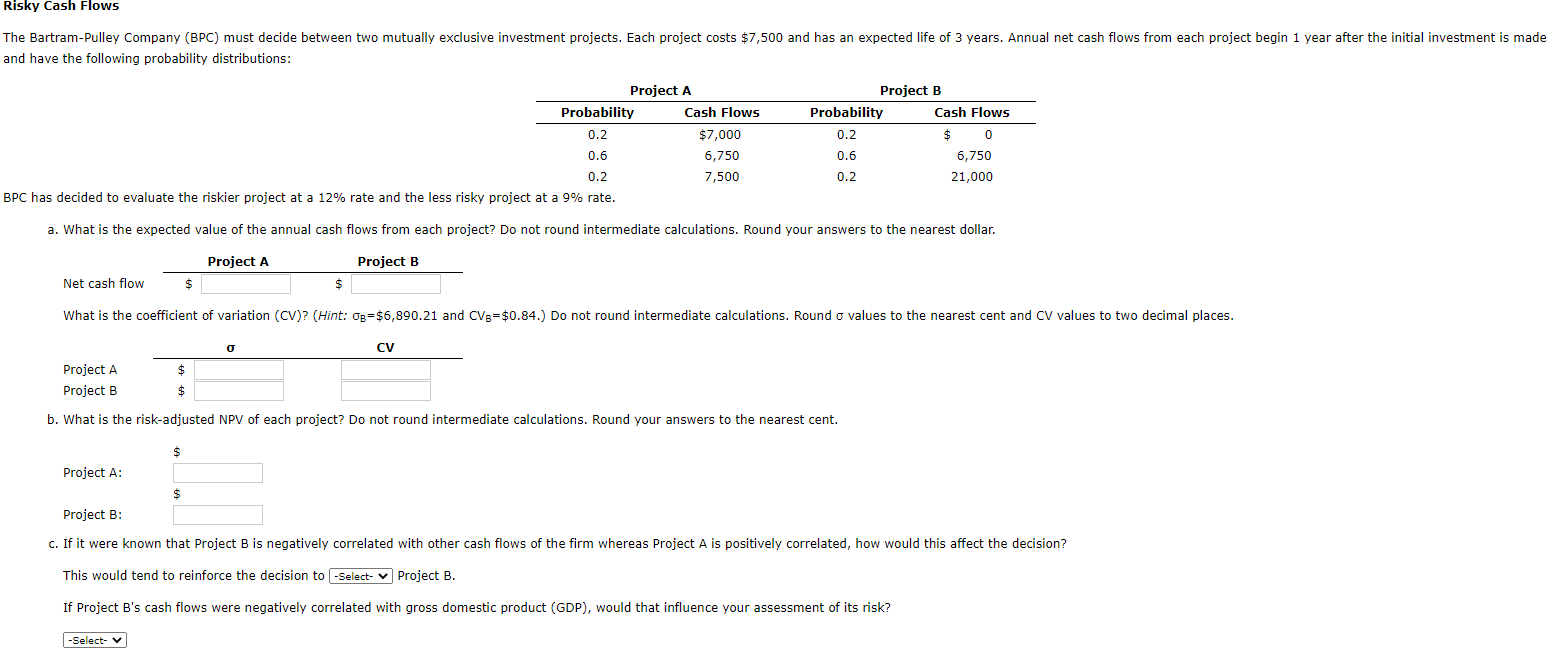
Risky Cash Flows The Bartram-Pulley Company (BPC) must decide between two mutually exclusive investment projects. Each project costs $7,500 and has an expected life of 3 years. Annual net cash flows from each project begin 1 year after the initial investment is made and have the following probability distributions: Project A Probability Cash Flows 0.2 $7,000 0.6 6,750 0.2 7,500 BPC has decided to evaluate the riskier project at a 12% rate and the less risky project at a 9% rate. Project B Probability Cash Flows 0.2 $ 0 0.6 6,750 0.2 21,000 a. What is the expected value of the annual cash flows from each project? Do not round intermediate calculations. Round your answers to the nearest dollar. Project A Project B Net cash flow $ $ What is the coefficient of variation (CV)? (Hint: 0g=$6,890.21 and CV3=$0.84.) Do not round intermediate calculations. Round o values to the nearest cent and CV values to two decimal places. o CV Project A Project B $ b. What is the risk-adjusted NPV of each project? Do not round intermediate calculations. Round your answers to the nearest cent. Project A: $ Project B: c. If it were known that Project B is negatively correlated with other cash flows of the firm whereas Project A is positively correlated, how would this affect the decision? This would tend to reinforce the decision to -Select- Project B. If Project B's cash flows were negatively correlated with gross domestic product (GDP), would that influence your assessment of its risk? -Select
Step by Step Solution
There are 3 Steps involved in it

Get step-by-step solutions from verified subject matter experts
 Study Help