







Question: if you find a problem with population size narrow it down to 500 for example the problem is about assumption you can choose the numbers
if you find a problem with population size narrow it down to 500 for example
the problem is about assumption
you can choose the numbers
all details about covid-19 and lebanon are present for assumptions 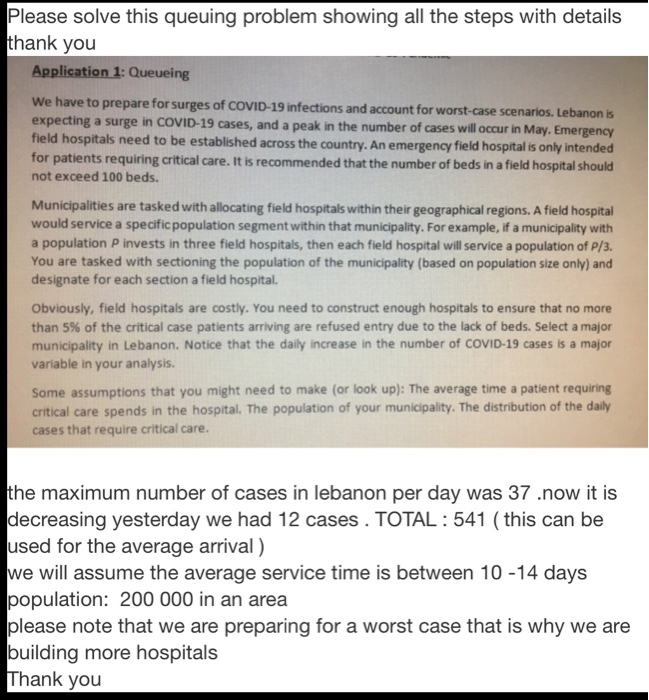
demgraphics for chosen area 200 000
population of country 6.082 million
age percentage 35% are more than 60, 65% are less than 60
please find attached the formulas below 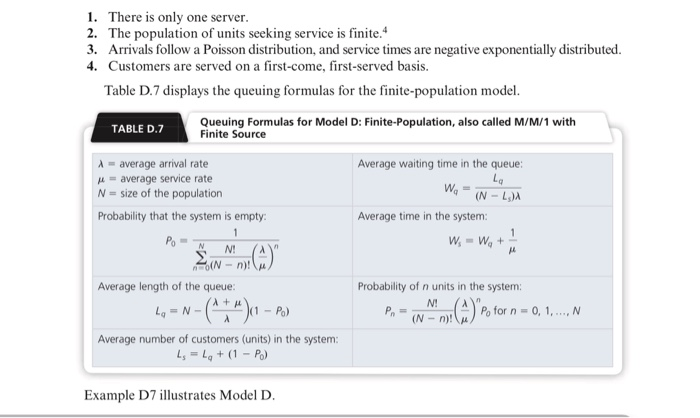
Please solve this queuing problem showing all the steps with details thank you Application 1: Queueing We have to prepare for surges of COVID-19 infections and account for worst-case scenarios. Lebanon is expecting a surge in COVID-19 cases, and a peak in the number of cases will occur in May. Emergency field hospitals need to be established across the country. An emergency field hospital is only intended for patients requiring critical care. It is recommended that the number of beds in a field hospital should not exceed 100 beds. Municipalities are tasked with allocating field hospitals within their geographical regions. A field hospital would service a specific population segment within that municipality. For example, if a municipality with a population P invests in three field hospitals, then each field hospital will service a population of P/3. You are tasked with sectioning the population of the municipality (based on population size only) and designate for each section a field hospital. Obviously, field hospitals are costly. You need to construct enough hospitals to ensure that no more than 5% of the critical case patients arriving are refused entry due to the lack of beds. Select a major municipality in Lebanon. Notice that the daily increase in the number of COVID-19 cases is a major variable in your analysis. Some assumptions that you might need to make (or look up): The average time a patient requiring critical care spends in the hospital. The population of your municipality. The distribution of the daily cases that require critical care. the maximum number of cases in lebanon per day was 37 .now it is decreasing yesterday we had 12 cases . TOTAL : 541 (this can be used for the average arrival) we will assume the average service time is between 10-14 days population: 200 000 in an area please note that we are preparing for a worst case that is why we are building more hospitals Thank you 1. There is only one server. 2. The population of units seeking service is finite. 3. Arrivals follow a Poisson distribution, and service times are negative exponentially distributed 4. Customers are served on a first-come, first-served basis. Table D. 7 displays the queuing formulas for the finite-population model. TABLE D.7 Queuing Formulas for Model D: Finite-Population, also called M/M/1 with Finite Source - average arrival rate H = average service rate N = size of the population Average waiting time in the queue: La W IN - LA Probability that the system is empty: Average time in the system: W. - W+? M. Average length of the queue: La = N-(*) - P) Probability of n units in the system: N! " Po for n = 0, 1,...,N P (N-n)! Average number of customers (units) in the system: - L = La + (1 - Po) Example D7 illustrates Model D. Please solve this queuing problem showing all the steps with details thank you Application 1: Queueing We have to prepare for surges of COVID-19 infections and account for worst-case scenarios. Lebanon is expecting a surge in COVID-19 cases, and a peak in the number of cases will occur in May. Emergency field hospitals need to be established across the country. An emergency field hospital is only intended for patients requiring critical care. It is recommended that the number of beds in a field hospital should not exceed 100 beds. Municipalities are tasked with allocating field hospitals within their geographical regions. A field hospital would service a specific population segment within that municipality. For example, if a municipality with a population P invests in three field hospitals, then each field hospital will service a population of P/3. You are tasked with sectioning the population of the municipality (based on population size only) and designate for each section a field hospital. Obviously, field hospitals are costly. You need to construct enough hospitals to ensure that no more than 5% of the critical case patients arriving are refused entry due to the lack of beds. Select a major municipality in Lebanon. Notice that the daily increase in the number of COVID-19 cases is a major variable in your analysis. Some assumptions that you might need to make (or look up): The average time a patient requiring critical care spends in the hospital. The population of your municipality. The distribution of the daily cases that require critical care. the maximum number of cases in lebanon per day was 37 .now it is decreasing yesterday we had 12 cases . TOTAL : 541 (this can be used for the average arrival) we will assume the average service time is between 10-14 days population: 200 000 in an area please note that we are preparing for a worst case that is why we are building more hospitals Thank you 1. There is only one server. 2. The population of units seeking service is finite. 3. Arrivals follow a Poisson distribution, and service times are negative exponentially distributed 4. Customers are served on a first-come, first-served basis. Table D. 7 displays the queuing formulas for the finite-population model. TABLE D.7 Queuing Formulas for Model D: Finite-Population, also called M/M/1 with Finite Source - average arrival rate H = average service rate N = size of the population Average waiting time in the queue: La W IN - LA Probability that the system is empty: Average time in the system: W. - W+? M. Average length of the queue: La = N-(*) - P) Probability of n units in the system: N! " Po for n = 0, 1,...,N P (N-n)! Average number of customers (units) in the system: - L = La + (1 - Po) Example D7 illustrates Model D
Step by Step Solution
There are 3 Steps involved in it
1 Expert Approved Answer
Step: 1 Unlock

Question Has Been Solved by an Expert!
Get step-by-step solutions from verified subject matter experts
Step: 2 Unlock
Step: 3 Unlock
 Study Help