



Question: Ignore any info above Problem 5. Solution: (h) (5 points) If the expected return of SPXL was instead just 3 instead of 34 - 2r,
 Ignore any info above Problem 5.
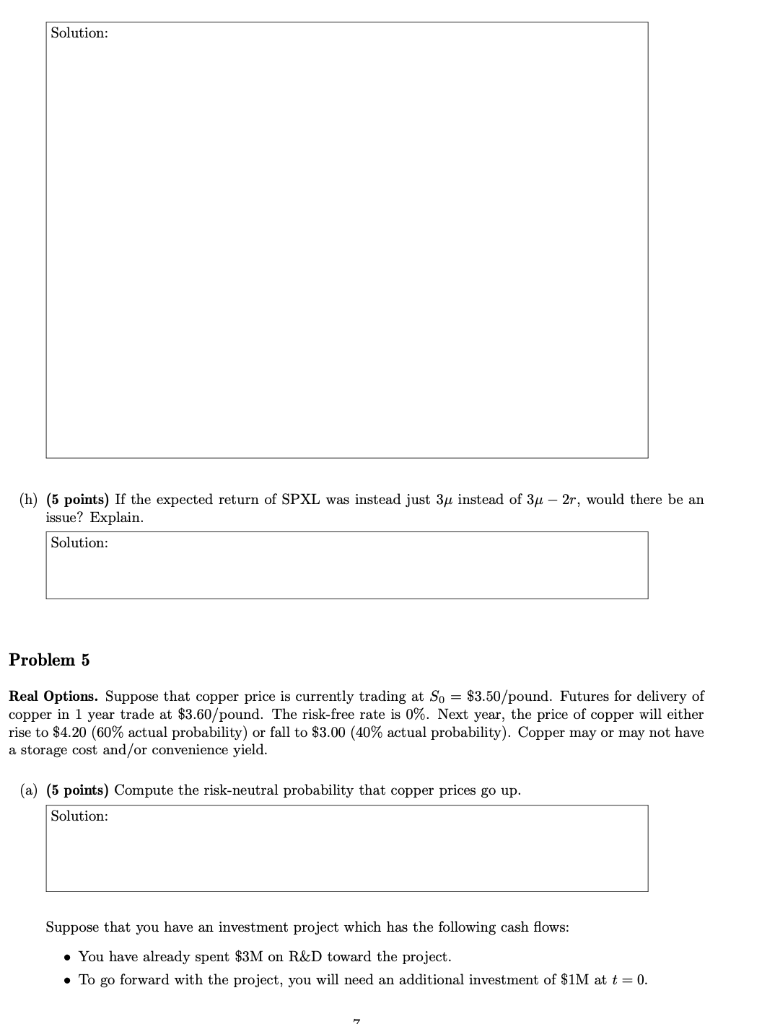
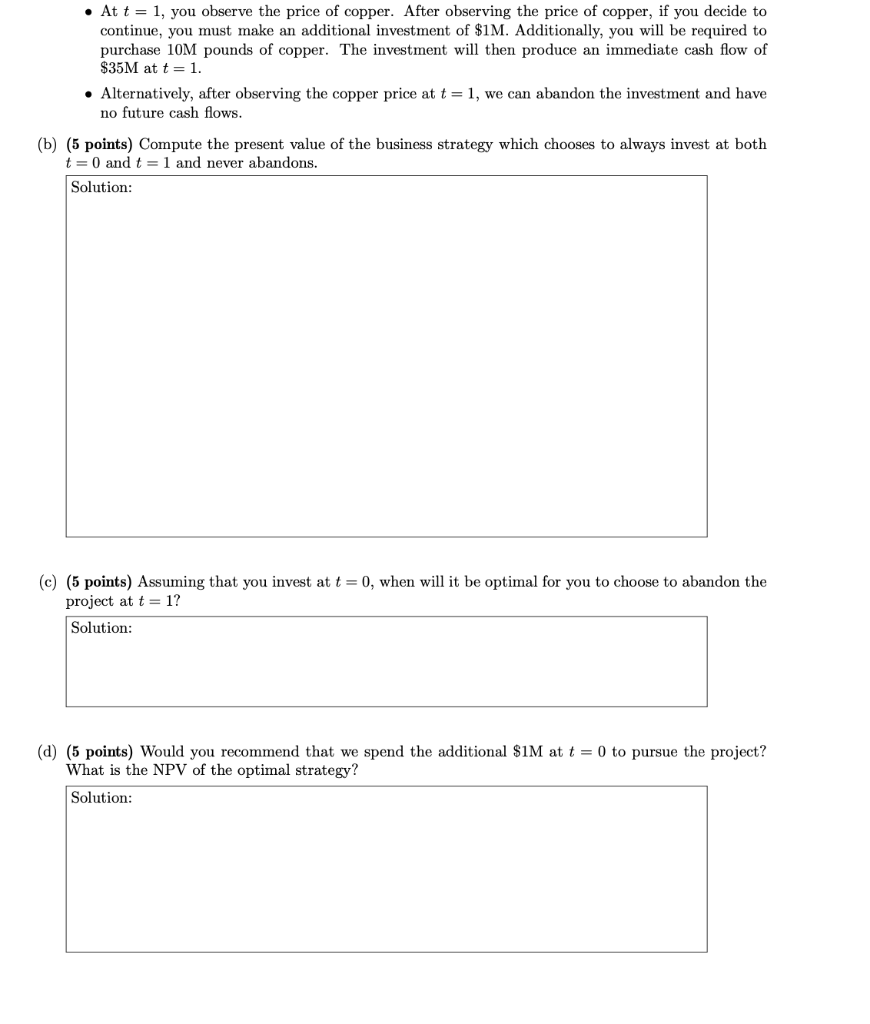
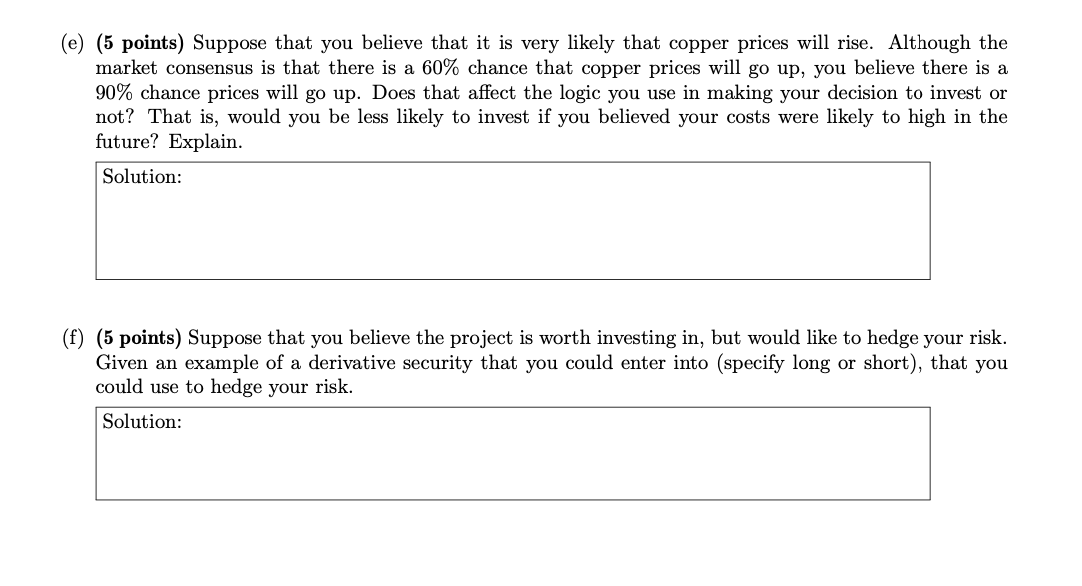
Solution: (h) (5 points) If the expected return of SPXL was instead just 3 instead of 34 - 2r, would there be an issue? Explain. Solution: Problem 5 Real Options. Suppose that copper price is currently trading at So = $3.50/pound. Futures for delivery of copper in 1 year trade at $3.60/pound. The risk-free rate is 0%. Next year, the price of copper will either rise to $4.20 60% actual probability) or fall to $3.00 (40% actual probability). Copper may or may not have a storage cost and/or convenience yield. (a) (5 points) Compute the risk-neutral probability that copper prices go up. Solution: Suppose that you have an investment project which has the following cash flows: . You have already spent $3M on R&D toward the project. To go forward with the project, you will need an additional investment of $1M at t = 0. At t = 1, you observe the price of copper. After observing the price of copper, if you decide to continue, you must make an additional investment $1M. Additionally, you will be required to purchase 10M pounds of copper. The investment will then produce an immediate cash flow of $35M at t=1. Alternatively, after observing the copper price at t = 1, we can abandon the investment and have no future cash flows. (b) (5 points) Compute the present value of the business strategy which chooses to always invest at both t = 0 and t = 1 and never abandons. Solution: (c) (5 points) Assuming that you invest at t = 0, when will it be optimal for you to choose to abandon the project at t = 1? Solution: (d) (5 points) Would you recommend that we spend the additional $1M at t = 0 to pursue the project? What is the NPV of the optimal strategy? Solution: (e) (5 points) Suppose that you believe that it is very likely that copper prices will rise. Although the market consensus is that there is a 60% chance that copper prices will go up, you believe there is a 90% chance prices will go up. Does that affect the logic you use in making your decision to invest or not? That is, would you be less likely to invest if you believed your costs were likely to high in the future? Explain. Solution: (f) (5 points) Suppose that you believe the project is worth investing in, but would like to hedge your risk. Given an example of a derivative security that you could enter into (specify long or short), that you could use to hedge your risk. Solution: Solution: (h) (5 points) If the expected return of SPXL was instead just 3 instead of 34 - 2r, would there be an issue? Explain. Solution: Problem 5 Real Options. Suppose that copper price is currently trading at So = $3.50/pound. Futures for delivery of copper in 1 year trade at $3.60/pound. The risk-free rate is 0%. Next year, the price of copper will either rise to $4.20 60% actual probability) or fall to $3.00 (40% actual probability). Copper may or may not have a storage cost and/or convenience yield. (a) (5 points) Compute the risk-neutral probability that copper prices go up. Solution: Suppose that you have an investment project which has the following cash flows: . You have already spent $3M on R&D toward the project. To go forward with the project, you will need an additional investment of $1M at t = 0. At t = 1, you observe the price of copper. After observing the price of copper, if you decide to continue, you must make an additional investment $1M. Additionally, you will be required to purchase 10M pounds of copper. The investment will then produce an immediate cash flow of $35M at t=1. Alternatively, after observing the copper price at t = 1, we can abandon the investment and have no future cash flows. (b) (5 points) Compute the present value of the business strategy which chooses to always invest at both t = 0 and t = 1 and never abandons. Solution: (c) (5 points) Assuming that you invest at t = 0, when will it be optimal for you to choose to abandon the project at t = 1? Solution: (d) (5 points) Would you recommend that we spend the additional $1M at t = 0 to pursue the project? What is the NPV of the optimal strategy? Solution: (e) (5 points) Suppose that you believe that it is very likely that copper prices will rise. Although the market consensus is that there is a 60% chance that copper prices will go up, you believe there is a 90% chance prices will go up. Does that affect the logic you use in making your decision to invest or not? That is, would you be less likely to invest if you believed your costs were likely to high in the future? Explain. Solution: (f) (5 points) Suppose that you believe the project is worth investing in, but would like to hedge your risk. Given an example of a derivative security that you could enter into (specify long or short), that you could use to hedge your risk. Solution
Step by Step Solution
There are 3 Steps involved in it

Get step-by-step solutions from verified subject matter experts