







Question: II am only asking for help with question #1. I have tried multiple times to get the right answers. part B is correct, but parts
 II am only asking for help with question #1. I have tried multiple times to get the right answers. part B is correct, but parts A, C, and D are incorrect. Thank you!
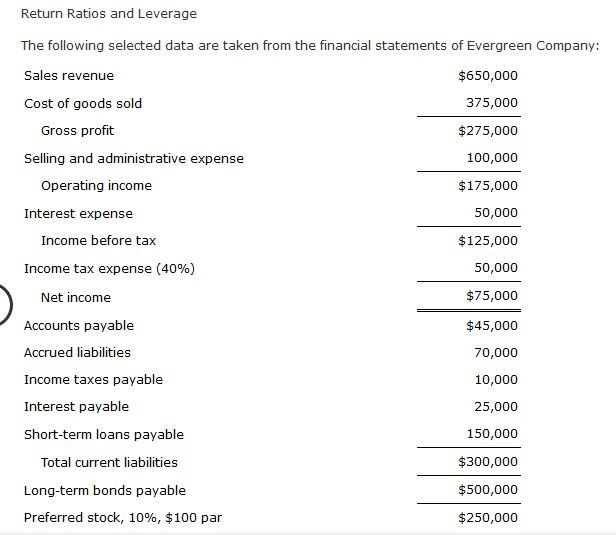
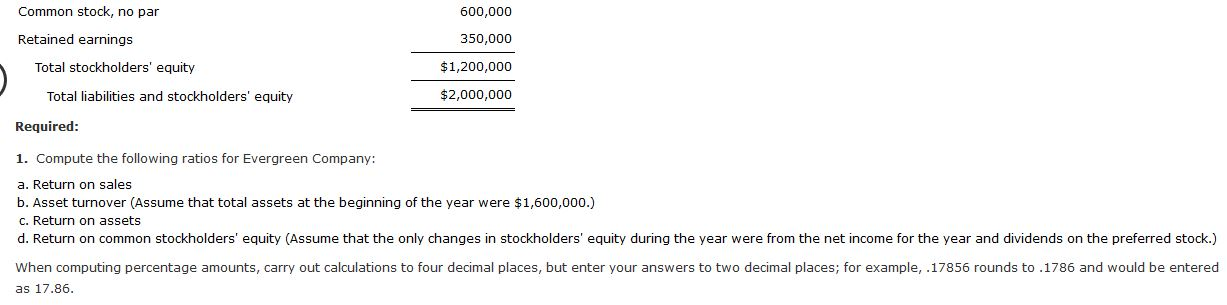
Return Ratios and Leverage The following selected data are taken from the financial statements of Evergreen Company: Sales revenue $650,000 375,000 $275,000 Cost of goods sold Gross profit Selling and administrative expense Operating income 100,000 $175,000 Interest expense 50,000 Income before tax $125,000 50,000 $75,000 $45,000 70,000 Income tax expense (40%) Net income Accounts payable Accrued liabilities Income taxes payable Interest payable Short-term loans payable Total current liabilities 10,000 25,000 150,000 $300,000 Long-term bonds payable $500,000 $250,000 Preferred stock, 10%, $100 par Common stock, no par 600,000 Retained earnings 350,000 Total stockholders' equity $1,200,000 $2,000,000 Total liabilities and stockholders' equity Required: 1. Compute the following ratios for Evergreen Company: a. Return on sales b. Asset turnover (Assume that total assets at the beginning of the year were $1,600,000.) C. Return on assets d. Return on common stockholders' equity (Assume that the only changes in stockholders' equity during the year were from the net income for the year and dividends on the preferred stock.) When computing percentage amounts, carry out calculations to four decimal places, but enter your answers to two decimal places; for example, .17856 rounds to .1786 and would be entered as 17.86. a. Return on sales 16.15 % b. Asset turnover (round to 2 decimal places) 0.36 times c. Return on assets 5.83 % d. Return on common stockholders' equity 5.55 % 2. Comment on Evergreen's use of leverage. Has it successfully employed leverage? Yes, Evergreen has successfully employed leverage because; the return on the stockholders funds is less than the return to all the providers of capital
Step by Step Solution
There are 3 Steps involved in it

Get step-by-step solutions from verified subject matter experts
 Study Help