







Question: II have this problem set and I do not know how to do them. 4. 0MP Practice (a) Suppose we have a vector 52' E
II have this problem set and I do not know how to do them.
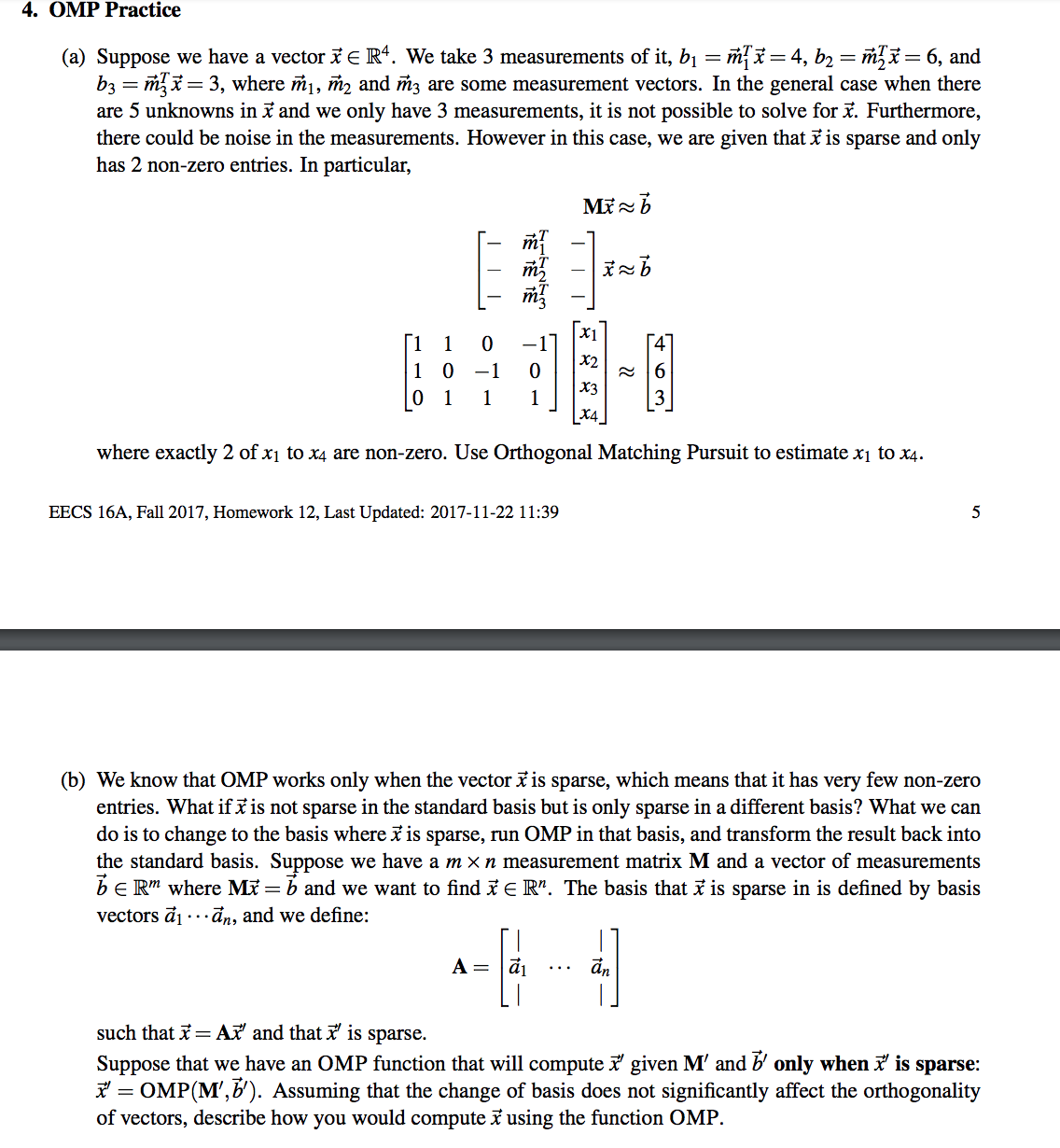
4. 0MP Practice (a) Suppose we have a vector 52' E R4. We take 3 measurements of it, b]: ff 4, b2 gf 6, and b3: gi 3, where ll, 5'12 and {1&3 are some measurement vectors. In the general case when there are 5 unknowns in if and we only have 3 measurements, it is not possible to solve for 1'. Furthermore, there could be noise in the measurements. However in this case, we are given that if is sparse and only has 2 non-zero entries. In particular, Mimi'5 i{ A fri3r'zb _,,,_ 110 1J'C1 4 101 0 xzz 011 1 x3 3 x4 where exactly 2 of x1 to x4 are non-zero. Use Orthogonal Matching Pursuit to estimate Jr] to 1:4. EECS 16A, Fall 2013', Homework 12, Last Updated: 2017-11-22 11:39 5 (b) We know that 0MP works only when the vector if is sparse, which means that it has very few non-zero entries. What if if is not sparse in the standard basis but is only sparse in a different basis? What we can do is to change to the basis where i" is sparse, run 0MP in that basis, and transform the result back into the standard basis. Suppose we have a m X n measurement matrix M and a vector of measurements b E R\" where W2 b and we want to nd x E R". The basis that x is sparse in is dened by basis vectors (11-min, and we dene: | o | A: 51 a" | I such that if : A3." and that 53' is sparse. Suppose that we have an 0MP function that will compute 3' given M' and 3' only when 3' is sparse: ? = 0MP(M',3'). Assuming that the change of basis does not signicantly affect the orthogonality of vectors, describe how you would compute .'x' using the function 0MP
Step by Step Solution
There are 3 Steps involved in it

Get step-by-step solutions from verified subject matter experts
 Study Help