







Question: ii) Malaria is a parasitic infection transmitted by mosquito bites. In the 1640's, the Jesuits in Peru introduced the bark of the cinchona tree to
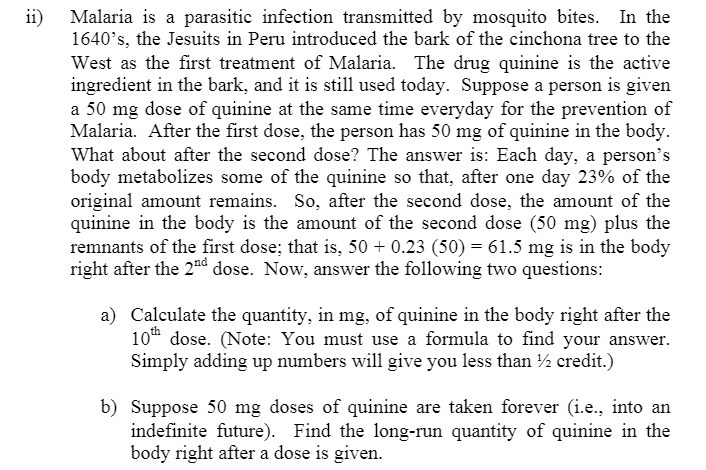
ii) Malaria is a parasitic infection transmitted by mosquito bites. In the 1640's, the Jesuits in Peru introduced the bark of the cinchona tree to the West as the first treatment of Malaria. The drug quinine is the active ingredient in the bark, and it is still used today. Suppose a person is given a 50 mg dose of quinine at the same time everyday for the prevention of Malaria. After the first dose, the person has 50 mg of quinine in the body. What about after the second dose? The answer is: Each day, a person's body metabolizes some of the quinine so that, after one day 23% of the original amount remains. So, after the second dose, the amount of the quinine in the body is the amount of the second dose (50 mg) plus the remnants of the first dose; that is, 50 + 0.23 (50) = 61.5 mg is in the body right after the 2" dose. Now, answer the following two questions: a) Calculate the quantity, in mg, of quinine in the body right after the 10" dose. (Note: You must use a formula to find your answer. Simply adding up numbers will give you less than 1/2 credit.) b) Suppose 50 mg doses of quinine are taken forever (i.e., into an indefinite future). Find the long-run quantity of quinine in the body right after a dose is given
Step by Step Solution
There are 3 Steps involved in it

Get step-by-step solutions from verified subject matter experts
 Study Help