







Question: II. QUESTION #2 - (Continued): B. Now, RESEARCH the ISSUES presented, and ANSWER the following QUESTION: Does Attomey Pantzox have any legal grounds to ask
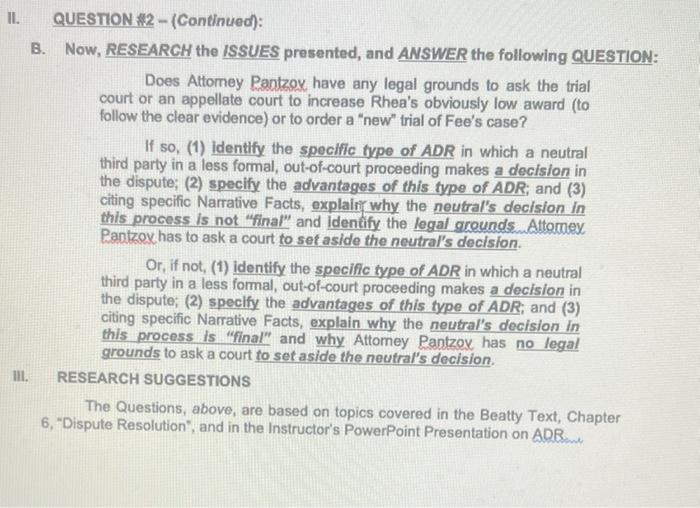
II. QUESTION #2 - (Continued): B. Now, RESEARCH the ISSUES presented, and ANSWER the following QUESTION: Does Attomey Pantzox have any legal grounds to ask the trial court or an appellate court to increase Rhea's obviously low award (to follow the clear evidence) or to order a "new" trial of Fee's case? If so, (1) Identify the specific type of ADR in which a neutral third party in a less formal, out-of-court proceeding makes a decision in the dispute; (2) specify the advantages of this type of ADR; and (3) citing specific Narrative Facts, explain why the neutral's decision In this process is not "final" and identify the legal grounds...Attomey. Pantzox has to ask a court to set aside the neutral's decision Or, if not, (1) identify the specific type of ADR in which a neutral third party in a less formal, out-of-court proceeding makes a decision in the dispute; (2) specify the advantages of this type of ADR; and (3) citing specific Narrative Facts, explain why the neutral's decision in this process is "final" and why Attorney Pantzox has no legal grounds to ask a court to set aside the neutral's decision III. RESEARCH SUGGESTIONS The Questions, above, are based on topics covered in the Beatty Text, Chapter 6,"Dispute Resolution, and in the Instructor's PowerPoint Presentation on ADR..... II. QUESTION #2 - (Continued): B. Now, RESEARCH the ISSUES presented, and ANSWER the following QUESTION: Does Attomey Pantzox have any legal grounds to ask the trial court or an appellate court to increase Rhea's obviously low award (to follow the clear evidence) or to order a "new" trial of Fee's case? If so, (1) Identify the specific type of ADR in which a neutral third party in a less formal, out-of-court proceeding makes a decision in the dispute; (2) specify the advantages of this type of ADR; and (3) citing specific Narrative Facts, explain why the neutral's decision In this process is not "final" and identify the legal grounds...Attomey. Pantzox has to ask a court to set aside the neutral's decision Or, if not, (1) identify the specific type of ADR in which a neutral third party in a less formal, out-of-court proceeding makes a decision in the dispute; (2) specify the advantages of this type of ADR; and (3) citing specific Narrative Facts, explain why the neutral's decision in this process is "final" and why Attorney Pantzox has no legal grounds to ask a court to set aside the neutral's decision III. RESEARCH SUGGESTIONS The Questions, above, are based on topics covered in the Beatty Text, Chapter 6,"Dispute Resolution, and in the Instructor's PowerPoint Presentation on ADR
Step by Step Solution
There are 3 Steps involved in it

Get step-by-step solutions from verified subject matter experts
 Study Help