



Question: Based on the Case Opinion, please answer the following questions: - What is the legal issue(s) the court had to decide? Write in the form
Based on the Case Opinion, please answer the following questions:
- What is the legal issue(s) the court had to decide? Write in the form of a question.
- What was the decision made? What is the answer to the question above?
- What is the Law & Reasoning behind this decision?
Thank you.
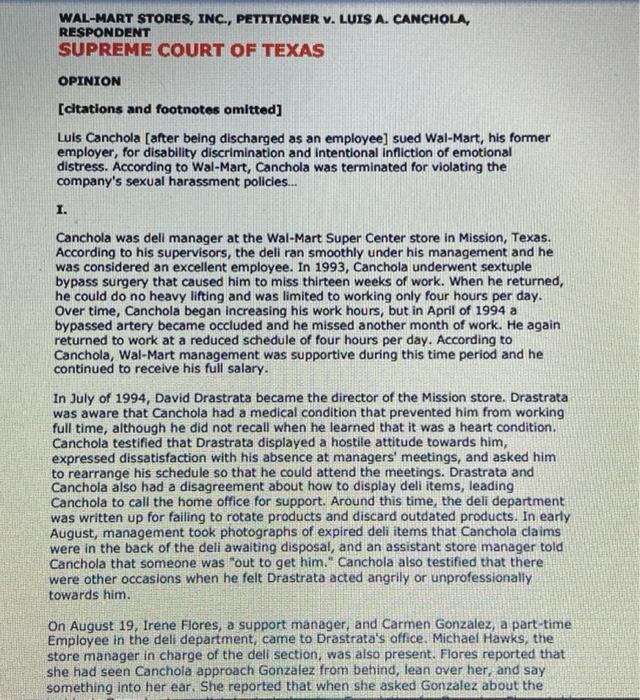
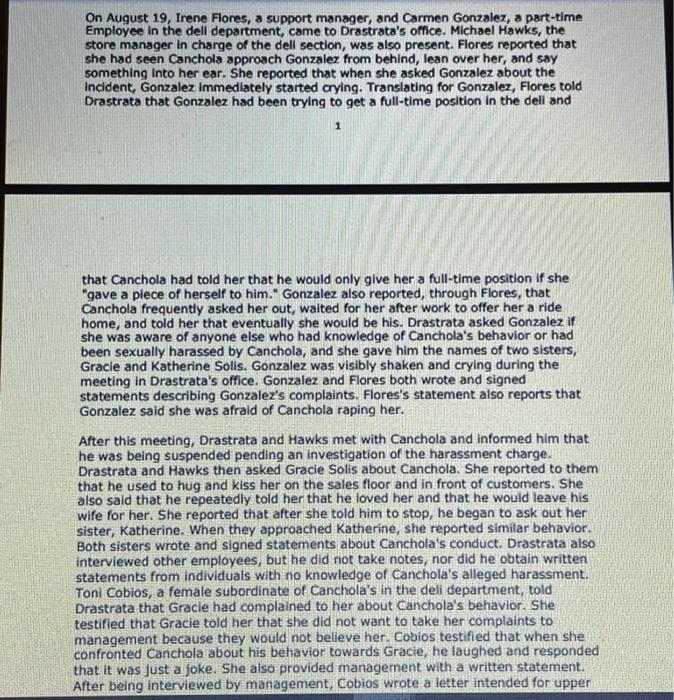
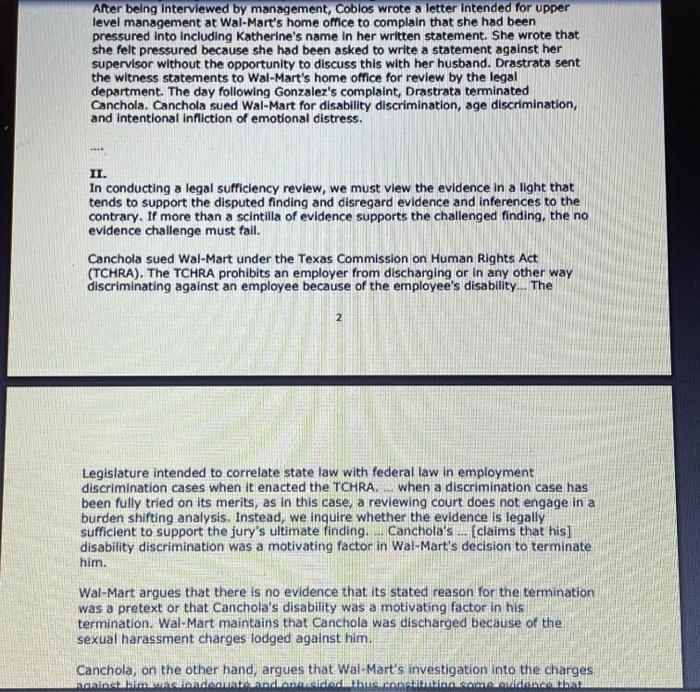
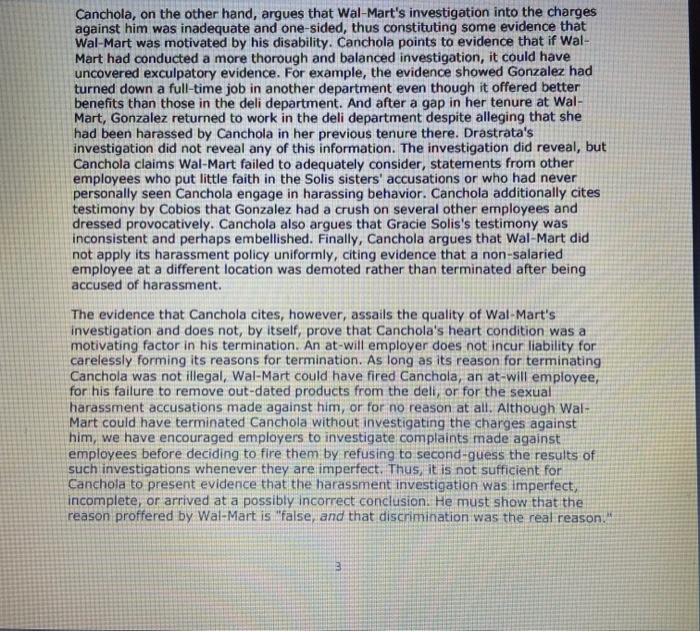
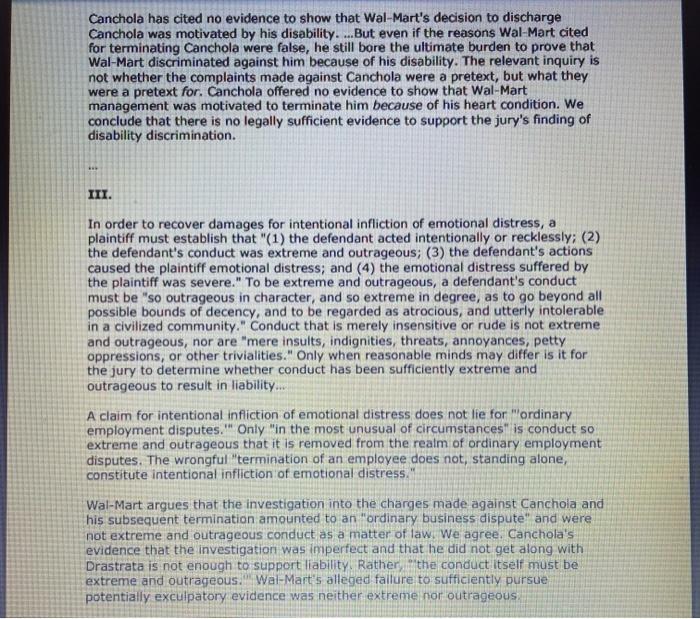
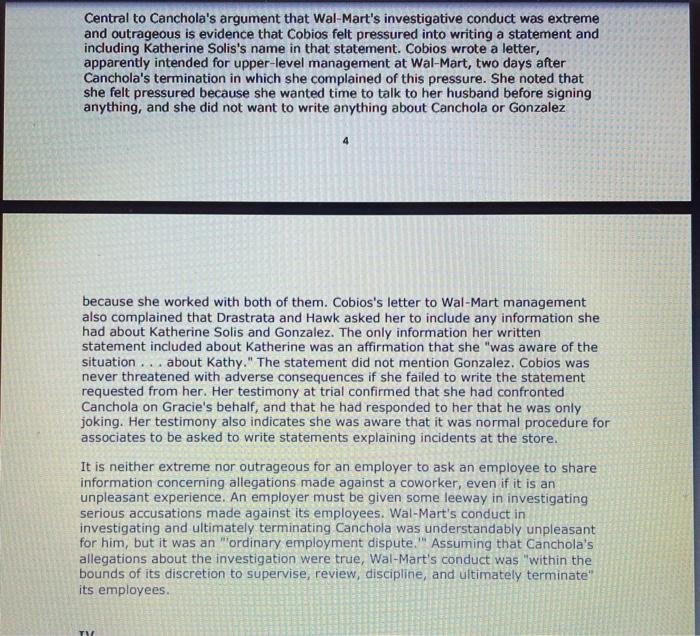
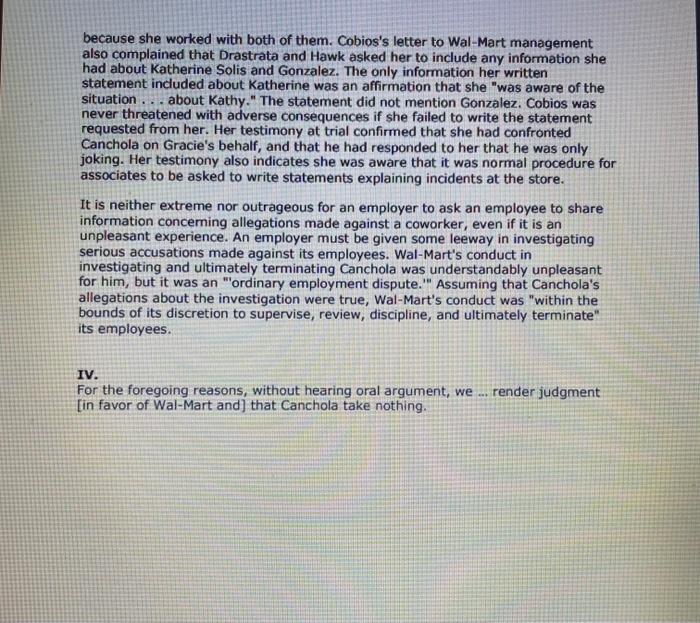
WAL-MART STORES, INC., PETITIONER V. LUIS A. CANCHOLA, RESPONDENT SUPREME COURT OF TEXAS OPINION [citations and footnotes omitted] Luis Canchola (after being discharged as an employee) sued Wal-Mart, his former employer, for disability discrimination and intentional Infliction of emotional distress. According to Wal-Mart, Canchola was terminated for violating the company's sexual harassment policies... I. Canchola was deli manager at the Wal-Mart Super Center store in Mission, Texas. According to his supervisors, the deli ran smoothly under his management and he was considered an excellent employee. In 1993, Canchola underwent sextuple bypass surgery that caused him to miss thirteen weeks of work. When he returned, he could do no heavy lifting and was limited to working only four hours per day. Over time, Canchola began increasing his work hours, but in April of 1994 a bypassed artery became occluded and he missed another month of work. He again returned to work at a reduced schedule of four hours per day. According to Canchola, Wal-Mart management was supportive during this time period and he continued to receive his full salary. In July of 1994, David Drastrata became the director of the Mission store. Drastrata was aware that Canchola had a medical condition that prevented him from working full time, although he did not recall when he learned that it was a heart condition. Canchola testified that Drastrata displayed a hostile attitude towards him, expressed dissatisfaction with his absence at managers' meetings, and asked him to rearrange his schedule so that he could attend the meetings. Drastrata and Canchola also had a disagreement about how to display deli items, leading Canchola to call the home office for support. Around this time, the deli department was written up for failing to rotate products and discard outdated products. In early August, management took photographs of expired deli items that Canchola claims were in the back of the deli awaiting disposal, and an assistant store manager told Canchola that someone was "out to get him." Canchola also testified that there were other occasions when he felt Drastrata acted angrily or unprofessionally towards him. On August 19, Irene Flores, a support manager, and Carmen Gonzalez, a part-time Employee in the deli department, came to Drastrata's office. Michael Hawks, the store manager in charge of the deli section, was also present. Flores reported that she had seen Canchola approach Gonzalez from behind, lean over her, and say something into her ear. She reported that when she asked Gonzalez about the On August 19, Irene Flores, a support manager, and Carmen Gonzalez, a part-time Employee in the dell department, came to Drastrata's office. Michael Hawks, the store manager in charge of the dell section, was also present. Flores reported that she had seen Canchola approach Gonzalez from behind, lean over her, and say something into her ear. She reported that when she asked Gonzalez about the Incident, Gonzalez immediately started crying. Translating for Gonzalez, Flores told Drastrata that Gonzalez had been trying to get a full-time position in the deli and 1 that Canchola had told her that he would only give her a full-time position if she "gave a piece of herself to him." Gonzalez also reported, through Flores, that Canchola frequently asked her out, waited for her after work to offer her a ride home, and told her that eventually she would be his. Drastrata asked Gonzalez if she was aware of anyone else who had knowledge of Canchola's behavior or had been sexually harassed by Canchola, and she gave him the names of two sisters, Gracie and Katherine Solis. Gonzalez was visibly shaken and crying during the meeting in Drastrata's office. Gonzalez and Flores both wrote and signed statements describing Gonzalez's complaints. Flores's statement also reports that Gonzalez said she was afraid of Canchola raping her. After this meeting, Drastrata and Hawks met with Canchola and informed him that he was being suspended pending an investigation of the harassment charge. Drastrata and Hawks then asked Gracie Solis about Canchola. She reported to them that he used to hug and kiss her on the sales floor and in front of customers. She also said that he repeatedly told her that he loved her and that he would leave his wife for her. She reported that after she told him to stop, he began to ask out her sister, Katherine. When they approached Katherine, she reported similar behavior. Both sisters wrote and signed statements about Canchola's conduct. Drastrata also interviewed other employees, but he did not take notes, nor did he obtain written statements from individuals with no knowledge of Canchola's alleged harassment. Toni Cobios, a female subordinate of Canchola's in the deli department, told Drastrata that Gracie had complained to her about Canchola's behavior. She testified that Gracie told her that she did not want to take her complaints to management because they would not believe her. Cobios testified that when she confronted Canchola about his behavior towards Gracie, he laughed and responded that it was just a joke. She also provided management with a written statement. After being interviewed by management, Cobios wrote a letter intended for upper After being interviewed by management, Coblos wrote a letter intended for upper level management at Wal-Mart's home office to complain that she had been pressured into including Katherine's name in her written statement. She wrote that she felt pressured because she had been asked to write a statement against her supervisor without the opportunity to discuss this with her husband. Drastrata sent the witness statements to Wal-Mart's home office for review by the legal department. The day following Gonzalez's complaint, Drastrata terminated Canchola. Canchola sued Wal-Mart for disability discrimination, age discrimination, and intentional Infliction of emotional distress. II. In conducting a legal sufficiency review, we must view the evidence in a light that tends to support the disputed finding and disregard evidence and inferences to the contrary. If more than a scintilla of evidence supports the challenged finding, the no evidence challenge must fail. Canchola sued Wal-Mart under the Texas Commission on Human Rights Act (TCHRA). The TCHRA prohibits an employer from discharging or in any other way discriminating against an employee because of the employee's disability... The Legislature intended to correlate state law with federal law in employment discrimination cases when it enacted the TCHRA. when a discrimination case has been fully tried on its merits, as in this case, a reviewing court does not engage in a burden shifting analysis. Instead, we inquire whether the evidence is legally sufficient to support the jury's ultimate finding. .. Canchola's .. (claims that his] disability discrimination was a motivating factor in Wal-Mart's decision to terminate him. Wal-Mart argues that there is no evidence that its stated reason for the termination was a pretext or that Canchola's disability was a motivating factor in his termination. Wal-Mart maintains that Canchola was discharged because of the sexual harassment charges lodged against him. Canchola, on the other hand, argues that Wal-Mart's investigation into the charges Heinsamente nadam dad Davidhata Canchola, on the other hand, argues that Wal-Mart's investigation into the charges against him was inadequate and one-sided, thus constituting some evidence that Wal-Mart was motivated by his disability. Canchola points to evidence that if Wal- Mart had conducted a more thorough and balanced investigation, it could have uncovered exculpatory evidence. For example, the evidence showed Gonzalez had turned down a full-time job in another department even though it offered better benefits than those in the deli department. And after a gap in her tenure at Wal- Mart, Gonzalez returned to work in the deli department despite alleging that she had been harassed by Canchola in her previous tenure there. Drastrata's investigation did not reveal any of this information. The investigation did reveal, but Canchola claims Wal-Mart failed to adequately consider, statements from other employees who put little faith in the Solis sisters' accusations or who had never personally seen Canchola engage in harassing behavior. Canchola additionally cites testimony by Cobios that Gonzalez had a crush on several other employees and dressed provocatively. Canchola also argues that Gracie Solis's testimony was inconsistent and perhaps embellished. Finally, Canchola argues that Wal-Mart did not apply its harassment policy uniformly, citing evidence that a non-salaried employee at a different location was demoted rather than terminated after being accused of harassment. The evidence that Canchola cites, however, assails the quality of Wal-Mart's investigation and does not, by itself, prove that Canchola's heart condition was a motivating factor in his termination. An at-will employer does not incur liability for carelessly forming its reasons for termination. As long as its reason for terminating Canchola was not illegal, Wal-Mart could have fired Canchola, an at-will employee, for his failure to remove out-dated products from the deli, or for the sexual harassment accusations made against him, or for no reason at all. Although Wal Mart could have terminated Canchola without investigating the charges against him, we have encouraged employers to investigate complaints made against employees before deciding to fire them by refusing to second-guess the results of such investigations whenever they are imperfect. Thus, it is not sufficient for Canchola to present evidence that the harassment investigation was imperfect, incomplete, or arrived at a possibly incorrect conclusion. He must show that the reason proffered by Wal-Mart is "false, and that discrimination was the real reason 3 Canchola has cited no evidence to show that Wal-Mart's decision to discharge Canchola was motivated by his disability. ...But even if the reasons Wal-Mart cited for terminating Canchola were false, he still bore the ultimate burden to prove that Wal-Mart discriminated against him because of his disability. The relevant inquiry is not whether the complaints made against Canchola were a pretext, but what they were a pretext for. Canchola offered no evidence to show that Wal-Mart management was motivated to terminate him because of his heart condition. We conclude that there is no legally sufficient evidence to support the jury's finding of disability discrimination. III. In order to recover damages for intentional infliction of emotional distress, a plaintiff must establish that "(1) the defendant acted intentionally or recklessly; (2) the defendant's conduct was extreme and outrageous; (3) the defendant's actions caused the plaintiff emotional distress; and (4) the emotional distress suffered by the plaintiff was severe." To be extreme and outrageous, a defendant's conduct must be "so outrageous in character, and so extreme in degree, as to go beyond all possible bounds of decency, and to be regarded as atrocious, and utterly intolerable in a civilized community." Conduct that is merely insensitive or rude is not extreme and outrageous, nor are "mere insults, indignities, threats, annoyances, petty oppressions, or other trivialities." Only when reasonable minds may differ is it for the jury to determine whether conduct has been sufficiently extreme and outrageous to result in liability... A claim for intentional infliction of emotional distress does not lie for "ordinary employment disputes. Only "in the most unusual of circumstances" is conduct so extreme and outrageous that it is removed from the realm of ordinary employment disputes. The wrongful "termination of an employee does not, standing alone, constitute intentional infliction of emotional distress." Wal-Mart argues that the investigation into the charges made against Canchola and his subsequent termination amounted to an "ordinary business dispute" and were not extreme and outrageous conduct as a matter of law. We agree. Canchola's evidence that the investigation was imperfect and that he did not get along with Drastrata is not enough to support liability Rather the conduct itself must be extreme and outrageous. Wal-Mart's alleged failure to sufficiently pursue potentially exculpatory evidence was neither extreme nor outrageous Central to Canchola's argument that Wal-Mart's investigative conduct was extreme and outrageous is evidence that Cobios felt pressured into writing a statement and including Katherine Solis's name in that statement. Cobios wrote a letter, apparently intended for upper-level management at Wal-Mart, two days after Canchola's termination in which she complained of this pressure. She noted that she felt pressured because she wanted time to talk to her husband before signing anything, and she did not want to write anything about Canchola or Gonzalez 4 because she worked with both of them. Cobios's letter to Wal-Mart management also complained that Drastrata and Hawk asked her to include any information she had about Katherine Solis and Gonzalez. The only information her written statement included about Katherine was an affirmation that she was aware of the situation ... about Kathy." The statement did not mention Gonzalez. Cobios was never threatened with adverse consequences if she failed to write the statement requested from her. Her testimony at trial confirmed that she had confronted Canchola on Gracie's behalf, and that he had responded to her that he was only joking. Her testimony also indicates she was aware that it was normal procedure for associates to be asked to write statements explaining incidents at the store. It is neither extreme nor outrageous for an employer to ask an employee to share information concerning allegations made against a coworker, even if it is an unpleasant experience. An employer must be given some leeway in investigating serious accusations made against its employees. Wal-Mart's conduct in investigating and ultimately terminating Canchola was understandably unpleasant for him, but it was an "ordinary employment dispute. Assuming that Canchola's allegations about the investigation were true, Wal-Mart's conduct was "within the bounds of its discretion to supervise, review, discipline, and ultimately terminate" its employees TY because she worked with both of them. Cobios's letter to Wal-Mart management also complained that Drastrata and Hawk asked her to include any information she had about Katherine Solis and Gonzalez. The only information her written statement included about Katherine was an affirmation that she "was aware of the situation ... about Kathy." The statement did not mention Gonzalez. Cobios was never threatened with adverse consequences if she failed to write the statement requested from her. Her testimony at trial confirmed that she had confronted Canchola on Gracie's behalf, and that he had responded to her that he was only joking. Her testimony also indicates she was aware that it was normal procedure for associates to be asked to write statements explaining incidents at the store. It is neither extreme nor outrageous for an employer to ask an employee to share information concerning allegations made against a coworker, even if it is an unpleasant experience. An employer must be given some leeway in investigating serious accusations made against its employees. Wal-Mart's conduct in investigating and ultimately terminating Canchola was understandably unpleasant for him, but it was an "ordinary employment dispute. Assuming that Canchola's allegations about the investigation were true, Wal-Mart's conduct was "within the bounds of its discretion to supervise, review, discipline, and ultimately terminate" its employees IV. For the foregoing reasons, without hearing oral argument, we ... render judgment [in favor of Wal-Mart and) that Canchola take nothing
Step by Step Solution
There are 3 Steps involved in it
1 Expert Approved Answer
Step: 1 Unlock

Question Has Been Solved by an Expert!
Get step-by-step solutions from verified subject matter experts
Step: 2 Unlock
Step: 3 Unlock