Question: III Chapter 9, Problem 26P 1 Bookmark Show all steps: ON To the left of the following problems (or their parts), we have inserted the
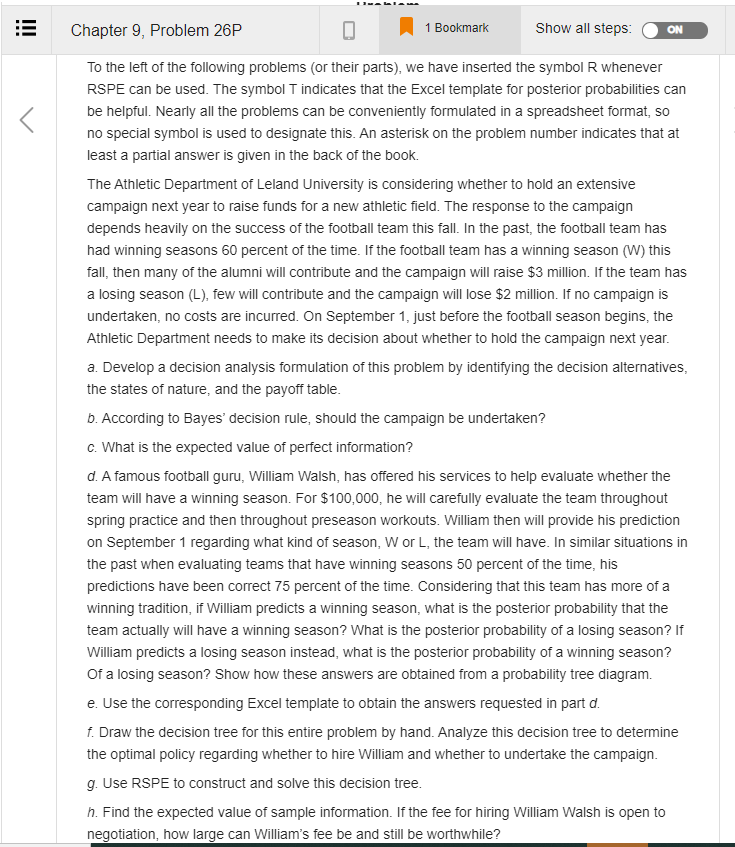
III Chapter 9, Problem 26P 1 Bookmark Show all steps: ON To the left of the following problems (or their parts), we have inserted the symbol R whenever RSPE can be used. The symbol T indicates that the Excel template for posterior probabilities can be helpful. Nearly all the problems can be conveniently formulated in a spreadsheet format, so no special symbol is used to designate this. An asterisk on the problem number indicates that at least a partial answer is given in the back of the book. The Athletic Department of Leland University is considering whether to hold an extensive campaign next year to raise funds for a new athletic field. The response to the campaign depends heavily on the success of the football team this fall. In the past, the football team has had winning seasons 60 percent of the time. If the football team has a winning season (W) this fall, then many of the alumni will contribute and the campaign will raise $3 million. If the team has a losing season (L), few will contribute and the campaign will lose $2 million. If no campaign is undertaken, no costs are incurred. On September 1, just before the football season begins, the Athletic Department needs to make its decision about whether to hold the campaign next year. a. Develop a decision analysis formulation of this problem by identifying the decision alternatives, the states of nature, and the payoff table. b. According to Bayes' decision rule, should the campaign be undertaken? c. What is the expected value of perfect information? d. A famous football guru, William Walsh, has offered his services to help evaluate whether the team will have a winning season. For $100,000, he will carefully evaluate the team throughout spring practice and then throughout preseason workouts. William then will provide his prediction on September 1 regarding what kind of season, W or L, the team will have. In similar situations in the past when evaluating teams that have winning seasons 50 percent of the time, his predictions have been correct 75 percent of the time. Considering that this team has more of a winning tradition, if William predicts a winning season, what is the posterior probability that the team actually will have a winning season? What is the posterior probability of a losing season? If William predicts a losing season instead, what is the posterior probability of a winning season? Of a losing season? Show how these answers are obtained from a probability tree diagram. e. Use the corresponding Excel template to obtain the answers requested in part d. f. Draw the decision tree for this entire problem by hand. Analyze this decision tree to determine the optimal policy regarding whether to hire William and whether to undertake the campaign. g. Use RSPE to construct and solve this decision tree. h. Find the expected value of sample information. If the fee for hiring William Walsh is open to negotiation, how large can William's fee be and still be worthwhile









 Study Help