







Question: 'III E myopenmathcom C r r ill 0 Question 6 v a 0/1 pt '0 5 Q 4 G) Details 0 taught warning in the
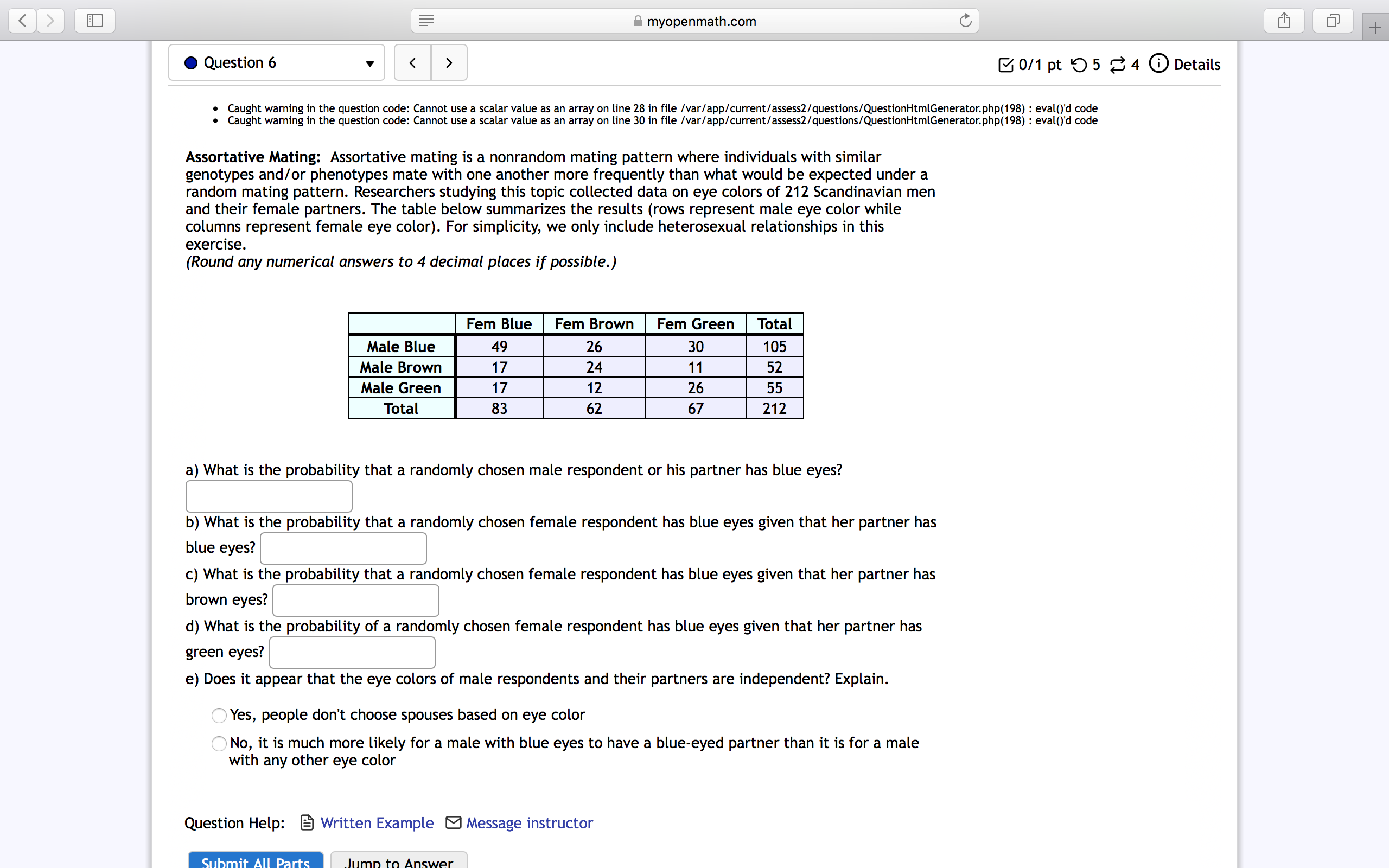
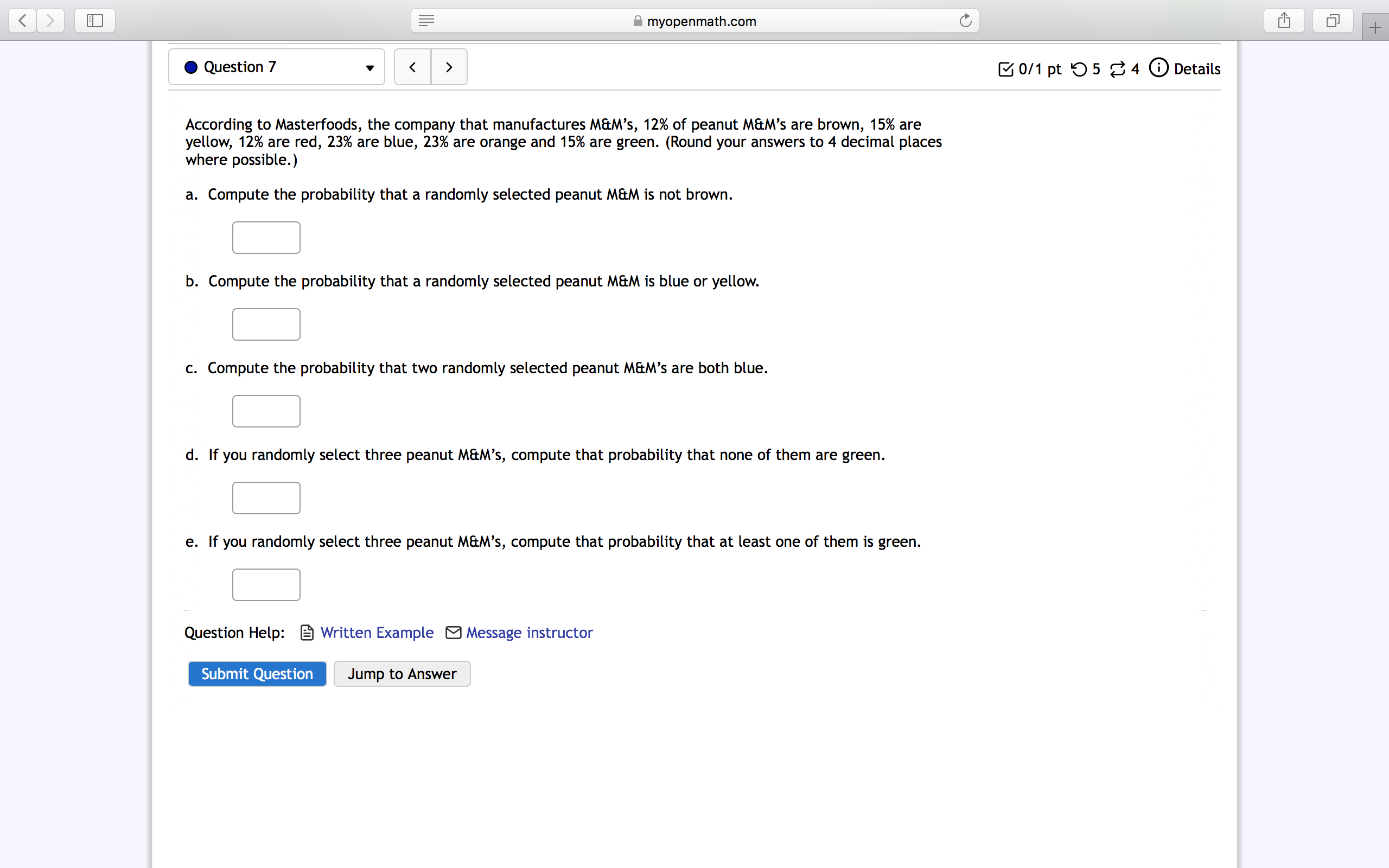
'III E myopenmathcom C r r ill 0 Question 6 v a 0/1 pt '0 5 Q 4 G) Details 0 taught warning in the question code: fannot use a scalar value as an array on line 28 in file Ivar/app/currentlassessZ/questionleuestionHtmlGeneramnphpU98) : eval()'d code 0 Caught warning in the question code: Cannot use a scalar value as an array on line 30 in file /varlapp/current/assessZlquestionleuestionHtmlGeneramnphp98) : eval()'d code Assortative Mating: Assortative mating is a nonrandom mating pattern where individuals with similar genotypes and/or phenotypes mate with one another more frequently than what would be expected under a random mating pattern. Researchers studying this topic collected data on eye colors of 212 Scandinavian men and their female partners. The table below summarizes the results (rows represent male eye color while columns represent female eye color). For simplicity, we only include heterosexual relationships in this exercrse. (Round any numerical answers to 4 decimal places if possible.) Fem Brown Male Blue Male Brown 52 Male Green 55 Total 212 a) What is the probability that a randomly chosen male respondent or his partner has blue eyes? b) What is the probability that a randomly chosen female respondent has blue eyes given that her partner has c) What is the probability that a randomly chosen female respondent has blue eyes given that her partner has d) What is the probability of a randomly chosen female respondent has blue eyes given that her partner has green eyes? e) Does it appear that the eye colors of male respondents and their partners are independent? Explain. '7 Yes, people don't choose spouses based on eye color \"f No, it is much more likely for a male with blue eyes to have a blue-eyed partner than it is for a male with any other eye color Question Help: lg Written Example 8 Message instructor - n '. a Jumn to Answer _E myopenmathcom Cl l l'i'l l UP] I o Question7 v l 30/1 pt '0 5 Z 4 G) Details According to Masterfoods, the company that manufactures M&M's, 12% of peanut M&M's are brown, 15% are yellow, 12% are red, 23% are blue, 23% are orange and 15% are green. (Round your answers to 4 decimal places where possible.) a. Compute the probability that a randomly selected peanut M&M is not brown. b. Compute the probability that a randomly selected peanut M&M is blue or yellow. c. Compute the probability that two randomly selected peanut M&M's are both blue. d. If you randomly select three peanut M&M's, compute that probability that none of them are green. e. If you randomly select three peanut M&M's, compute that probability that at least one of them is green. Question Help: [Q Written Example 8 Message instructor _l umpAnstowe l
Step by Step Solution
There are 3 Steps involved in it

Get step-by-step solutions from verified subject matter experts
 Study Help