Question: il cricket VPN 4:48 PM 62% Case Study 2: Attempt 1 Students, Read the following case study and examples of addressing the complicating factors that
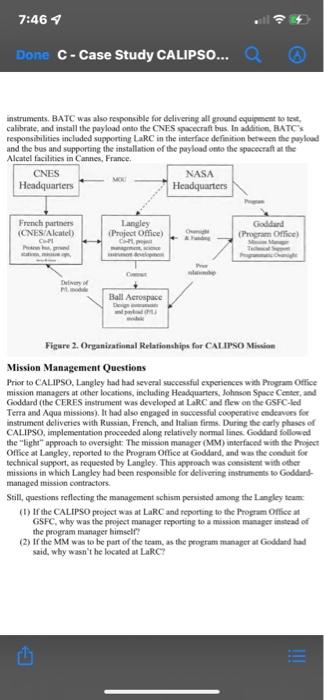
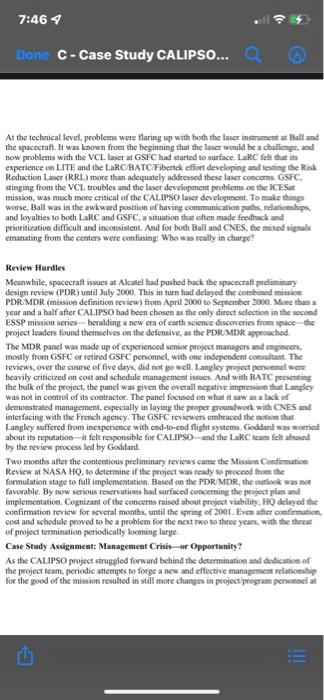
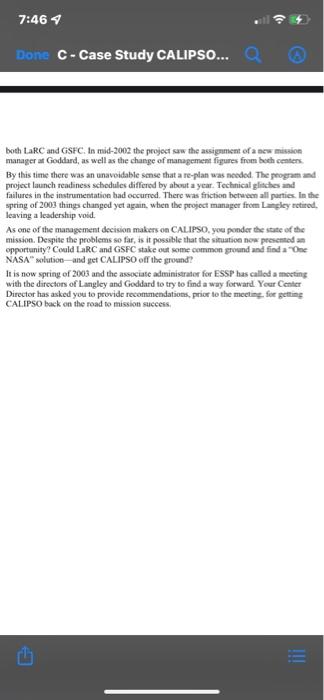
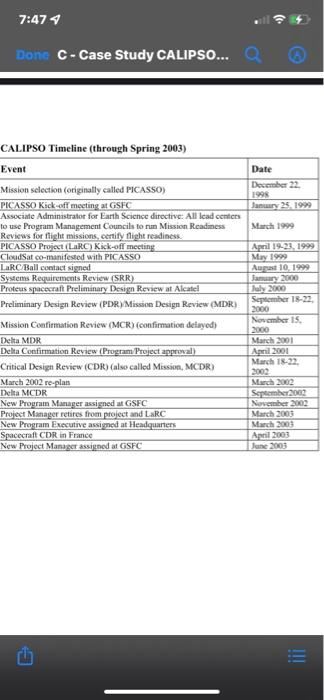
il cricket VPN 4:48 PM 62% Case Study 2: Attempt 1 Students, Read the following case study and examples of addressing the complicating factors that exists in this project in a two- page single space paper. Provide references where applicable. This paper needs to be written in 12-point New Times Roman. This assignment is due on 2/23/2020 at 10:00PM CST. 7:46 Done C- Case Study CALIPSO... Q Case Study #2 CALIPSO: Management Challenges within a Complex Project Structure Background The CALIPSO (Cloud Aerosol Lidar and Infrared Pathfinder Satellite Observations)mission was designed as a pioneering tool for observing and measuring clouds and aerosols, tiny airborne particles. A better understanding of the role of clouds and aerosols has many applications, from pollution control to weather forecasting CALIPSO was a joint project between NASA and the French space agency CNES The Origins of CALIPSO The CALIPSO mission was proposed by Langley Research Center (LaRC) in 1998 for NASA's second series of missions in the Earth System Science Pathfinder (ESSP) program. The CALIPSO lidar instrument was the maturation of a 1993 Shuttle attached instrument experiment called LITE Figure 1. CALIPSO/CloudSat Contrasting Views of Project Management CALIPSO (first named PICASSO) originated when NASA was in the early stages of the Principal Investigator (Pl) mode of project management approach advocated by Agency Administrator Dan Goldin. The promise was that the Pls chosen to lead future space science missions would have complete responsibility for the mission with minimum project guidance or involvement from NASA There were two schools of thought about this new direction. One held that the P1 mode would lead to increased competition among NASA centers, ultimately benefiting the overall NASA mission Specifically, it would develop project management capabilities outside of Goddard Space Flight Center (GSFC) and Jet Propulsion Laboratory (PL), the two centers that did the majority of robotic space flight missions in the agency The other camp argued that only GSFC and JPL should do flight missions all missions, in this view, should go through one of these two centers if only because replication of project management capabilities was too costly elsewhere. CALIPSO, though proposed by Langley and with the Pl from that center, was funded through Goddard's ESSP Program Office (like all other ESSP missions in the ESSP program). Based on the emerging Pt mode, however, the Program Office was expected to TI 7:46 Done C- Case Study CALIPSO...Q apply only light touch management to the mission, allowing the Pland his team to manage the mission. This was in accord with the ESSP announcement of opportunity "The Principal Investigator and mission team will have full responsibility for all aspects of the mission, including instrument and spacecraft definition development, integration, and test, launch services (if acquired by mission team) or mission launch interfaces (if launch service is NASA providedkground system, science operation, mission operations, and data processing and distribution. It is the intent of NASA to give the P and the mission team the ability to use their own processes, procedures, and methods to the fullest extent possible." Defining Roles and Responsibilities Despite the AO, the centers running CALIPSO had different positions on project management. At LaRC, the director was interested in Langley gaining the capability for full fight mission project management. Further, as funding for Aeronautics was going down, Langley saw Earth Science as a growing pice in its budget pie The director wanted to bypass the Program Office at GSFC and report directly to NASA Headquarters and in fact requested this many times, with the logic that LRC deserved the chance to prove itself in flight mission project management just as sthad over the years for flight instrument management. The GSFC director took the position that only GSFC and IPL should be doing flight missions because of their proven management capability. In support of this view was the fact that LaRC had not managed a full flight mission since the Viking mission to Mars in the 1970s. All of this was in the era of "Faster, Better, Cheaper, a government-wide approach intended to make the federal government more efficient in its use of taxpayer dollars NASA HQ defined the roles and responsibilities as follows: Langley would serve as Mission Office, responsible for development of the science instrument, and Goddard would provide high-level technical and programmatic oversight with a light touch- through the Program Office and in its role as the lead center The project structure was not restricted to NASA. The winning CALIPSO proposal included a partnership with the French space agency Centre National d'Etudes Spatiales (CNES). with a co-principal investigator (co-Pl) from the Simon Laplace Institution Through the NASA CNES Memorandum of Understanding (MOU) CNES was responsible for providing a number of components and services the ground stations, mission operations, tracking, and the assembly, integration, and test of the payload to the spacecraft bus. In addition, the French agency was responsible for one of the three science instruments (the imaging infrared radiometer, built by Sodern) and for providing the Proteus spacecraft bus, built by the French firm Alcatel Also on the team was Ball Aerospace & Technologies Corp. (BATC). Together with Langley, BATC would design and build the CALIPSO lidar-the primary instrumento the satellite, in addition, the firm was contracted to deliver a wide-field camera The Ball facility in Boulder, Colorado, was the location for the integration of all three science TI 7:46 Done C - Case Study CALIPSO... instruments. BATC was also responsible for delivering all ground equipment to test calibrate, and install the payload onto the CNES spacecraft bus. In addition, BATC responsibilities included supporting LRC in the interface definition between the payload and the bus and supporting the installation of the payload onto the spacecraft at the Alcatel facilities in Cannes, France CNES NASA Headquarters Headquarters French partners (CNES Alcatel C Langley (Project Office) Goddard (Program Office . Duit Ball Aerospace Figure 2. Organisational Relationships for CALIPSO Mission Mission Management Questions Prior to CALIPSO. Langley had had several successful experiences with Program Office mission managers at other locations, including Headquarters, Johnson Space Center, and Goddard (the CERES instrument was developed LRC and flew on the GSFC-led Terra and Aqua missions). It had also engaged in successful cooperative endeaves for instrument deliveries with Russian, French, and Italian firms. During the carly phases of CALIPSO, implementation proceeded along relatively normal lines. Goddard followed the "light" approach to oversight: The mission manager (MM) interfaced with the Project Office at Langky, reported to the Program Office at Goddard, and was the conduit for technical support, as requested by Langley. This approach was consistent with other missions in which Langley had been responsible for delivering instruments to Goddard managed mission contractors Still, questions reflecting the management schism persisted among the Langley team (1) If the CALIPSO project was at LaRC and reporting to the Program Office at GSFC, why was the project manager reporting to a mission manager instead of the program manager himself? (2) If the MM was to be part of the team, as the program manager at Goddard Sad said, why wasn't he located at LaRC? 7:46 Done C- Case Study CALIPSO... (3) In fact, why have a mission manager at all? The MM's only function was a link between the program manager at GSFC) and the project manager (at LRC) what was his purpose? (4) Wasn't the Pl mode supposed to let the PI run the missionWhat did the original AO mean when one center has program responsibility and another has project responsibility Members of the Goddard team also had questions that troubled them (1) How were they supposed to provide oversight when they didn't know what all of the partners and contractors were doing? (2) How could they be expected to be responsible for mission management if they did not have authority to manage the overall schedule, and had no confidence in the schedule LaRC put forth? (3) What was the overall responsibility split between the Program Office GSFC and the Project Office at LaRC? What was the role of the lead center (4) Who was HQ holding accountable for mission success? Why wouldn't HQ clarity the roles and responsibilities! Meanwhile, the LRC team was having a tough time getting the BATC contract in place Then, in the spring of 1999, the Associate Administrator for Earth Scienceescada directive that lead centers should take responsibility for running mission readiness reviews (MRRs) and certifying flight readiness. In this light, the GSFC head felt it was even more necessary for Goddard personnel to be involved in the missionssentially, to have more oversight if they were going to be held accountable for the mission Now it appeared that two organizations, Langley and Goddard, were equally responsible for the CALIPSO mission Mounting Mistrust Following the new directive from HQ, an increasingly large shadow team at GSFC had begun to mirror the work at Langley, to give GSFC confidence in the technical approaches being taken. While the feeling at LRC was, "They don't trust wat Goddard there was a sense among some managers that Langley was keeping them in the dark. And within Langley, some team members felt that they didn't have the complete support of their upper management--and wondered whether some senior managers in fact didn't really want to get into mission management at all. Still, despite the frustration with the way the program was being managed, many of the LRC and GSFC team members were working well together and maintaining good relationship Personnel both centers put much of the blame on Headquarters In the international component, the US International Trafficking in Arms Regulation (ITAR) was making the interfaces with the French partner very difficult Under ITAR restrictions, LaRC found it hard to share information with the CNES Alcatel team, and a times CNES Alcatel representatives were required to leave project meetings when ITAR- sensitive material was covered. The French were alternately frustrated and insulted as a result. CNES refused to provide some reciprocal information when requested li 7:46 4 Done C- Case Study CALIPSO...a At the technical level. problems were flaring up with both the laser instrument at Balland the spacecraft. It was known from the beginning that the laser would be a challenge, and now problems with the VCL laser at GSFC had started to surface. LaRC felt that its experience on LITE and the LRC BATC Fibenick effort developing and testing the Risk Roduction Laser (RR) more than adequately addressed these laser concerns. GSFC, stinging from the VCL troubles and the laser development problems on the ICES mission, was much more critical of the CALIPSO laser development. To make things worse, Ball was in the awkward position of having communication path relationships and loyalties to both LaRC and GSFC, a situation that often made feedback and prioritization difficult and inconsistent. And for both Ball and CNES, the mixed signals emanating from the centers were confusing: Who was really in charge! Review Hurdles Meanwhile, spacecraft issues at Alcatel had pushed back the spacecraft preliminary design review (PDR) until July 2000. This in turn had delayed the combined mission PDR/MDR (mission definition review) from April 2000 to September 2000. More than a year and a half after CALIPSO had been chosen as the only direct selection in the second ESSP mission series - heralding a new era of carth science discoveries from space the project leaders found themselves on the defensive, as the PDR MDR approached The MDR panel was made up of experienced senior project managers and engineers mostly from GSFC or retired GSFC personnel, with one independent consultant. The reviews, over the course of five days, did not go well. Langley project personnel were heavily criticized on cost and schedule management issues. And with BATC presenting the bulk of the project, the panel was given the overall negative impression that Langley was not in control of its contractor. The panel focused on what it saw as a lack of demonstrated management, especially in laying the proper groundwork with CNES interfacing with the French agency. The GSFC reviewers embraced the nation that Langley suffered from inexperience with end-to-end flight systems. Goddard was worried about its reputation--it felt responsible for CALIPSO and the LaRC teamfelt abused by the review process led by Goddard. Two months after the contentious preliminary reviews came the Mission Confirmation Review at NASA HQ, to determine if the project was ready to proceed from the formulation stage to full implementation Based on the PDR/MDR, the outlook was mee favorable. By now serious reservations had surfaced concerning the project plan and implementation. Cognizant of the concerns raised about project viability, HQ delayed the confirmation review for several months, until the spring of 2001. Even after confirmation cost and schedule proved to be a problem for the next two to three years, with the threat of project termination periodically looming large Case Study Assignment: Management Crisis-or Opportunity? As the CALIPSO project struggled forward behind the determination and dedication of the project team, periodic attempts to forge a new and effective management relationship for the good of the mission resulted in still more changes in project program personnel at 7:46 Done C - Case Study CALIPSO...a both LRC and GSFC. In mid-2002 the project saw the assignment of a new mission manager at Goddard, as well as the change of management figures from both center By this time there was an unavoidable sense that a re-plan was needed. The program and project launch readiness schedules differed by about a year. Technical glitches and failures in the instrumentation bad occurred. There was friction between all parties. In the spring of 2003 things changed yet again when the project manager from Langley retired leaving a leadership void. As one of the management decision makers on CALIPSO you pender the state of the mission. Despite the problems so far, is it possible that the situation now presented opportunity? Could LRC and GSFC stake out some common ground and find a "One NASA solution and get CALIPSO off the ground? It is now spring of 2003 and the associate administrator for ESSP has called a meeting with the directors of Langley and Goddard to try to find a way forward Year Center Director has asked you to provide recommendations, prior to the meeting, for getting CALIPSO back on the road to mission success a 7:47 Done C- Case Study CALIPSO...a Date December 22 1995 January 25 1999 March 1999 CALIPSO Timeline (through Spring 2003) Event Mission selection (originally called PICASSO) PICASSO Kick off meeting at GSFC Associate Administrator for Earth Science directive: All lead centers to use Program Management Councils to na Mission Readiness Reviews for flight missions, certify flight readiness PICASSO Project (LRC) Kick-off meeting CloudSat co-manifested with PICASSO LaRC Ball contact signed System Requirements Review (SRR) Proteus spacecraft Preliminary Design Review at Alcate! Preliminary Design Review (PDR)/Mission Design Review (MDR) Mission Confirmation Review (MCR) (confirmation delayed) Delta MDR Delta Confirmation Review (Program Project approval Critical Design Review (CDR) (also called Mission, MCDR) March 2002 re-plan Delta MCDR New Program Manager assigned at GSFC Project Manager retires from project and LRC New Program Executive assigned at Headquarters Spacecraft CDR in France New Project Manager assigned at GSFC Al 19-20. 1999 May 1999 Aug 10.1991 January 2000 July 2000 September 18-22 2000 November 15, 2000 March 2001 April 2008 March 18-22 2002 March 2002 September 2009 November 2002 March 2003 March 2001 April 2003 June 2009 ci DIE










 Study Help