Question: ilings Review View t t OFF Track Changes All Markup Markup Options = Reviewing x Reject New Comment Delete Resolve Accept improvements, choose Check for
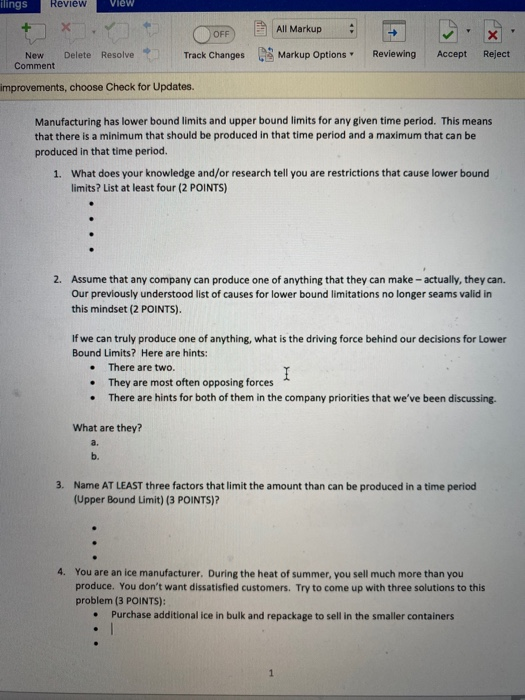
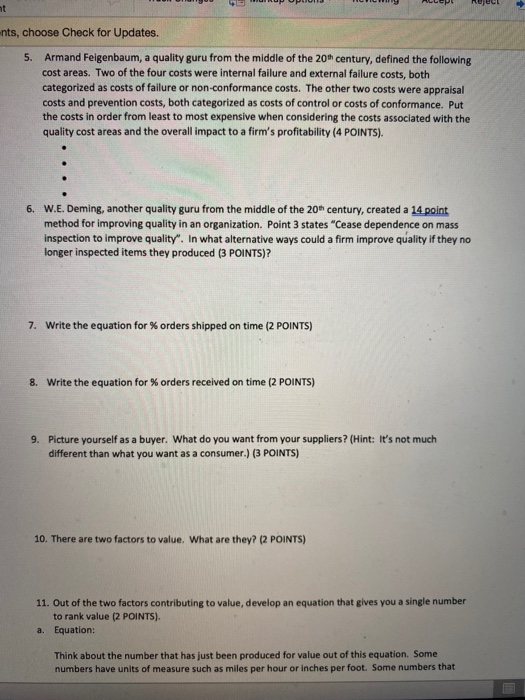
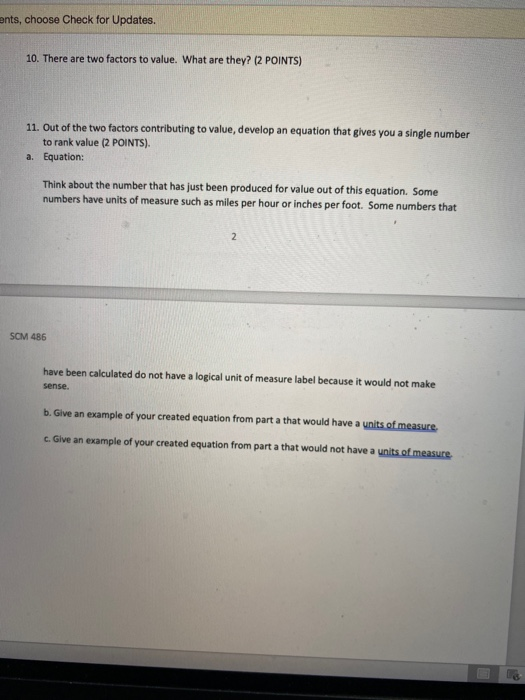
ilings Review View t t OFF Track Changes All Markup Markup Options = Reviewing x Reject New Comment Delete Resolve Accept improvements, choose Check for Updates. Manufacturing has lower bound limits and upper bound limits for any given time period. This means that there is a minimum that should be produced in that time period and a maximum that can be produced in that time period. 1. What does your knowledge and/or research tell you are restrictions that cause lower bound limits? List at least four (2 POINTS) 2. Assume that any company can produce one of anything that they can make - actually, they can. Our previously understood list of causes for lower bound limitations no longer seams valid in this mindset (2 POINTS). If we can truly produce one of anything, what is the driving force behind our decisions for Lower Bound Limits? Here are hints: There are two. They are most often opposing forces There are hints for both of them in the company priorities that we've been discussing. What are they? 3. Name AT LEAST three factors that limit the amount than can be produced in a time period (Upper Bound Limit) (3 POINTS)? 4. You are an ice manufacturer. During the heat of summer, you sell much more than you produce. You don't want dissatisfied customers. Try to come up with three solutions to this problem (3 POINTS): Purchase additional ice in bulk and repackage to sell in the smaller containers Allepi Reel nts, choose Check for Updates. 5. Armand Feigenbaum, a quality guru from the middle of the 20th century, defined the following cost areas. Two of the four costs were internal failure and external failure costs, both categorized as costs of failure or non-conformance costs. The other two costs were appraisal costs and prevention costs, both categorized as costs of control or costs of conformance. Put the costs in order from least to most expensive when considering the costs associated with the quality cost areas and the overall impact to a firm's profitability (4 POINTS). 6. W.E. Deming, another quality guru from the middle of the 20th century, created a 14 point method for improving quality in an organization. Point 3 states "Cease dependence on mass inspection to improve quality". In what alternative ways could a firm improve quality if they no longer inspected items they produced (3 POINTS)? 7. Write the equation for % orders shipped on time (2 POINTS) 8. Write the equation for % orders received on time (2 POINTS) 9. Picture yourself as a buyer. What do you want from your suppliers? (Hint: It's not much different than what you want as a consumer.) (3 POINTS) 10. There are two factors to value. What are they? (2 POINTS) 11. Out of the two factors contributing to value, develop an equation that gives you a single number to rank value (2 POINTS). a. Equation: Think about the number that has just been produced for value out of this equation. Some numbers have units of measure such as miles per hour or inches per foot. Some numbers that ents, choose Check for Updates. 10. There are two factors to value. What are they? (2 POINTS) 11. Out of the two factors contributing to value, develop an equation that gives you a single number to rank value (2 POINTS). a. Equation: Think about the number that has just been produced for value out of this equation. Some numbers have units of measure such as miles per hour or inches per foot. Some numbers that SCM 486 have been calculated do not have a logical unit of measure label because it would not make sense. b. Give an example of your created equation from part a that would have a units of measure c. Give an example of your created equation from part a that would not have a units of measure ilings Review View t t OFF Track Changes All Markup Markup Options = Reviewing x Reject New Comment Delete Resolve Accept improvements, choose Check for Updates. Manufacturing has lower bound limits and upper bound limits for any given time period. This means that there is a minimum that should be produced in that time period and a maximum that can be produced in that time period. 1. What does your knowledge and/or research tell you are restrictions that cause lower bound limits? List at least four (2 POINTS) 2. Assume that any company can produce one of anything that they can make - actually, they can. Our previously understood list of causes for lower bound limitations no longer seams valid in this mindset (2 POINTS). If we can truly produce one of anything, what is the driving force behind our decisions for Lower Bound Limits? Here are hints: There are two. They are most often opposing forces There are hints for both of them in the company priorities that we've been discussing. What are they? 3. Name AT LEAST three factors that limit the amount than can be produced in a time period (Upper Bound Limit) (3 POINTS)? 4. You are an ice manufacturer. During the heat of summer, you sell much more than you produce. You don't want dissatisfied customers. Try to come up with three solutions to this problem (3 POINTS): Purchase additional ice in bulk and repackage to sell in the smaller containers Allepi Reel nts, choose Check for Updates. 5. Armand Feigenbaum, a quality guru from the middle of the 20th century, defined the following cost areas. Two of the four costs were internal failure and external failure costs, both categorized as costs of failure or non-conformance costs. The other two costs were appraisal costs and prevention costs, both categorized as costs of control or costs of conformance. Put the costs in order from least to most expensive when considering the costs associated with the quality cost areas and the overall impact to a firm's profitability (4 POINTS). 6. W.E. Deming, another quality guru from the middle of the 20th century, created a 14 point method for improving quality in an organization. Point 3 states "Cease dependence on mass inspection to improve quality". In what alternative ways could a firm improve quality if they no longer inspected items they produced (3 POINTS)? 7. Write the equation for % orders shipped on time (2 POINTS) 8. Write the equation for % orders received on time (2 POINTS) 9. Picture yourself as a buyer. What do you want from your suppliers? (Hint: It's not much different than what you want as a consumer.) (3 POINTS) 10. There are two factors to value. What are they? (2 POINTS) 11. Out of the two factors contributing to value, develop an equation that gives you a single number to rank value (2 POINTS). a. Equation: Think about the number that has just been produced for value out of this equation. Some numbers have units of measure such as miles per hour or inches per foot. Some numbers that ents, choose Check for Updates. 10. There are two factors to value. What are they? (2 POINTS) 11. Out of the two factors contributing to value, develop an equation that gives you a single number to rank value (2 POINTS). a. Equation: Think about the number that has just been produced for value out of this equation. Some numbers have units of measure such as miles per hour or inches per foot. Some numbers that SCM 486 have been calculated do not have a logical unit of measure label because it would not make sense. b. Give an example of your created equation from part a that would have a units of measure c. Give an example of your created equation from part a that would not have a units of measure