







Question: I'll give down vote please do not solve AI based solution, I genuinely need for my research paper, I need solution based on knowledge, I
I'll give down vote please do not solve AI based solution, I genuinely need for my research paper, I need solution based on knowledge, I need complete Calculation , Certainly! Let's modify the question by including specific numerical data that participants will use in their calculations.
### Modified Question: Calculating the Trajectory and Impact of an Interstellar Object on a Planet
#### Background: Participants are tasked with analyzing the trajectory of a newly discovered interstellar object (e.g., a comet) and determining its potential impact on a fictional planet in a distant solar system.
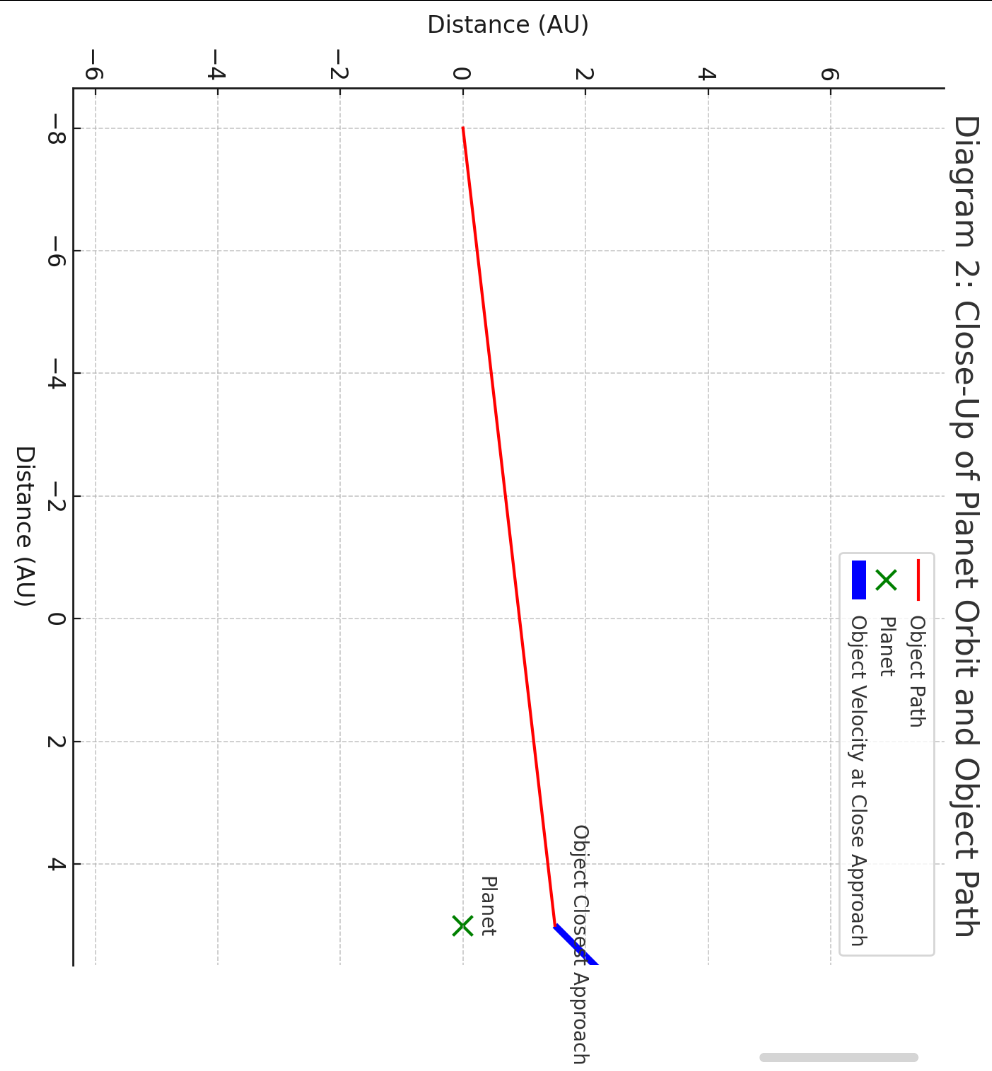
#### Data and Diagrams Provided: 1. **Diagram 1**: Solar System Layout with the Object's Initial Trajectory. 2. **Diagram 2**: Close-Up View of the Planet's Orbit and the Object's Path. 3. **Numerical Data**: - Mass of the interstellar object: \(5 \times 10^{12}\) kg - Initial velocity of the object: \(30,000\) m/s - Distance of the planet from its star: \(1.5 \times 10^{11}\) meters (1 AU) - Mass of the planet: \(6 \times 10^{24}\) kg - Diameter of the planet: \(12,742\) km - Gravitational constant: \(6.674 \times 10^{-11}\) N\(\)m\(^2\)/kg\(^2\)
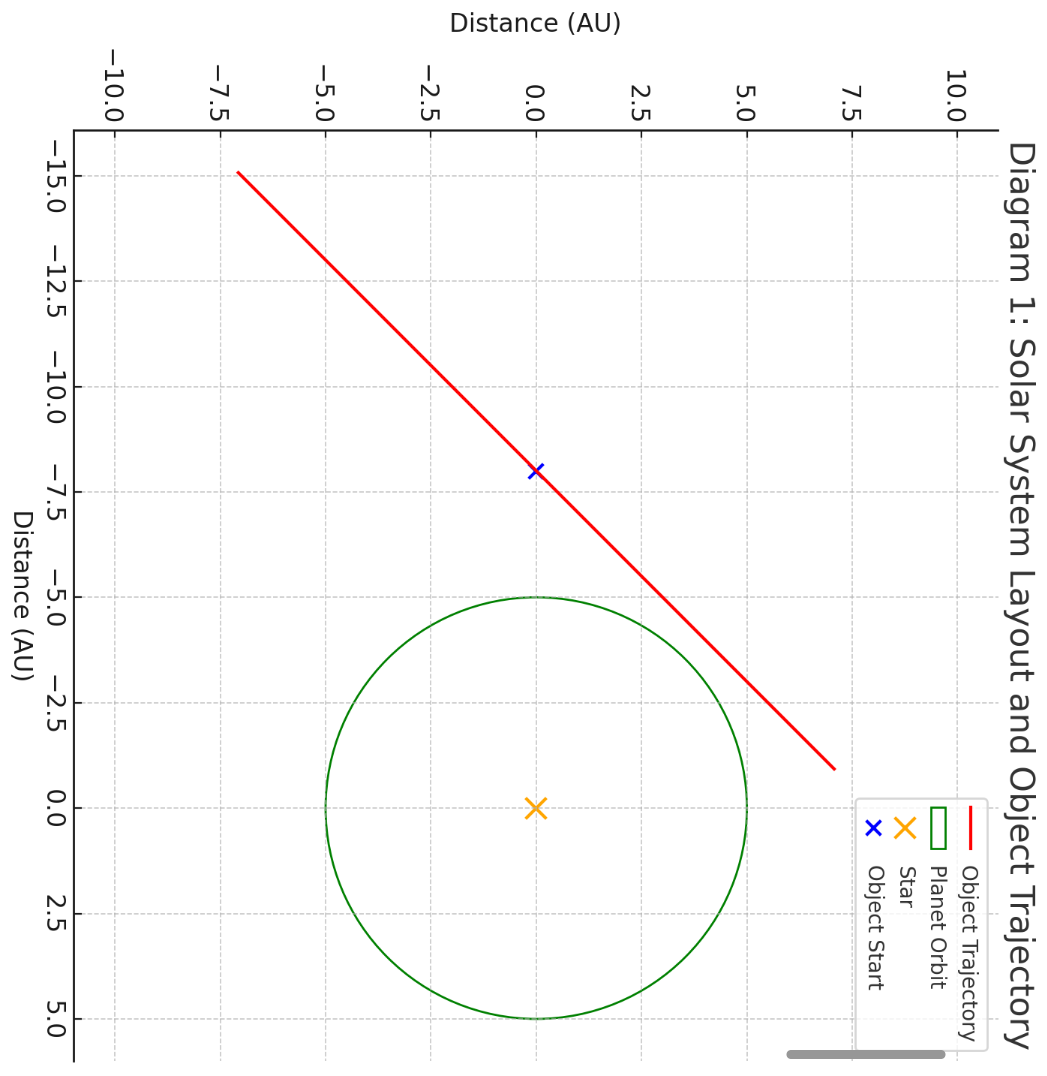
#### Task: 1. Using the provided data and diagrams, calculate the trajectory of the interstellar object as it approaches the planet. 2. Determine whether the object will collide with the planet or be deflected. Calculate the parameters of the collision or near-miss (e.g., distance at closest approach, speed at closest point). 3. If a collision is predicted, estimate the potential impact on the planet, considering the energy released and possible crater size.
#### Skills Tested: - Application of physics and mathematics in astrophysics - Understanding of orbital mechanics and gravitational interactions - Analytical and problem-solving skills
This question, along with the diagrams and numerical data, should present a challenging and engaging problem for the participants, requiring them to apply their knowledge in physics and mathematics to a real-world-like scenario.
Step by Step Solution
There are 3 Steps involved in it

Get step-by-step solutions from verified subject matter experts
 Study Help