





Question: ILU Question 24 (2 points) There are many arguments for choosing one supplier versus multiple suppliers per item. Which option typically results in the most
ILU Question 24 (2 points) There are many
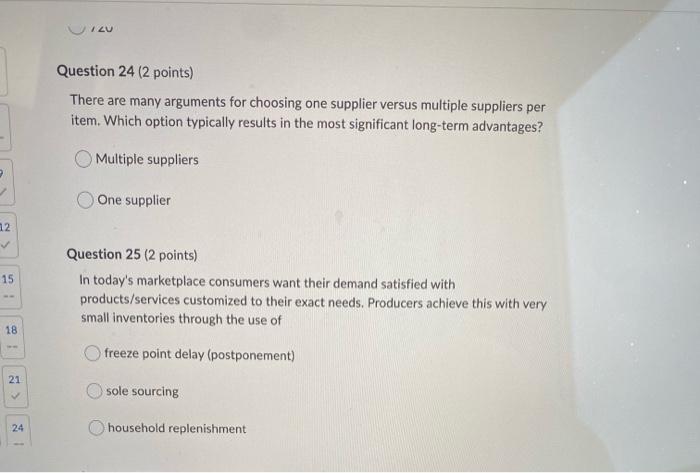
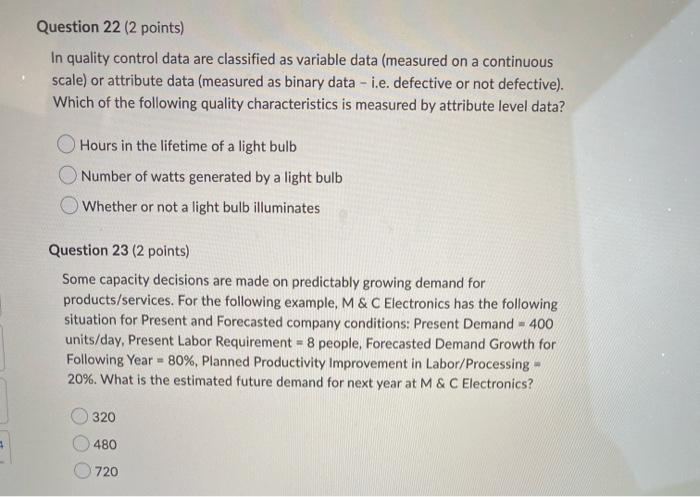
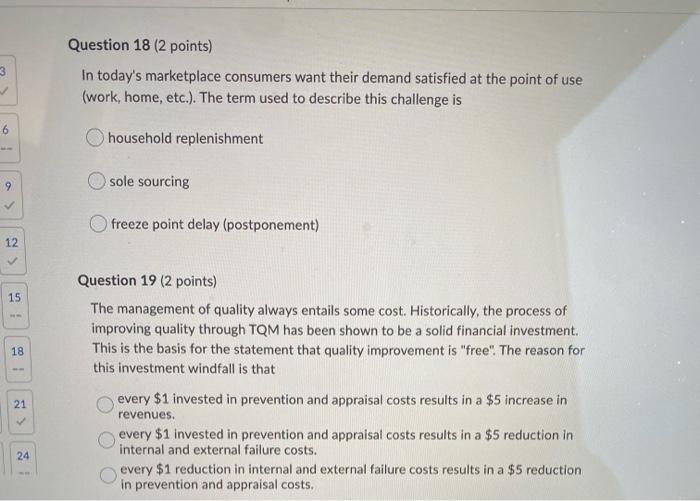
ILU Question 24 (2 points) There are many arguments for choosing one supplier versus multiple suppliers per item. Which option typically results in the most significant long-term advantages? Multiple suppliers 2 One supplier 12 15 Question 25 (2 points) In today's marketplace consumers want their demand satisfied with products/services customized to their exact needs. Producers achieve this with very small inventories through the use of 18 freeze point delay (postponement) 21 sole sourcing 24 household replenishment Question 22 (2 points) In quality control data are classified as variable data (measured on a continuous scale) or attribute data (measured as binary data - i.e. defective or not defective). Which of the following quality characteristics is measured by attribute level data? Hours in the lifetime of a light bulb Number of watts generated by a light bulb Whether or not a light bulb illuminates Question 23 (2 points) Some capacity decisions are made on predictably growing demand for products/services. For the following example, M & C Electronics has the following situation for Present and Forecasted company conditions: Present Demand - 400 units/day, Present Labor Requirement - 8 people, Forecasted Demand Growth for Following Year = 80%, Planned Productivity Improvement in Labor/Processing - 20%. What is the estimated future demand for next year at M & C Electronics? 320 480 720 3 Question 18 (2 points) In today's marketplace consumers want their demand satisfied at the point of use (work, home, etc.). The term used to describe this challenge is 6 household replenishment 9 sole sourcing freeze point delay (postponement) 12 15 S 18 Question 19 (2 points) The management of quality always entails some cost. Historically, the process of improving quality through TQM has been shown to be a solid financial investment. This is the basis for the statement that quality improvement is "free". The reason for this investment windfall is that every $1 invested in prevention and appraisal costs results in a $5 increase in revenues. every $1 invested in prevention and appraisal costs results in a $5 reduction in internal and external failure costs. every $1 reduction in internal and external failure costs results in a $5 reduction in prevention and appraisal costs, 21 24
Step by Step Solution

There are 3 Steps involved in it

1 Expert Approved Answer
Step: 1 Unlock blur-text-image

Question Has Been Solved by an Expert!

Get step-by-step solutions from verified subject matter experts

Step: 2 Unlock
Step: 3 Unlock

Students Have Also Explored These Related General Management Questions!