







Question: I'm doing some practice worksheets to study for an exam. I'm stuck on this one. Help? 12) Suppose you throw a fair 6-sided die (sides:
I'm doing some practice worksheets to study for an exam. I'm stuck on this one. Help?
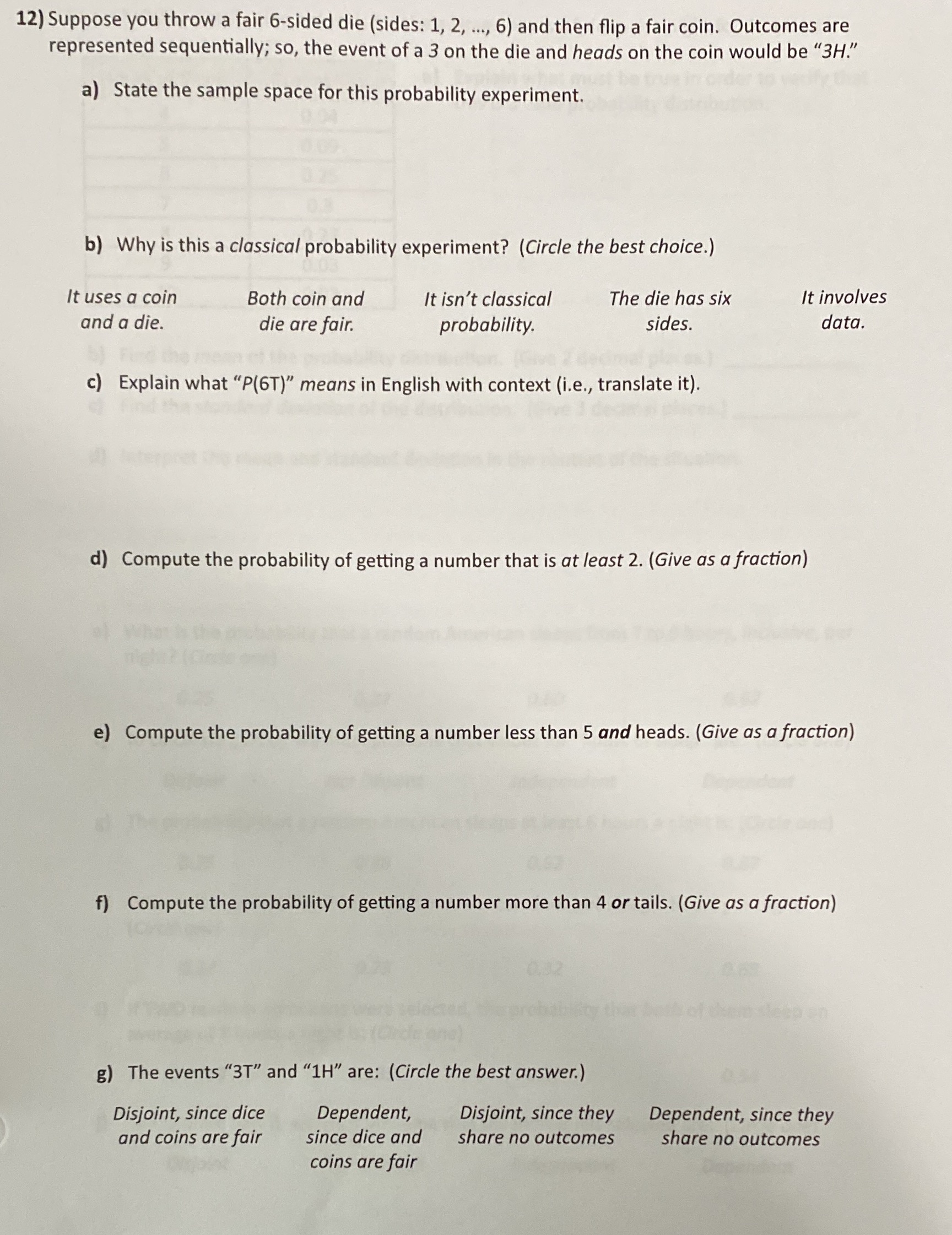
12) Suppose you throw a fair 6-sided die (sides: 1, 2, ..., 6) and then flip a fair coin. Outcomes are represented sequentially; so, the event of a 3 on the die and heads on the coin would be "3H." a) State the sample space for this probability experiment. b) Why is this a classical probability experiment? (Circle the best choice.) It uses a coin Both coin and It isn't classical The die has six It involves and a die. die are fair. probability. sides. data. c) Explain what "P(6T)" means in English with context (i.e., translate it). d) Compute the probability of getting a number that is at least 2. (Give as a fraction) e) Compute the probability of getting a number less than 5 and heads. (Give as a fraction) f) Compute the probability of getting a number more than 4 or tails. (Give as a fraction) g) The events "3T" and "1H" are: (Circle the best answer.) Disjoint, since dice Dependent, Disjoint, since they Dependent, since they and coins are fair since dice and share no outcomes share no outcomes coins are fair
Step by Step Solution
There are 3 Steps involved in it

Get step-by-step solutions from verified subject matter experts
 Study Help