







Question: I'm having some trouble getting started with this problem, because Br can have 79 and 81 does that mean the first M/z I calculate both
I'm having some trouble getting started with this problem, because Br can have 79 and 81 does that mean the first M/z I calculate both isotopes separately? and I'm not sure I understand what M+2 and M+4 signals mean/represent. Any help for part A and B at least is greatly appreciated.
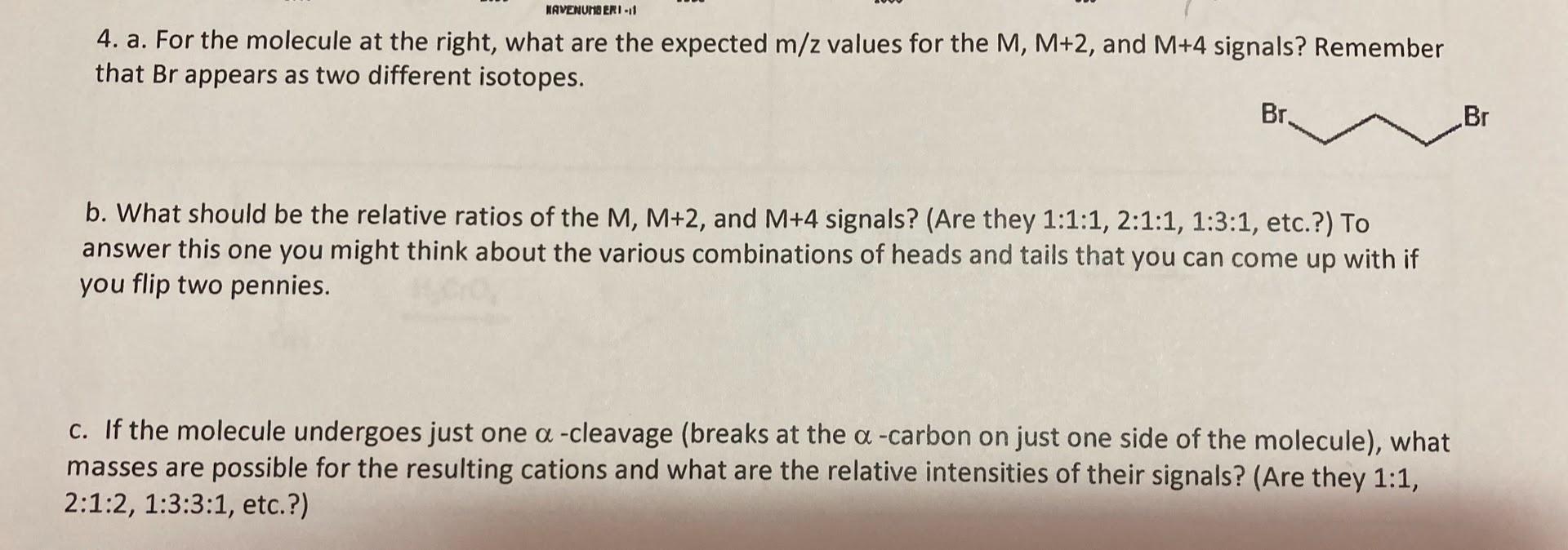
4. a. For the molecule at the right, what are the expected m/z values for the M,M+2, and M+4 signals? Remember that Br appears as two different isotopes. b. What should be the relative ratios of the M,M+2, and M+4 signals? (Are they 1:1:1,2:1:1,1:3:1, etc.?) To answer this one you might think about the various combinations of heads and tails that you can come up with if you flip two pennies. c. If the molecule undergoes just one -cleavage (breaks at the -carbon on just one side of the molecule), what nasses are possible for the resulting cations and what are the relative intensities of their signals? (Are they 1:1, :1:2,1:3:3:1, etc.?)
Step by Step Solution
There are 3 Steps involved in it

Get step-by-step solutions from verified subject matter experts
 Study Help