







Question: I'm having trouble doing this in MatLab, so posted code would be much appreciated thank you! The stock follows the GBM as where p =
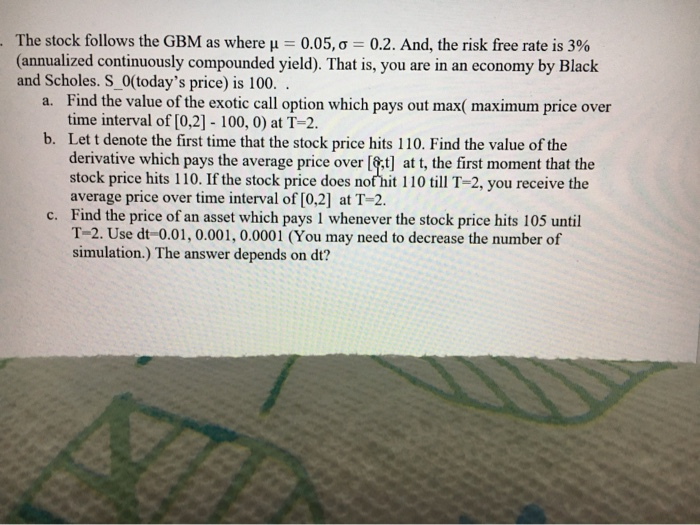
The stock follows the GBM as where p = 0.05,0 = 0.2. And, the risk free rate is 3% (annualized continuously compounded yield). That is, you are in an economy by Black and Scholes. S_O(today's price) is 100. a. Find the value of the exotic call option which pays out max( maximum price over time interval of (0,2] - 100, 0) at T-2. b. Let t denote the first time that the stock price hits 110. Find the value of the derivative which pays the average price over [ft] at t, the first moment that the stock price hits 110. If the stock price does not hit 110 till T-2, you receive the average price over time interval of [0,2] at T-2. c. Find the price of an asset which pays 1 whenever the stock price hits 105 until T-2. Use dt 0.01, 0.001, 0.0001 (You may need to decrease the number of simulation.) The answer depends on dt? The stock follows the GBM as where p = 0.05,0 = 0.2. And, the risk free rate is 3% (annualized continuously compounded yield). That is, you are in an economy by Black and Scholes. S_O(today's price) is 100. a. Find the value of the exotic call option which pays out max( maximum price over time interval of (0,2] - 100, 0) at T-2. b. Let t denote the first time that the stock price hits 110. Find the value of the derivative which pays the average price over [ft] at t, the first moment that the stock price hits 110. If the stock price does not hit 110 till T-2, you receive the average price over time interval of [0,2] at T-2. c. Find the price of an asset which pays 1 whenever the stock price hits 105 until T-2. Use dt 0.01, 0.001, 0.0001 (You may need to decrease the number of simulation.) The answer depends on dt
Step by Step Solution
There are 3 Steps involved in it

Get step-by-step solutions from verified subject matter experts
 Study Help