







Question: I'm working on example 5.10. The only think I don't understand is we plug .05 into qnorm(.05,0,1,FALSE). Can someone please explain why? thankyou. Figure 5.7
I'm working on example 5.10. The only think I don't understand is we plug .05 into qnorm(.05,0,1,FALSE). Can someone please explain why? thankyou.
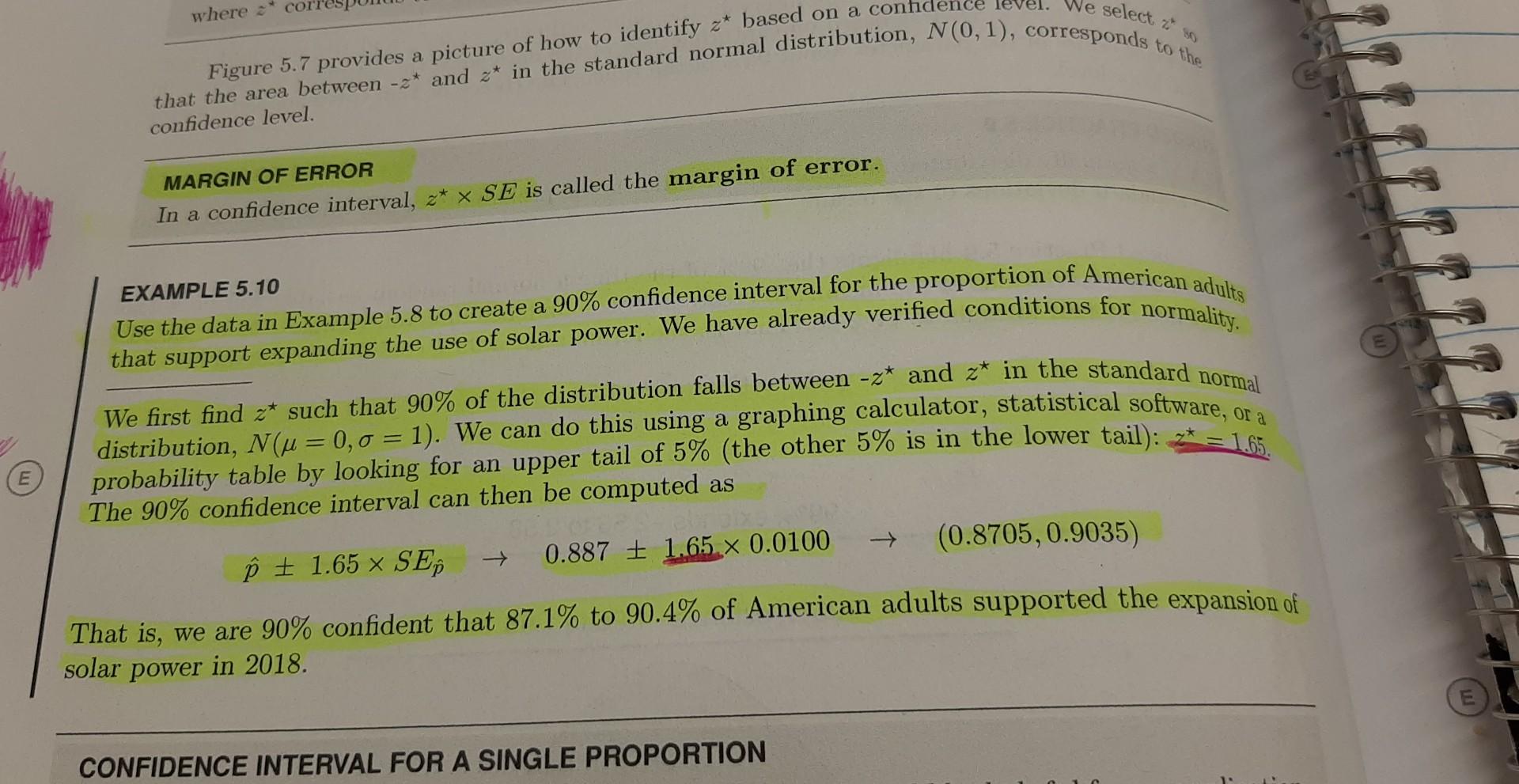
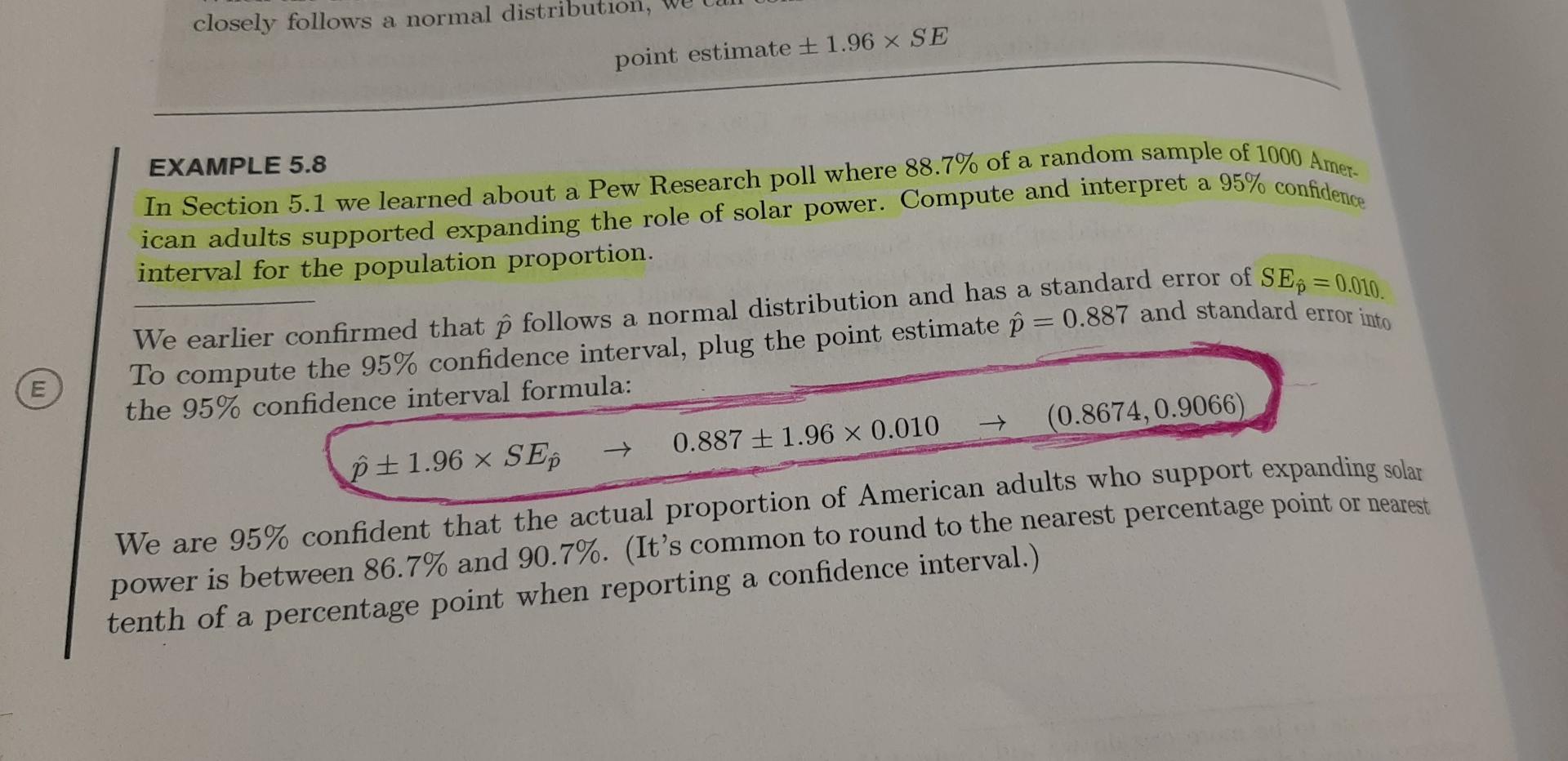
Figure 5.7 provides a picture of how to identify z based on a confidence lever. We select z that the area between z and z in the standard normal distribution, N(0,1), corresponds to the confidence level. MARGIN OF ERROR In a confidence interval, zSE is called the margin of error. EXAMPLE 5.10 Use the data in Example 5.8 to create a 90% confidence interval for the proportion of American adults that support expanding the use of solar power. We have already verified conditions for normality. We first find z such that 90% of the distribution falls between z and z in the standard normal distribution, N(=0,=1). We can do this using a graphing calculator, statistical software, or a probability table by looking for an upper tail of 5% (the other 5% is in the lower tail): z=1.65. The 90% confidence interval can then be computed as p^1.65SEp^0.8871.650.0100(0.8705,0.9035) That is, we are 90% confident that 87.1% to 90.4% of American adults supported the expansion of solar power in 2018. EXAMPLE 5.8 In Section 5.1 we learned about a Pew Research poll where 88.7% of a random sample of 1000 American adults supported expanding the role of solar power. Compute and interpret a 95% confidence interval for the population proportion. We earlier confirmed that p^ follows a normal distribution and has a standard error of SEp^=0.010. To compute the 95% confidence interval, plug the point estimate p^=0.887 and standard error into the 95% confidence interval formula: p^1.96SEp^0.8871.960.010(0.8674,0.9066) We are 95% confident that the actual proportion of American adults who support expanding solar power is between 86.7% and 90.7%. (It's common to round to the nearest percentage point or nearest tenth of a percentage point when reporting a confidence interval.)Step by Step Solution
There are 3 Steps involved in it
1 Expert Approved Answer
Step: 1 Unlock

Question Has Been Solved by an Expert!
Get step-by-step solutions from verified subject matter experts
Step: 2 Unlock
Step: 3 Unlock
 Study Help