







Question: Imagine a situation in which a star that has initially a radius of Ro = 8 108m collapses to become a red dwarf with
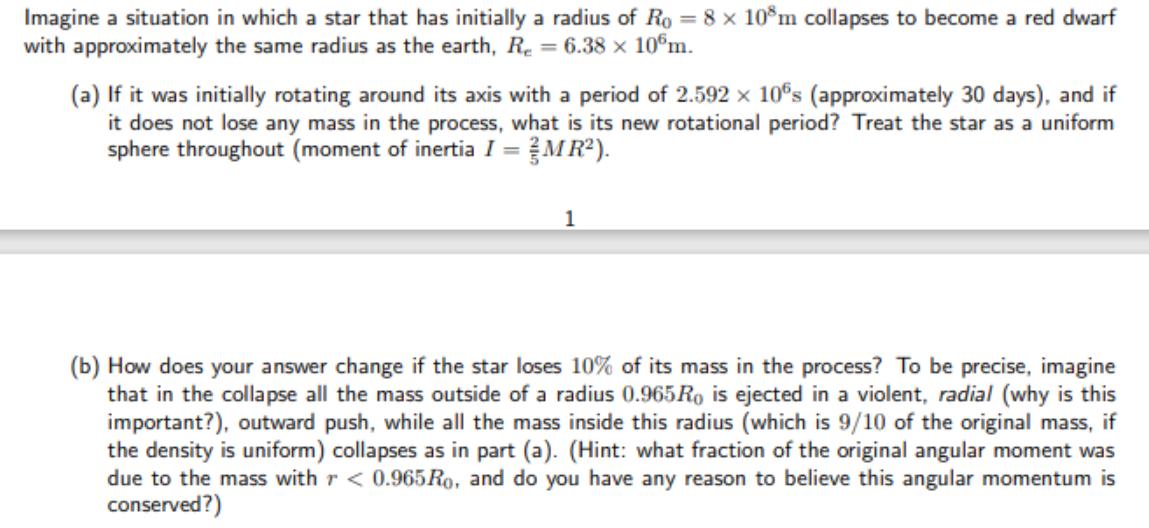
Imagine a situation in which a star that has initially a radius of Ro = 8 108m collapses to become a red dwarf with approximately the same radius as the earth, R = 6.38 x 10 m. (a) If it was initially rotating around its axis with a period of 2.592 x 10⁶s (approximately 30 days), and if it does not lose any mass in the process, what is its new rotational period? Treat the star as a uniform sphere throughout (moment of inertia I = 3MR). 1 (b) How does your answer change if the star loses 10% of its mass in the process? To be precise, imagine that in the collapse all the mass outside of a radius 0.965 Ro is ejected in a violent, radial (why is this important?), outward push, while all the mass inside this radius (which is 9/10 of the original mass, if the density is uniform) collapses as in part (a). (Hint: what fraction of the original angular moment was due to the mass with r < 0.965 Ro, and do you have any reason to believe this angular momentum is conserved?)
Step by Step Solution
3.39 Rating (158 Votes )
There are 3 Steps involved in it
a Without any mass loss the conservation of angular momentum applies The initial angular momentum Li ... View full answer

Get step-by-step solutions from verified subject matter experts
 Study Help