







Question: Implement the bolded prototype delete-node function using the c source code provided that gives the expected outcome. #include #include #include #include /***** error message *****/
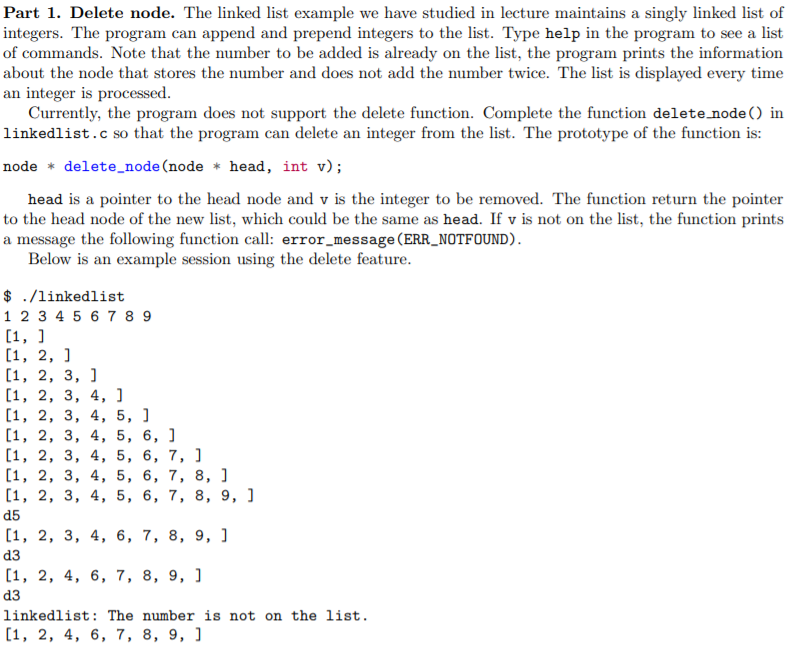
Implement the bolded prototype delete-node function using the c source code provided that gives the expected outcome.
#include
/***** error message *****/ enum ErrorNumber {ERR_OK, ERR_NOMEM, ERR_NODELETE, ERR_NOTFOUND, ERR_NOSORT, ERR_NOREVERSE, ERR_LONGTOKEN, ERR_NONUMBER, ERR_UNKNOWNTOEKN, ERR_END};
// print an error message by an error number, and return // the function does not exit from the program // the function does not return a value void error_message(enum ErrorNumber errno) { char *messages[] = {"OK", "Memory allocaton failed.", "Deleting a node is not supported.", "The number is not on the list.", "Sorting is not supported.", "Reversing is not supported.", "Token is too long.", "A number should be specified after character d, a, or p.", "Token is not recognized.", "Invalid error number."};
if (errno ERR_END) errno = ERR_END; printf("linkedlist: %s ", messages[errno]); }
/***** list *****/ typedef struct node_tag { int v; struct node_tag * next; // A pointer to this type of struct } node; // Define a type. Easier to use.
node * new_node(int v) { node *p = malloc(sizeof(node)); // Allocate memory if (p == NULL) { error_message(ERR_NOMEM); exit(-1); }
// Set the value in the node. p->v = v; // you could do (*p).v p->next = NULL; return p; // return }
node * prepend(node * head, node * newnode) { newnode->next = head; return newnode; }
node * find_node(node * head, int v) { while (head != NULL) { if (head->v == v) return head; head = head->next; } return head; }
node * find_last(node * head) { if (head != NULL) { while (head->next != NULL) head = head->next; } return head; }
node * append(node * head, node * newnode) { node *p = find_last(head);
newnode->next = NULL; if (p == NULL) return newnode; p->next = newnode; return head; }
node * delete_list(node * head) { while (head != NULL) { node *p = head->next; free(head); head = p; } return head; }
void print_list(node *head) { printf("["); while (head) { printf("%d, ", head->v); head = head->next; } printf("] "); }
void print_node(node * p) { printf("%p: v=%-5d next=%p ", p, p->v, p->next); }
void print_list_details(node *head) { while (head) { print_node(head); head = head->next; } }
// functions that have not been implemented
node * delete_node(node * head, int v) { // TODO error_message(ERR_NODELETE); return head; }
/* * Given a pointer to the head node of an acyclic list, change the * next links such that the nodes are linked in reverse order. * Allocating new nodes or copying values from one node to another * is not allowed, but you may use additional pointer variables. * Return value is a pointer to the new head node. */ node * reverse_list (node * head) { // TODO error_message(ERR_NOREVERSE); return head; }
/***** main *****/
// Make sure the numbers match in the following two macros #define MAX_TOKEN_LEN 32 #define FORMAT_STR "%32s"
void print_help(void);
int main(int argc, char **argv) { int res; char token[MAX_TOKEN_LEN + 1]; // add 1 for NUL
node *head = NULL;
while (1) { res = scanf(FORMAT_STR, token); if (res == EOF) break; if (! isspace(getchar())) { error_message(ERR_LONGTOKEN); exit(-1); } // puts(token);
if (!strcmp(token, "help")) { print_help(); continue; } else if (!strcmp(token, "reverse") || !strcmp(token, "r")) { head = reverse_list (head); } else if (!strcmp(token, "info") || !strcmp(token, "i")) { printf("head = %p ", head); print_list_details(head); } // could support more functions/commands else { // try to convert it to an integer // we use atol() long lv; char *endptr;
char action = 'a'; char *pn = token;
if (token[0] == 'd' || token[0] == 'a' || token[0] == 'p') { if (! token[1]) { error_message(ERR_NONUMBER); continue; }
action = token[0]; pn ++; }
lv = strtol(pn, &endptr, 10); // decimal numbers if (*endptr) { // the entire token should be a valid number error_message(ERR_UNKNOWNTOEKN); printf("%s ", token); continue; }
int i = lv;
switch (action) { case 'd': head = delete_node(head, i); break; case 'a': case 'p': { node *p; p = find_node(head, i); if (p != NULL) { print_node(p); } else { p = new_node(i); head = (action == 'p') ? prepend(head, p) : append(head, p); } break; } default: // should not be here. break; } } print_list(head); } head = delete_list(head); return 0; }
void print_help(void) { // Example of long strings char * helpmsg = "a
Part 1. Delete node. The linked list example we have studied in lecture maintains a singly linked list of integers. The program can append and prepend integers to the list. Type help in the program to see a list of commands. Note that the number to be added is already on the list, the program prints the information about the node that stores the number and does not add the number twice. The list is displayed every time an integer is processed. Currently, the program does not support the delete function. Complete the function delete node() in linkedlist.c so that the program can delete an integer from the list. The prototype of the function is: node * delete_node (node * head, int v); head is a pointer to the head node and v is the integer to be removed. The function return the pointer to the head node of the new list, which could be the same as head. If v is not on the list, the function prints a message the following function call: error_message (ERR_NOTFOUND). Below is an example session using the delete feature. $ ./linkedlist 1 2 3 4 5 6 7 8 9 [1, ] [1, 2, ] [1, 2, 3, ] [1, 2, 3, 4, ) 2, 3, 4, 5, ] [1, 2, 3, 4, 5, 6, ] [1, 2, 3, 4, 5, 6, 7, ] [1, 2, 3, 4, 5, 6, 7, 8, ] [1, 2, 3, 4, 5, 6, 7, 8, 9, ] d5 [1, 2, 3, 4, 6, 7, 8, 9, ] d3 [1, 2, 4, 6, 7, 8, 9, ] d3 linkedlist: The number is not on the list. [1, 2, 4, 6, 7, 8, 9, ]
Step by Step Solution
There are 3 Steps involved in it

Get step-by-step solutions from verified subject matter experts
 Study Help