







Question: Implementation Aclass TodoList def initialize @tasks = [ ] enddef add _ task ( description ) @tasks description puts Task added: # { description }
Implementation Aclass TodoList
def initialize
@tasks
enddef addtaskdescription
@tasks description
puts "Task added: #description
enddef completetaskindex
if index && index @tasks.length
task @tasksindex
@tasks.deleteatindex
puts "Completed: #task
else
puts "Task not found"
end
enddef showtasks
puts "Todo List:"
@tasks.eachwithindex do task index
puts #index #task
end
enddef savetasks
file File.opentaskstxtw
@tasks.each do task
file.putstask
end
file.close
puts "Tasks saved to file"
end
end
Notes: Implementation BThe Task class represents an individual task with a description.
class Task
def initializedescription
@description description
enddef description
@description
end
endclass TodoList
def initialize
@tasks
enddef addtaskdescription
task Task.newdescription
@tasks task
puts "Task added: #description
enddef completetaskindex
if index && index @tasks.length
task @tasksindex
@tasks.deleteatindex
puts "Completed: #taskdescription
else
puts "Task not found"
end
end
# Displays all tasks in the list. def showtasks
puts "Todo List:"
@tasks.eachwithindex do task index
puts #index #taskdescription
end
enddef tasks
@tasks
end
endclass FileManagerdef savetaskstasks
file File.opentaskstxtw
tasks.each do task
file.putstaskdescription
end
file.close
puts "Tasks saved to file"
end
end
Notes:
Responsibilities are divided among multiple classes:
Task class: Represents individual tasks.
TodoList class: Manages the collection of tasks.
FileManager class: Handles file operations.
Tasks are instances of the Task class, encapsulating task data.
File Operations are handled separately by the FileManager class.
Guiding Questions:
Representation of Tasks:
What's the main difference in how tasks are represented in each
implementation?
Consider how this affects the ability to manage and extend task
functionality.Single Responsibility Principle SRP:
How does Implementation B separate concerns compared to
Implementation A
Identify which classes in Implementation B adhere to SRP and
how.
Extensibility:
Which implementation would be easier to add new features to like
task due dates or priorities? Why?
Discuss how the design impacts the ease of adding new
attributes or methods to tasks.
Coupling and Cohesion:
How does each implementation handle the task of saving to a file?
Analyze the level of coupling between task management and file
operations in both implementations.
Evaluate the cohesion within the classes.
Understandability and Maintainability:
Which implementation do you think is easier to understand and
maintain? Why?
Reflect on how the design principles affect code readability and
maintainability.
Tips for Success:
Be Specific: Use concrete examples from the code to support your analysis.
Apply OOP Terminology: Use appropriate OOP concepts and vocabulary in
your explanations.
Think Critically: Analyze not just what the code does, but how it's structured
and why that matters.
Submission
This file with answers for each question and your brief summary.Objective:
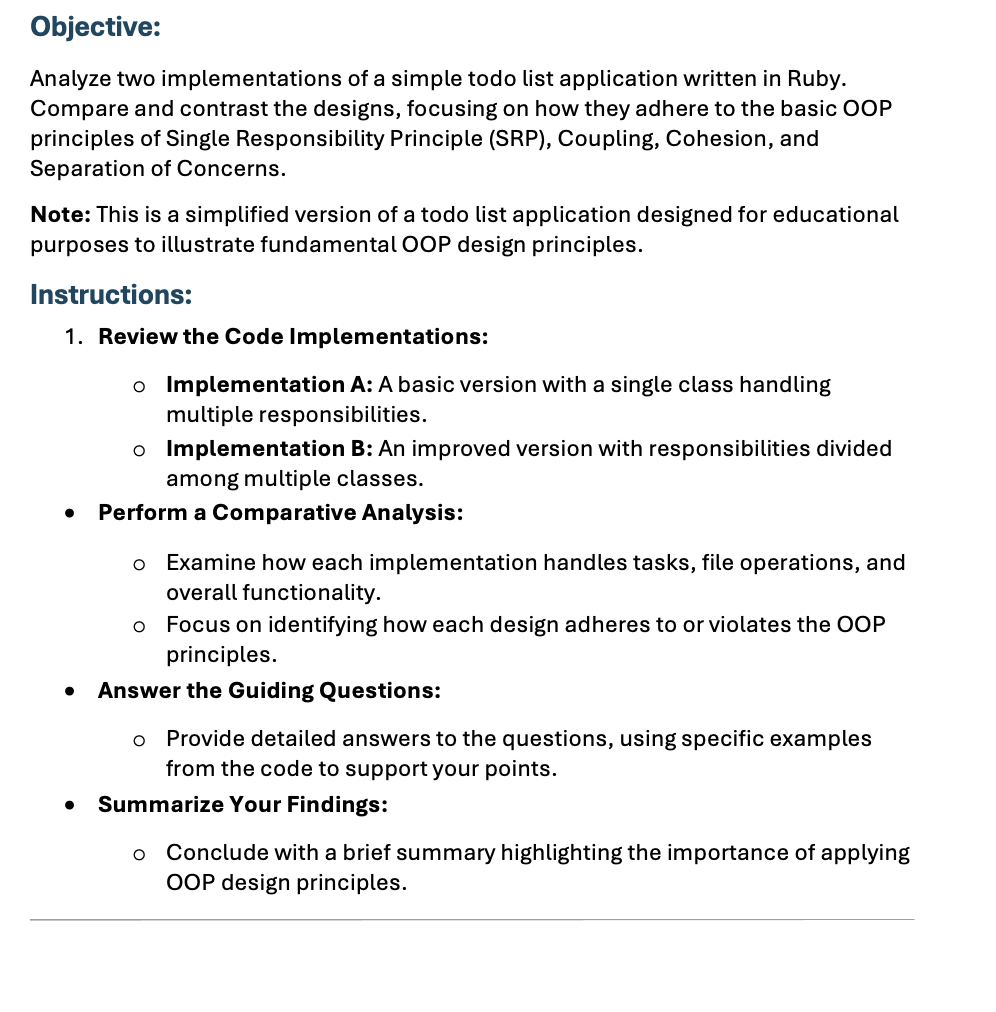
Analyze two implementations of a simple todo list application written in Ruby.
Compare and contrast the designs, focusing on how they adhere to the basic OOP
principles of Single Responsibility Principle SRP Coupling, Cohesion, and
Separation of Concerns.
Note: This is a simplified version of a todo list application designed for educational
purposes to illustrate fundamental OOP design principles.
Instructions:
Review the Code Implementations:
Implementation A: A basic version with a single class handling
multiple responsibilities.
Implementation B: An improved version with responsibilities divided
among multiple classes.
Perform a Comparative Analysis:
Examine how each implementation handles tasks, file operations, and
overall functionality.
Focus on identifying how each design adheres to or violates the OOP
principles.
Answer the Guiding Questions:
Provide detailed answers to the questions, using specific examples
from the code to support your points.
Summarize Your Findings:
Conclude with a brief summary highlighting the importance of applying
OOP design principles.
Step by Step Solution
There are 3 Steps involved in it
1 Expert Approved Answer
Step: 1 Unlock

Question Has Been Solved by an Expert!
Get step-by-step solutions from verified subject matter experts
Step: 2 Unlock
Step: 3 Unlock
 Study Help