







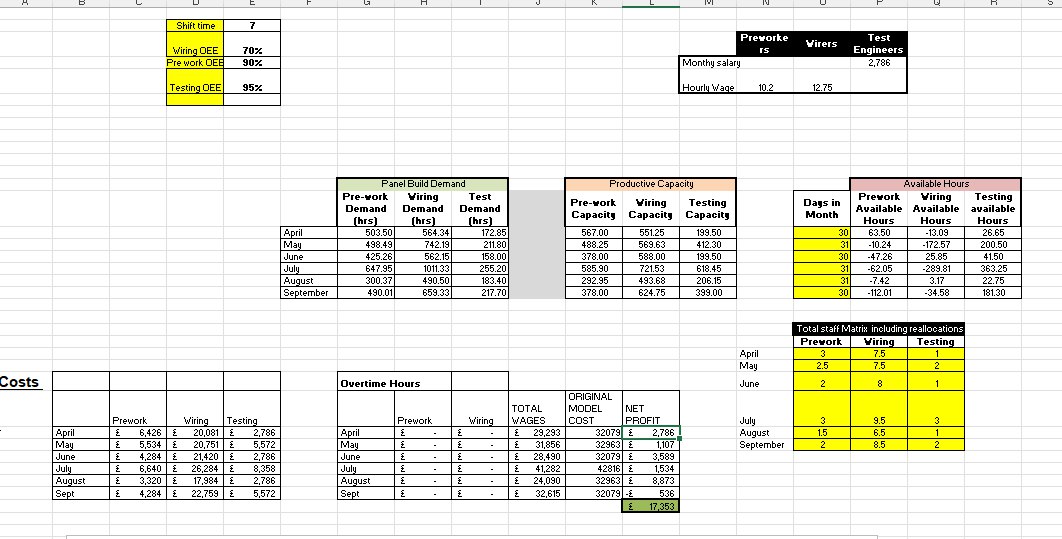
Question: Implications of the Refined Strategy: Cross - Allocation and Precise Employee Numbers Based on the refined strategy that focuses on cross - allocation and precise
Implications of the Refined Strategy: CrossAllocation and Precise Employee Numbers
Based on the refined strategy that focuses on crossallocation and precise employee numbers, several positive implications arise. Cost Efficiency: By optimizing staff allocation and minimizing overtime, the company can significantly reduce labor costs. This refined strategy resulted in a decrease in cost by Euros as calculated. Flexibility: Crosstrained staff can adapt to various roles, allowing for a more agile response to fluctuating demand. This ensures that the production targets are met without the need for excessive overtime or additional hiring. Improved Employee Utilization: Efficient use of available staff ensures that workers are fully utilized, reducing idle time and increasing overall productivity. Employee Satisfaction: A balanced workload can improve employee morale and reduce burnout, leading to higher retention rates and a more stable workforce.
However, there are potential negative implications to consider. Training Costs: Initial investment in crosstraining staff to handle multiple roles may be significant. Overreliance on Flexibility: There is a risk of understaffing if the demand forecast is inaccurate. Overrelying on the flexibility of the workforce might also lead to fatigue and decreased performance over time.
To mitigate these risks, several strategies can be implemented. Gradual Training Implementation: Spread out the training over time to manage costs and ensure that employees are not overwhelmed. Effective Change Management: Engage employees early in the process to get their buyin and provide incentives for flexibility. This can include offering additional pay or benefits for taking on additional roles. Robust Demand Forecasting: Implement robust systems for accurate demand forecasting to avoid the risks of over or understaffing. Regularly review and adjust the forecasts based on realtime data and trends.
Several assumptions are made for this strategy to be successful. Employee Capability and Willingness: Assumes that employees are capable of and willing to undergo crosstraining to handle multiple roles. Predictable Demand Fluctuations: Assumes that demand fluctuations are predictable to some extent, allowing for effective planning and allocation. Fluid Market for Temporary Staff: Assumes that the market for temporary staff is flexible enough to allow for quick hiring when needed to meet unexpected demand spikes.
Summary of the Strategy
This strategy emphasizes efficient allocation of existing staff, leveraging crosstraining, and minimizing overtime to meet production demands. While initial training costs and potential risks related to overreliance on flexibility exist, these can be mitigated through careful planning and robust management practices. The approach ensures cost efficiency, maintains high flexibility, and enhances productivity within the workforce.
Step by Step Solution
There are 3 Steps involved in it
1 Expert Approved Answer
Step: 1 Unlock

Question Has Been Solved by an Expert!
Get step-by-step solutions from verified subject matter experts
Step: 2 Unlock
Step: 3 Unlock
 Study Help