







Question: //import java.*; import java.util.Scanner; // For every integer n, if n^2 is odd then n is odd. // Contrapositive: for every integer n, if n
//import java.*;
import java.util.Scanner; // For every integer n, if n^2 is odd then n is odd. // Contrapositive: for every integer n, if n is not odd then n^2 is not odd class Lab2 { public static void main(String[] args) { int n; Scanner Sc = new Scanner(System.in); System.out.print("Enter n: "); n = Sc.nextInt(); YOUR CODE HERE } }
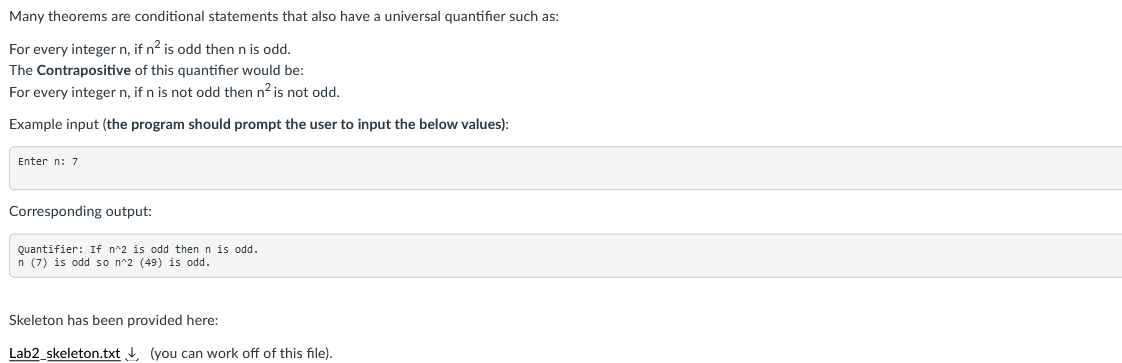
Many theorems are conditional statements that also have a universal quantifier such as: For every integer n, if n2 is odd then n is odd. The Contrapositive of this quantifier would be: For every integer n, if n is not odd then n2 is not odd. Example input (the program should prompt the user to input the below values): Enter n: 7 Corresponding output: Quantifier: If n2 is odd then n is odd. n (7) is odd so n2 (49) is odd. Skeleton has been provided here: Lab2_skeleton.txt (you can work off of this file)
Step by Step Solution
There are 3 Steps involved in it

Get step-by-step solutions from verified subject matter experts
 Study Help