Question: Important note: Please Write by microsoft word (text) . Excelsior Equipment For more than thirty years, Excelsior, a 150 employee company located in Cedar Rapids,
Important note: Please Write by microsoft word (text) .
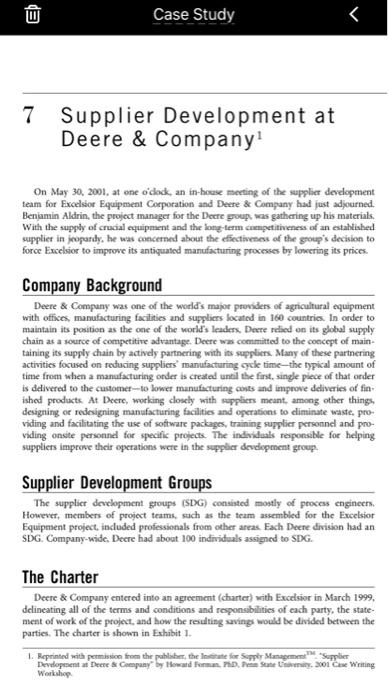
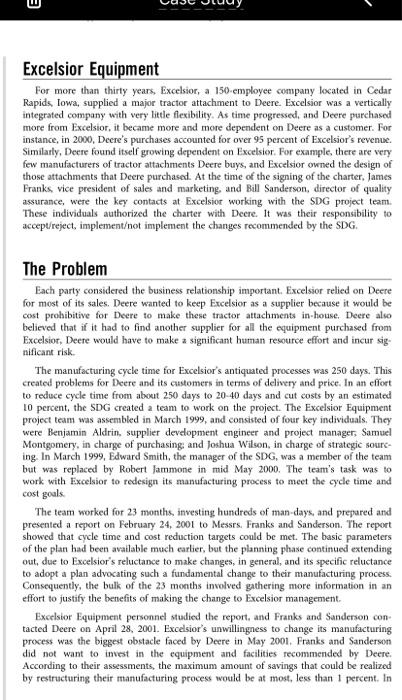
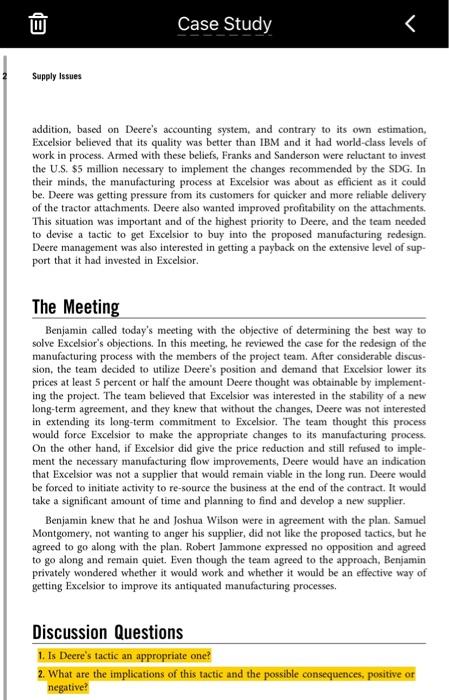
Excelsior Equipment For more than thirty years, Excelsior, a 150 employee company located in Cedar Rapids, Iowa, supplied a major tractor attachment to Deere. Excelsior was a vertically integrated company with very little flexibility. As time progressed, and Deere purchased more from Excelsior, it became more and more dependent on Deere as a customer. For instance, in 2000, Deere's purchases accounted for over 95 percent of Excelsior's revenue. Similarly, Deere found itself growing dependent on Excelsior. For example, there are very few manufacturers of tractor attachments Deere buys, and Excelsior owned the design of those attachments that Deere purchased. At the time of the signing of the charter, James Franks, vice president of sales and marketing, and Bill Sanderson, director of quality assurance, were the key contacts at Excelsior working with the SDG project team. These individuals authorized the charter with Deere. It was their responsibility to accept/ reject, implementot implement the changes recommended by the SDG The Problem Each party considered the business relationship important. Excelsior relied on Deere for most of its sales. Deere wanted to keep Excelsior as a supplier because it would be cost prohibitive for Deere to make these tractor attachments in-house . Deere also believed that if it had to find another supplier for all the equipment purchased from Excelsior, Deere would have to make a significant human resource effort and incur sig. nificant risk The manufacturing cycle time for Excelsior's antiquated processes was 250 days. This created problems for Deere and its customers in terms of delivery and price. In an effort to reduce cycle time from about 250 days to 20-40 days and cut costs by an estimated 10 percent, the SDG created a team to work on the project. The Excelsior Equipment project team was assembled in March 1999, and consisted of four key individuals. They were Benjamin Aldrin, supplier development engineer and project manager, Samuel Montgomery, in charge of purchasing and Joshua Wilson, in charge of strategic sourc- ing. In March 1999, Edward Smith, the manager of the SDG, was a member of the team but was replaced by Robert Sammone in mid May 2000. The team's task was to work with Excelsior to redesign its manufacturing process to meet the cycle time and cost goals The team worked for 23 months, investing hundreds of man-days, and prepared and presented a report on February 24, 2001 to Messrs. Franks and Sanderson. The report showed that cycle time and cost reduction targets could be met. The basic parameters of the plan had been available much earlier, but the planning phase continued extending out, due to Excelsior's reluctance to make changes, in general, and its specific reluctance to adopt a plan advocating such a fundamental change to their manufacturing process. Consequently, the bulk of the 23 months involved gathering more information in an effort to justify the benefits of making the change to Excelsior management Excelsior Equipment personnel studied the report, and Franks and Sanderson con tacted Deere on April 28, 2001. Excelsior's unwillingness to change its manufacturing process was the biggest obstacle faced by Deere in May 2001. Franks and Sanderson did not want to invest in the equipment and facilities recommended by Deere. According to their assessments, the maximum amount of savings that could be realized by restructuring their manufacturing process would be at most, less than 1 percent. In ED Case Study Supply Issues addition, based on Deere's accounting system, and contrary to its own estimation, Excelsior believed that its quality was better than IBM and it had world-class levels of work in process. Armed with these beliefs, Franks and Sanderson were reluctant to invest the U.S. $5 million necessary to implement the changes recommended by the SDG. In their minds, the manufacturing process at Excelsior was about as efficient as it could be. Deere was getting pressure from its customers for quicker and more reliable delivery of the tractor attachments. Deere also wanted improved profitability on the attachments. This situation was important and of the highest priority to Deere, and the team needed to devise a tactic to get Excelsior to buy into the proposed manufacturing redesign Deere management was also interested in getting a payback on the extensive level of sup- port that it had invested in Excelsior. The Meeting Benjamin called today's meeting with the objective of determining the best way to solve Excelsior's objections. In this meeting, he reviewed the case for the redesign of the manufacturing process with the members of the project team. After considerable discus- sion, the team decided to utilize Deere's position and demand that Excelsior lower its prices at least 5 percent or half the amount Deere thought was obtainable by implement- ing the project. The team believed that Excelsior was interested in the stability of a new long-term agreement, and they knew that without the changes, Deere was not interested in extending its long-term commitment to Excelsior. The team thought this process would force Excelsior to make the appropriate changes to its manufacturing process. On the other hand, if Excelsior did give the price reduction and still refused to imple- ment the necessary manufacturing flow improvements, Deere would have an indication that Excelsior was not a supplier that would remain viable in the long run. Deere would be forced to initiate activity to re-source the business at the end of the contract. It would take a significant amount of time and planning to find and develop a new supplier. Benjamin knew that he and Joshua Wilson were in agreement with the plan. Samuel Montgomery, not wanting to anger his supplier, did not like the proposed tactics, but he agreed to go along with the plan. Robert Jammone expressed no opposition and agreed to go along and remain quiet. Even though the team agreed to the approach, Benjamin privately wondered whether it would work and whether it would be an effective way of getting Excelsior to improve its antiquated manufacturing processes, Discussion Questions 1. Is Deere's tactic an appropriate one! 2. What are the implications of this tactic and the possible consequences, positive or negative









 Study Help