



Question: In 1985, computer scientist David Parnas resigned from an advisory panel of the Strategic Defense Initia- tive Organization (SDIO).63 He had concluded that SDI was
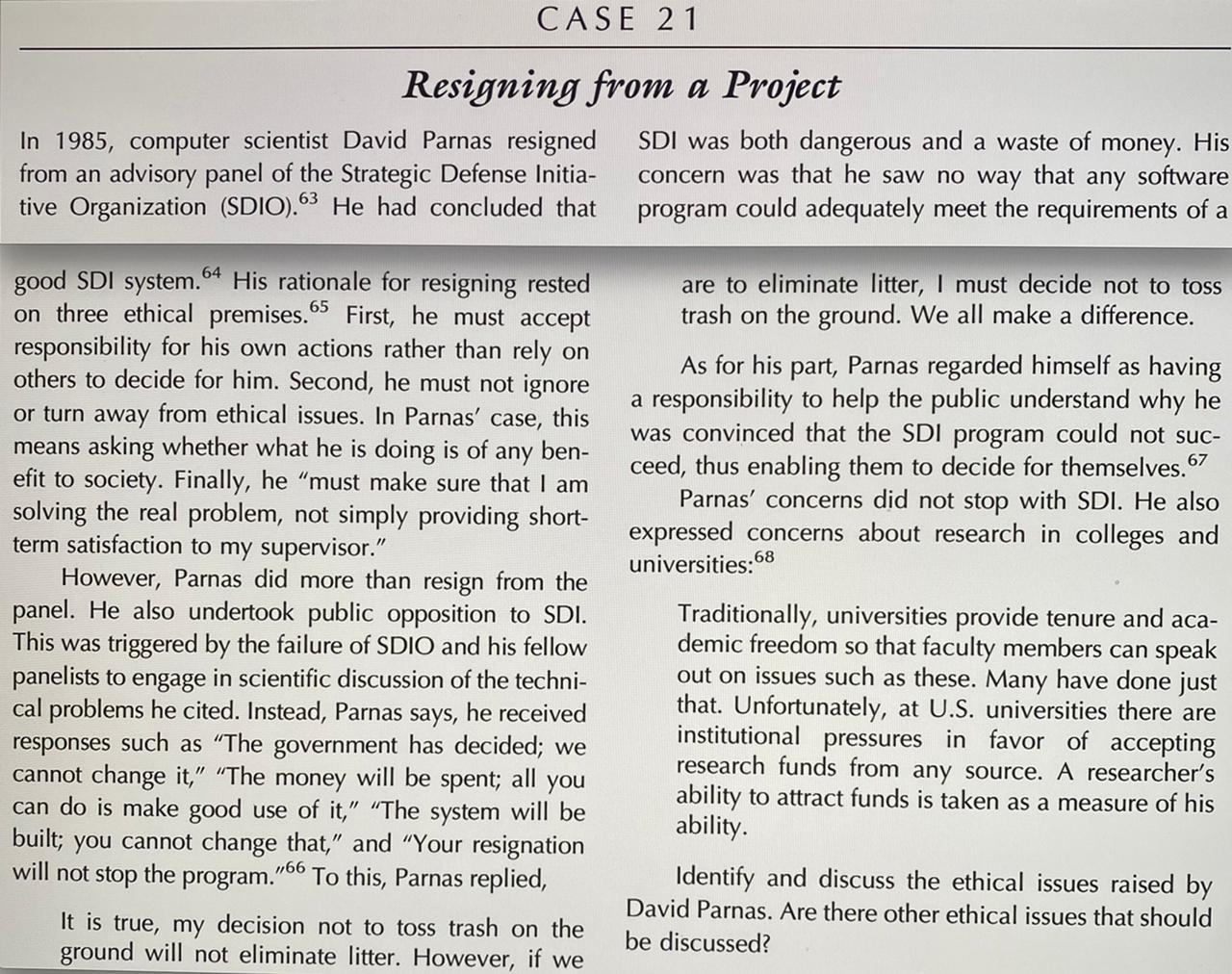
In 1985, computer scientist David Parnas resigned from an advisory panel of the Strategic Defense Initia- tive Organization (SDIO).63 He had concluded that SDI was both dangerous and a waste of money. His concern was that he saw no way that any software program could adequately meet the requirements of a good SDI system.64 His rationale for resigning rested on three ethical premises.65 First, he must accept responsibility for his own actions rather than rely on others to decide for him. Second, he must not ignore or turn away from ethical issues. In Parnas case, this means asking whether what he is doing is of any ben- efit to society. Finally, he must make sure that I am solving the real problem, not simply providing short- term satisfaction to my supervisor.
However, Parnas did more than resign from the panel. He also undertook public opposition to SDI. This was triggered by the failure of SDIO and his fellow panelists to engage in scientific discussion of the techni- cal problems he cited. Instead, Parnas says, he received responses such as The government has decided; we cannot change it, The money will be spent; all you can do is make good use of it, The system will be built; you cannot change that, and Your resignation will not stop the program. 66 To this, Parnas replied, It is true, my decision not to toss trash on the ground will not eliminate litter. However, if we are to eliminate litter, I must decide not to toss trash on the ground. We all make a difference. As for his part, Parnas regarded himself as having a responsibility to help the public understand why he was convinced that the SDI program could not suc- ceed, thus enabling them to decide for themselves.67 Parnas concerns did not stop with SDI. He also expressed concerns about research in colleges and universities:68 Traditionally, universities provide tenure and aca- demic freedom so that faculty members can speak out on issues such as these. Many have done just that. Unfortunately, at U.S. universities there are institutional pressures in favor of accepting research funds from any source. A researcher s ability to attract funds is taken as a measure of his ability.
- Identify and discuss the ethical issues raised by David Parnas.
- Are there other ethical issues that should be discussed?
- Did David Parnas follow any code of ethics? why or why not ?
- What are some ways in where the issues could have been dealt with?
- Provide engineering opinion on whether further changes are needed to prevent similar failure
- Discuss the technical and ethical lessons that may be learned by engineers from this failure
CASE 21 Resigning from a Project In 1985, computer scientist David Parnas resigned SDI was both dangerous and a waste of money. His from an advisory panel of the Strategic Defense Initia- concern was that he saw no way that any software tive Organization (SDIO). He had concluded that program could adequately meet the requirements of a 63 64 are to eliminate litter, I must decide not to toss trash on the ground. We all make a difference. As for his part, Parnas regarded himself as having a responsibility to help the public understand why he was convinced that the SDI program could not suc- ceed, thus enabling them to decide for themselves. 67 Parnas' concerns did not stop with SDI. He also expressed concerns about research in colleges and universities: 68 good SDI system. His rationale for resigning rested on three ethical premises.65 First, he must accept responsibility for his own actions rather than rely on others to decide for him. Second, he must not ignore or turn away from ethical issues. In Parnas' case, this means asking whether what he is doing is of any ben- efit to society. Finally, he "must make sure that I am solving the real problem, not simply providing short- term satisfaction to my supervisor." However, Parnas did more than resign from the panel. He also undertook public opposition to SDI. This was triggered by the failure of SDIO and his fellow panelists to engage in scientific discussion of the techni- cal problems he cited. Instead, Parnas says, he received responses such as "The government has decided; we cannot change it," "The money will be spent; all you can do is make good use of it," "The system will be built; you cannot change that," and "Your resignation will not stop the program. To this, Parnas replied, It is true, my decision not to toss trash on the ground will not eliminate litter. However, if we Traditionally, universities provide tenure and aca- demic freedom so that faculty members can speak out on issues such as these. Many have done just that. Unfortunately, at U.S. universities there are institutional pressures in favor of accepting research funds from any source. A researcher's ability to attract funds is taken as a measure of his ability. Identify and discuss the ethical issues raised by David Parnas. Are there other ethical issues that should be discussed? 1,66Step by Step Solution
There are 3 Steps involved in it

Get step-by-step solutions from verified subject matter experts