







Question: In 1989, research scientists published a model for predicting the cumulative number of AIDS cases reported in the United States: a(t) = 155(1-980/10)^3, (thousands) where
In 1989, research scientists published a model for predicting the cumulative number of AIDS cases reported in the United States: a(t) = 155(1-980/10)^3, (thousands)
where t is the year. This paper was considered a "relief," since there was a fear the correct model would be of exponential type. Use the two data points predicted by the research model a(t) for the years 1989 and 1995 to construct a new exponential model b(t) for the number of cumulative AIDS cases.
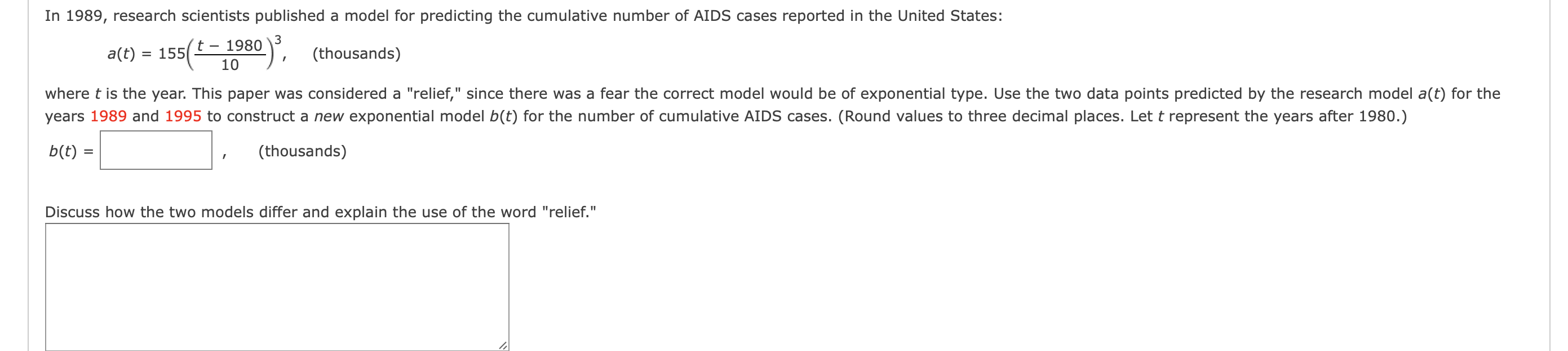
In 1989, research scientists published a model for predicting the cumulative number of AIDS cases reported in the United States: t1980 3 0 ), (thousands) at) = 155( where t is the year. This paper was considered a "relief," since there was a fear the correct model would be of exponential type. Use the two data points predicted by the research model a(t) for the years 1989 and 1995 to construct a new exponential model b(t) for the number of cumulative AIDS cases. (Round values to three decimal places. Let t represent the years after 1980.) b(t) = , (thousands) Discuss how the two models differ and explain the use of the word "relief." N
Step by Step Solution
There are 3 Steps involved in it

Get step-by-step solutions from verified subject matter experts
 Study Help