



Question: In 2007, Amazon decided to make a foray into the grocery market by launching Amazon Fresh. This service allowed customers to order groceries online, which
In 2007, Amazon decided to make a foray into the grocery market by launching Amazon Fresh. This service allowed customers to order groceries online, which would then be delivered to their homes the same or next day. AmazonFresh originally targeted affluent customers, emphasizing extreme convenience at a reasonable price. Groceries represent the largest single retail category and is one of the few retail categories that has not migrated online. However, the grocery industry is highly mature, fiercely competitive, and features low margins; previous attempts to take the industry online failed. Amazon entered into this industry with caution, and it started by offering AmazonFresh in just one test city - Seattle. This is the content in which the case is based.
Case Assignment Questions:
- What is your assessment of the online grocery market opportunity? What explains the prior failures in this market? (Note: Five forces analysis is not needed to answer Q1.)
- Discuss the business level strategies Amazon used to establish AmazonFresh as a new business adventure. How would you assess Amazon's effort in this new market? How would you compare AmazonFresh's operating model to Instacart's?
- Should Amazon continue refining AmazonFresh's business model in Seattle or expand to another city? Explain your answers.
4. Five forces analysis
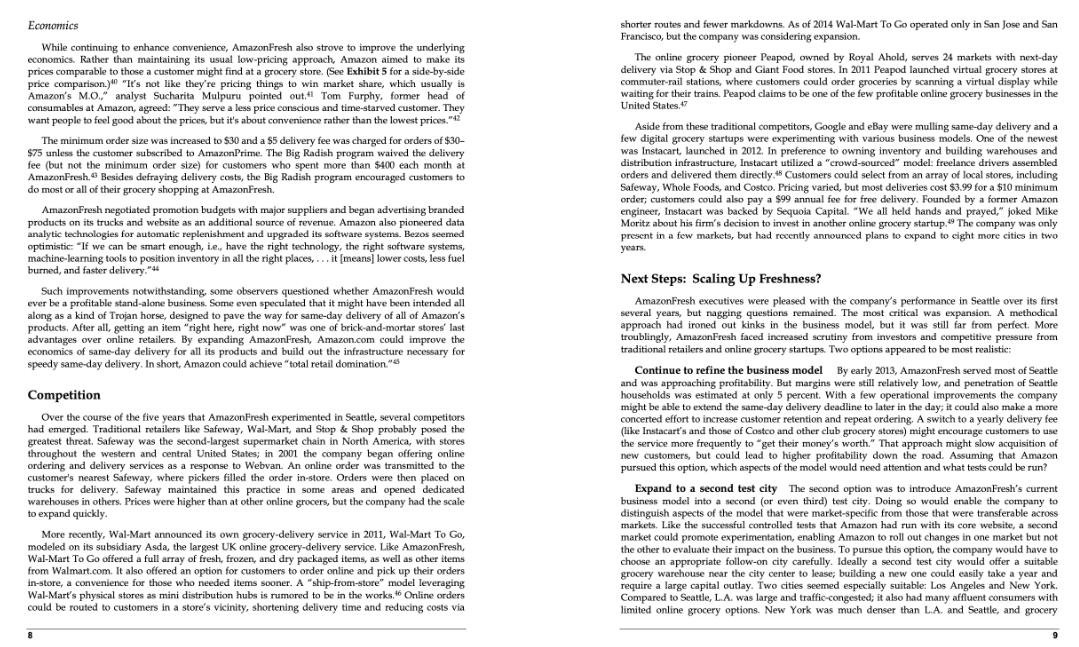
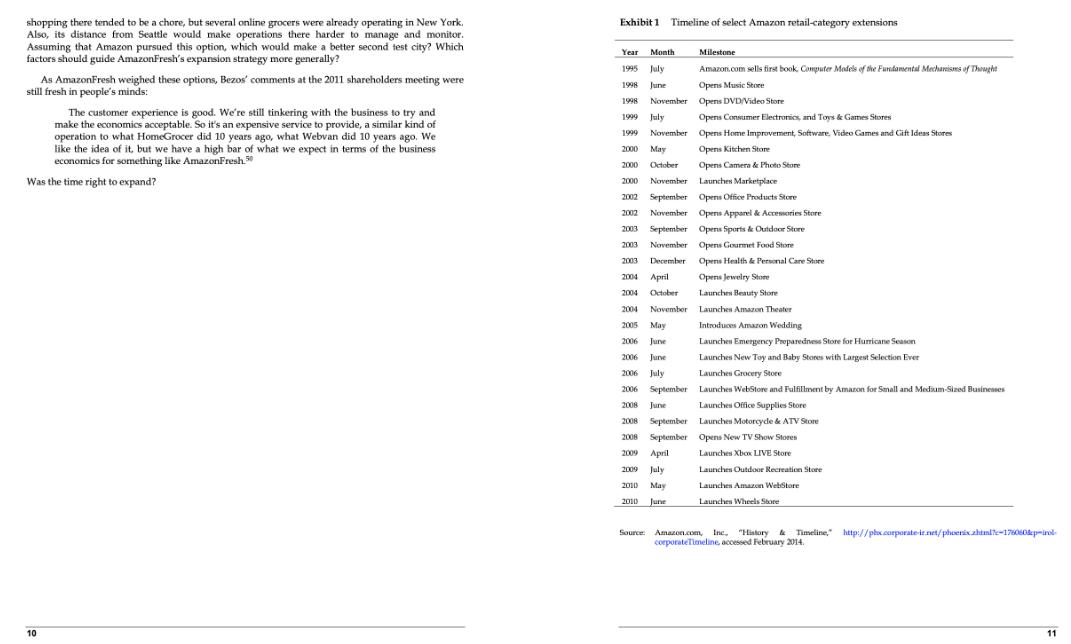
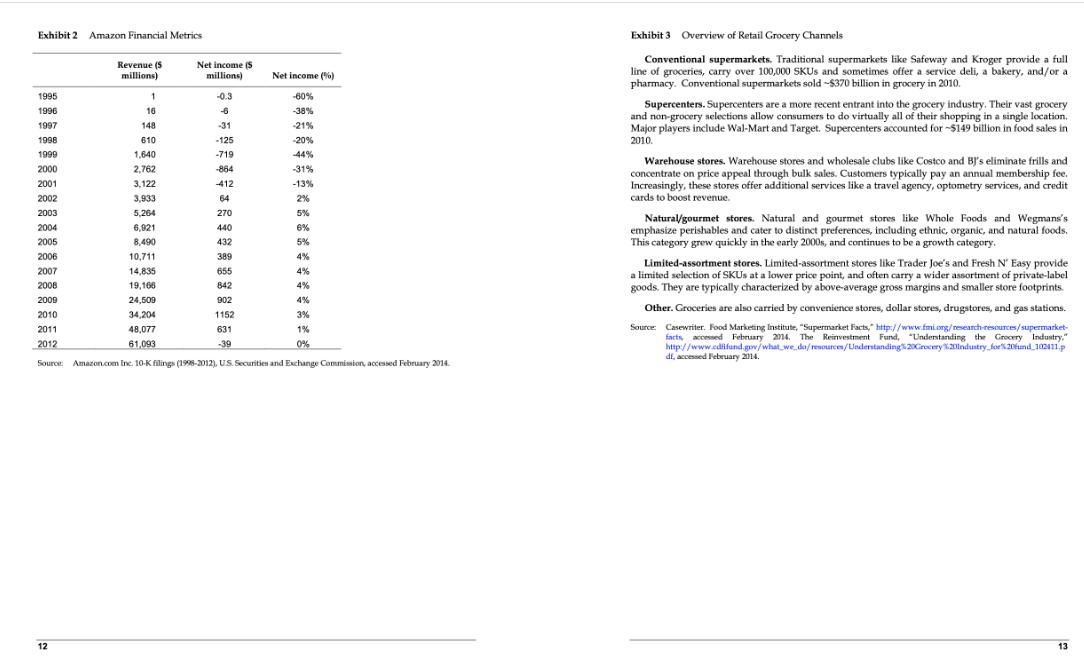
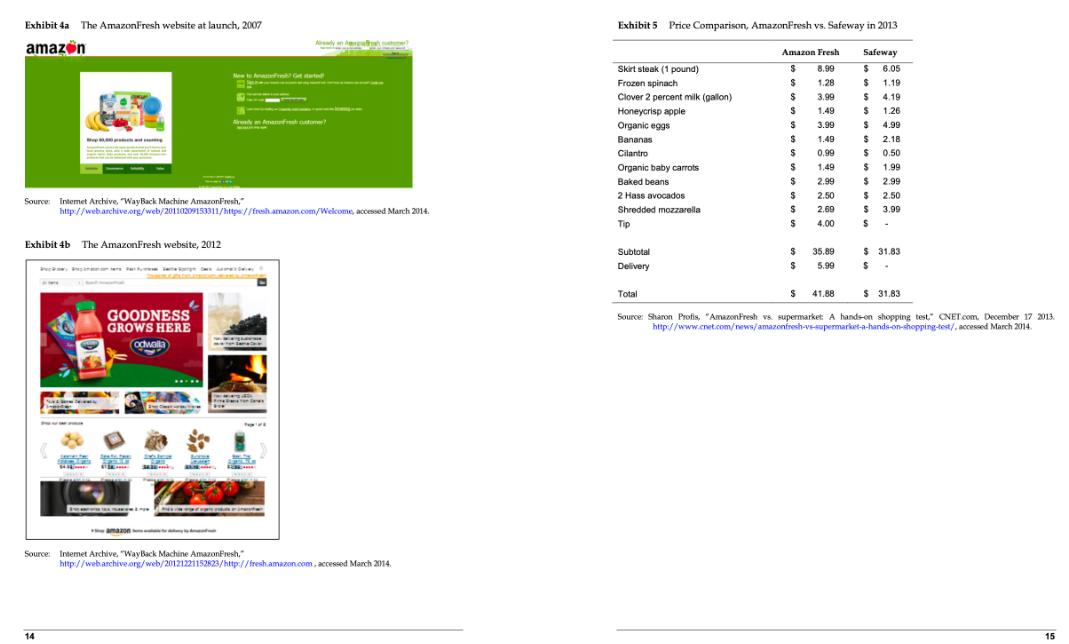
AmazonFresh: Rekindling the Online Grocery Market We believe that a fundamental measure of our success will be the shareholder value we create over the long term.... We will make bold rather than timid investment decisions where we see a sufficient probability of gaining market leadership advantages. Some of these investments will pay off, others will not, and we will have learned another valuable lesson in either case. - Jeff Bezos, 1997 Letter to Shareholders As Fishmonger Ryan Reese skillfully filleted a fresh rainbow trout at Seattle's Pike Place Market one morning in late 2012, the usual mix of tourists and locals gathered to admire his prowess. The iconic downtown market's appealing array of fresh and specialty foods drew daily crowds eager to admire its vendors' showmanship and buy their wares. But the trout wasn't for any of them. Ryan's customer was miles away on Mercer Island. Within hours AmazonFresh, the grocery subsidiary of Amazon.com, would deliver the fish, which she'd ordered online, right to her doorstep. AmazonFresh had spent five years testing and refining its business model since its launch in August 2007. The challenges were numerous; no other online grocer had yet succeeded on a national scale. Amazon typically allowed new businesses only a short time to achieve profitability before shutting down failed attempts. But CEO Jeff Bezos and his management team also made allowances for enterprises they believed would succeed in the long term. Known for being "stubborn on vision and flexible on details," Amazon was also famously resistant to Wall Street's quarterly earnings pressures. Grocery was an especially attractive sector because it was both the largest single U.S. retail category and one of the few that had not yet migrated online. (In 2012 less than 2 percent of overall U.S. grocery sales were transacted online.) Furthermore, customers shopped for groceries frequently and the category was more downturn-resistant than most. Even so, when Amazon announced its intention to launch AmazonFresh, skepticism reigned. Critics questioned whether a shift to online purchases would ever happen in the grocery sector. Others asked whether Amazon could operate profitably in a notoriously low-margin business. Perhaps for these reasons, AmazonFresh had taken an uncharacteristically cautious approach; to date, it only operated in Seattle. Meanwhile, both Professors Rory McDonald and Clayton Christensen, Robin Yang (MBA 2014), and Ty Hollingsworth (MBA 2014) prepared this case. This case was developed from published sources. Funding for the development of this case was provided by Harvard Business School and not by the company. HBS cases are developed solely as the basis for class discussion. Cases are not intended to serve as endorsements, sources of primary data, or illustrations of effective or ineffective management. Copyright 2014 President and Fellows of Harvard College. To order copies or request permission to reproduce materials, call 1-800-545-7685, write Harvard Business School Publishing, Boston, MA 02163, or go to www.hbsp.harvard.edu. This publication may not be digitized, photocopied, or otherwise reproduced, posted, or transmitted, without the permission of Harvard Business School.
Step by Step Solution
3.55 Rating (166 Votes )
There are 3 Steps involved in it
1 Assessment of the online grocery market opportunity The online grocery market opportunity is significant due to the size and growth potential of the grocery industry Grocery shopping represents a la... View full answer

Get step-by-step solutions from verified subject matter experts