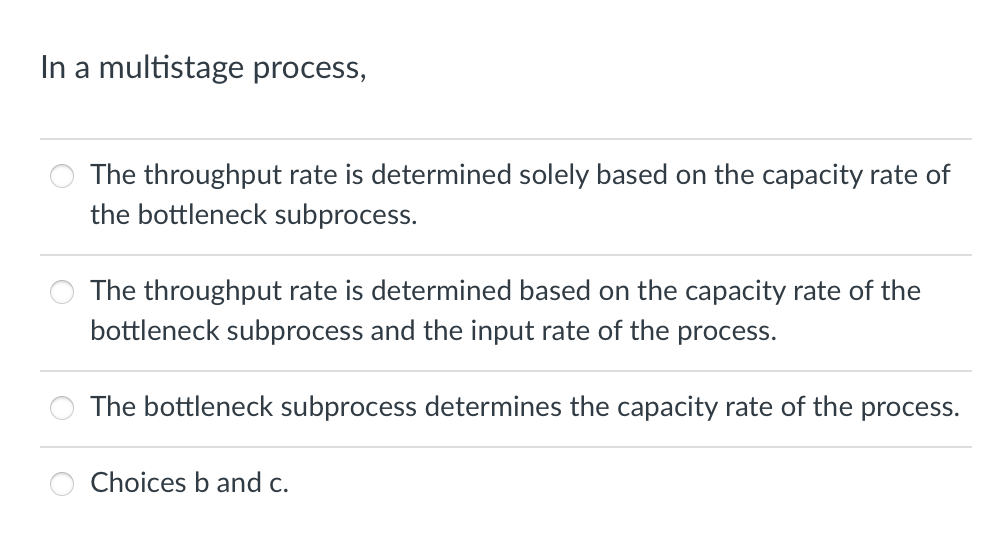
Question: In a multistage process, The throughput rate is determined solely based on the capacity rate of the bottleneck subprocess. The throughput rate is determined based
In a multistage process, The throughput rate isIn a multistage process, The throughput rate isIn a multistage process, The throughput rate isIn a multistage process, The throughput rate is

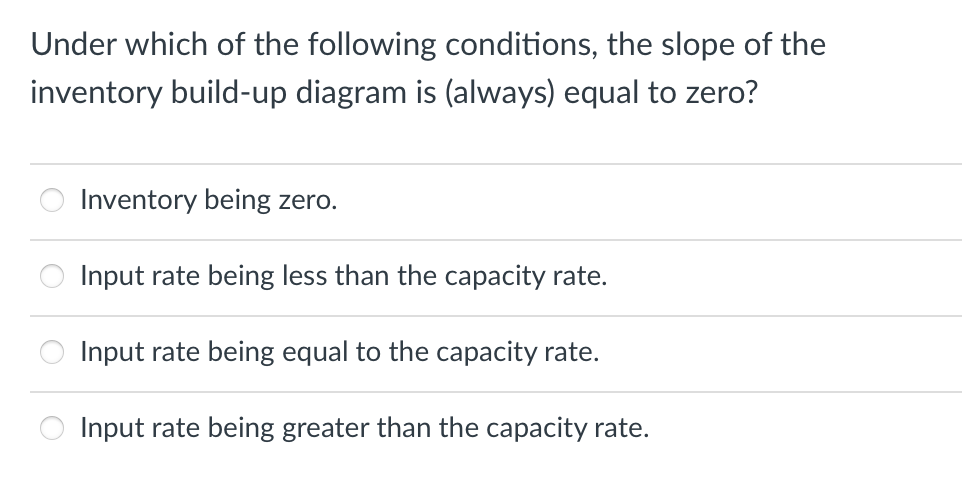
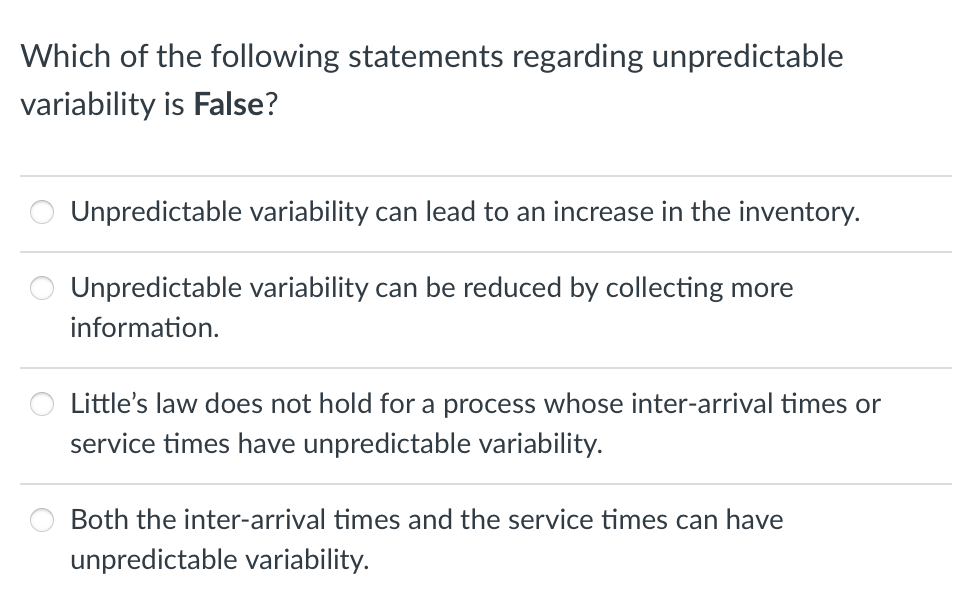
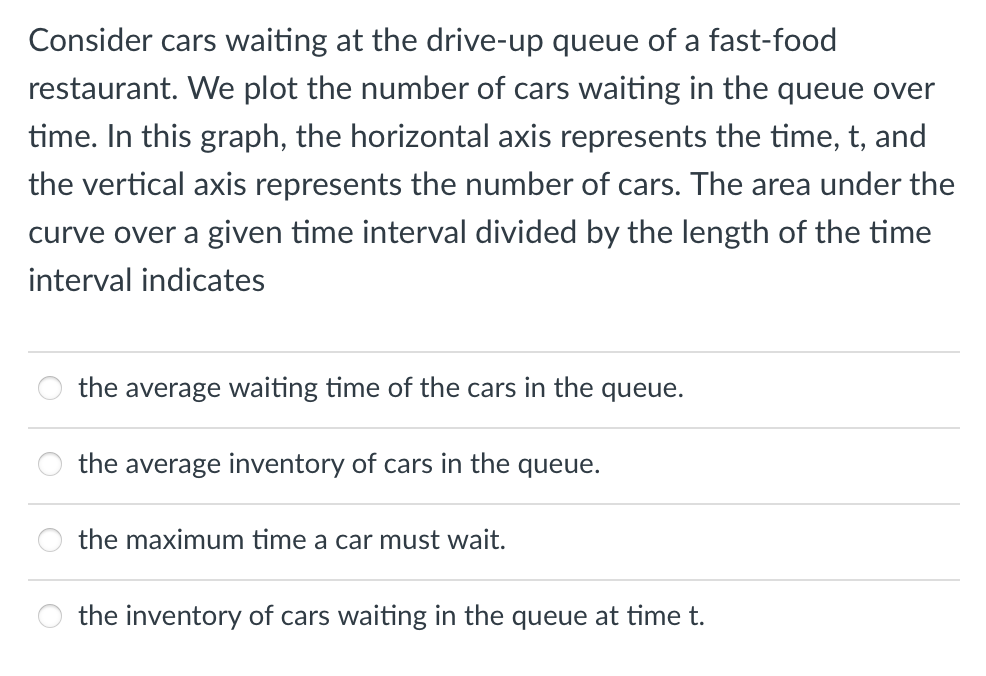
In a multistage process, The throughput rate is determined solely based on the capacity rate of the bottleneck subprocess. The throughput rate is determined based on the capacity rate of the bottleneck subprocess and the input rate of the process. The bottleneck subprocess determines the capacity rate of the process. Choices b and c. Which of the following statements regarding unpredictable variability is False? Unpredictable variability can lead to an increase in the inventory. Unpredictable variability can be reduced by collecting more information. Little's law does not hold for a process whose inter-arrival times or service times have unpredictable variability. Both the inter-arrival times and the service times can have unpredictable variability. Consider cars waiting at the drive-up queue of a fast-food restaurant. We plot the number of cars waiting in the queue over time. In this graph, the horizontal axis represents the time, t, and the vertical axis represents the number of cars. The area under the curve over a given time interval divided by the length of the time interval indicates the average waiting time of the cars in the queue. the average inventory of cars in the queue. the maximum time a car must wait. the inventory of cars waiting in the queue at time t. Under which of the following conditions, the slope of the inventory build-up diagram is (always) equal to zero? Inventory being zero. Input rate being less than the capacity rate. Input rate being equal to the capacity rate. Input rate being greater than the capacity rate
Step by Step Solution

There are 3 Steps involved in it

1 Expert Approved Answer
Step: 1 Unlock blur-text-image

Question Has Been Solved by an Expert!

Get step-by-step solutions from verified subject matter experts

Step: 2 Unlock
Step: 3 Unlock

Students Have Also Explored These Related General Management Questions!