







Question: In a random sample ofmales, it was found that 17 write with their left hands and 218 do not. In a random sample offemales, it
In a random sample ofmales, it was found that 17 write with their left hands and 218 do not. In a random sample offemales, it was found that 57 write with their left hands and 451 do not. Use a 0.01 significance level to test the claim that the rate ofleft-handedness among males is less than that among females. Test the claim using a hypothesis test. Consider the first sample to be the sample of males and the second sample to be the sample of females. What are the null and alternative hypotheses for the hypothesistest? Identify the test statistic. Identify theP-value. What is the conclusion based on the hypothesistest? Test the claim by constructing an appropriate confidence interval. What is the conclusion based on the confidenceinterval? Based on theresults, is the rate ofleft-handedness among males less than the rate ofleft-handedness amongfemales?
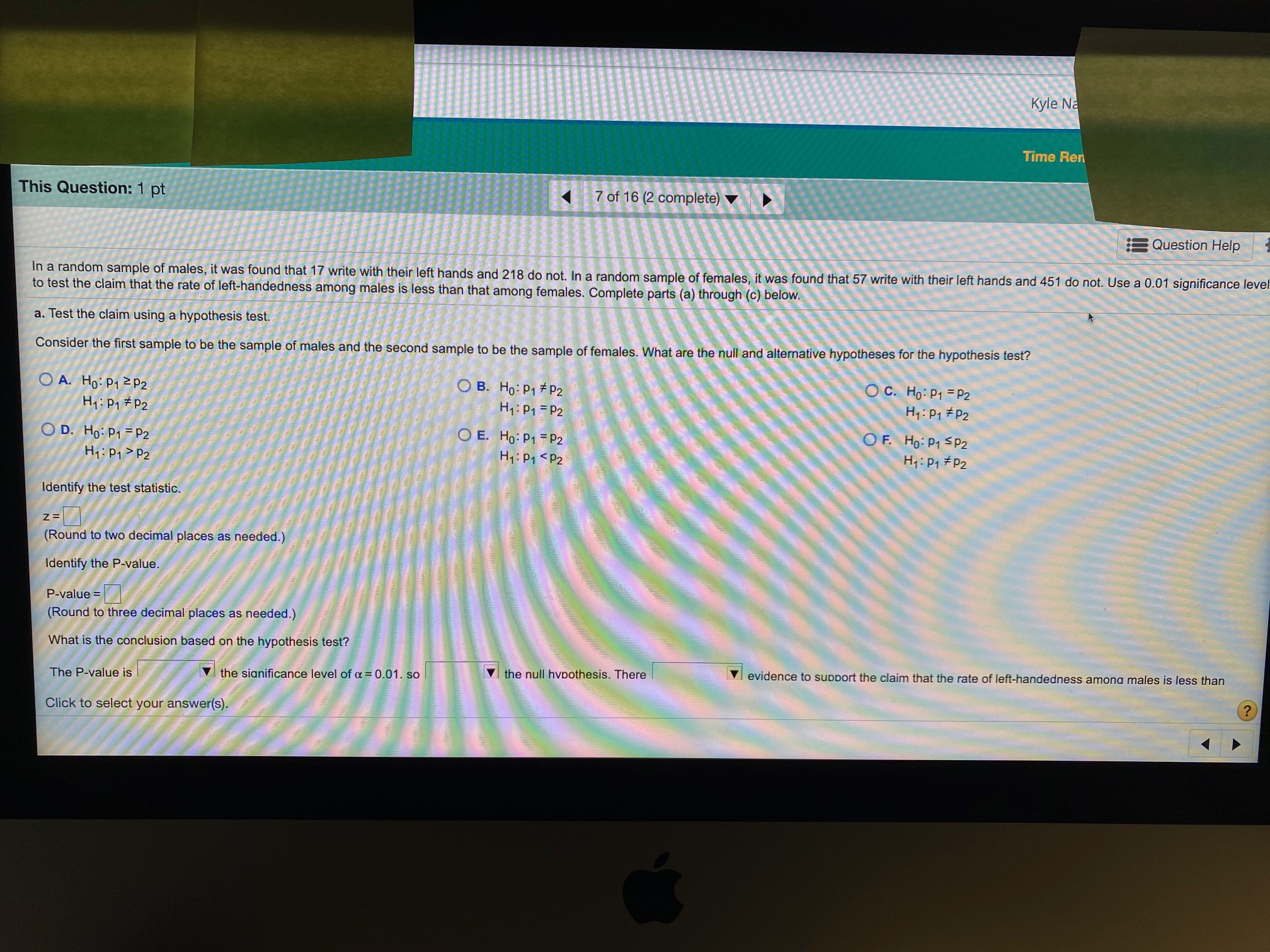
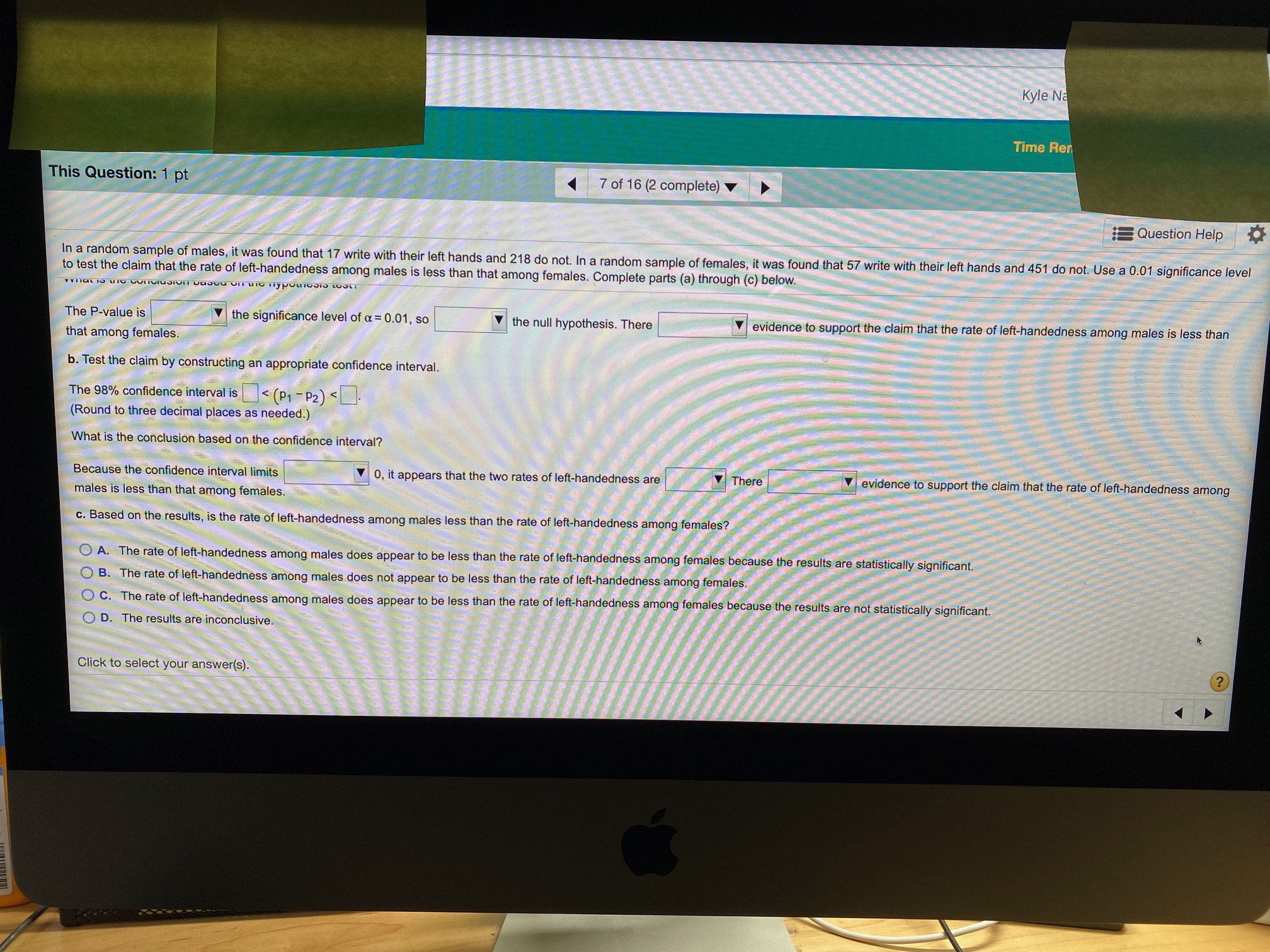
Kyle Na Time Ren This Question: 1 pt 7 of 16 (2 complete) Question Help In a random sample of males, it was found that 17 write with their left hands and 218 do not. In a random sample of females, it was found that 57 write with their left hands and 451 do not. Use a 0.01 significance level to test the claim that the rate of left-handedness among males is less than that among females. Complete parts (a) through (c) below. a. Test the claim using a hypothesis test. Consider the first sample to be the sample of males and the second sample to be the sample of females. What are the null and alternative hypotheses for the hypothesis test? O A. Ho: P1 2 P2 O B. Ho: P1 * P2 O C. Ho: P1 = P2 H1 : P1 # P2 H1 : P1 = P2 H1: P1 # P2 OD. HO: P1 = P2 O E. Ho: P1 = P2 OF. Ho: P1 SP2 H1 : P1 > P2 H1: P1
Step by Step Solution
There are 3 Steps involved in it

Get step-by-step solutions from verified subject matter experts
 Study Help