



Question: In Activity 1 you will need to forecast for each month of Year 2 , beginning in January. The Year 1 Table provides Actual Demand
In Activity you will need to forecast for each month of Year beginning in January.
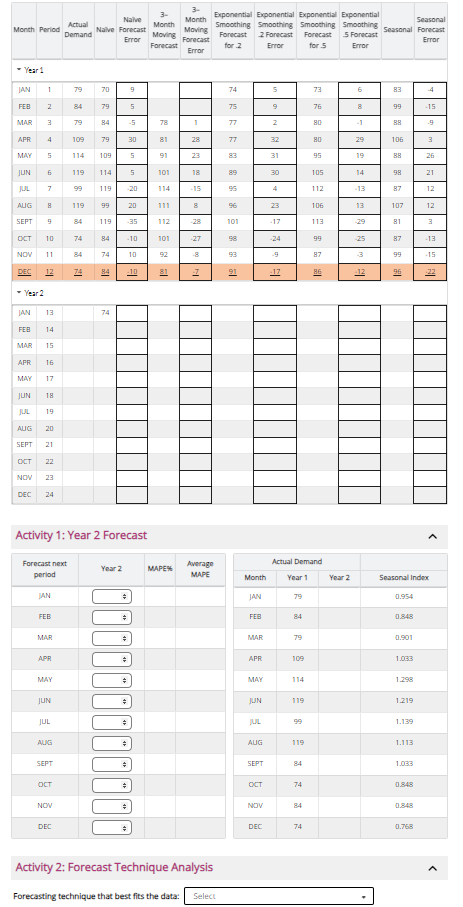
The Year Table provides Actual Demand as well as the demand that forecasted using different forecasting techniques: NaveMonth Moving Average, Exponential Smoothing for Exponential Smooth for and Seasonal. From month to month, different techniques may be more effective, which you can tell from the Forecast Error. The most effective technique is the one with a Forecast Error closest to
Note that the Year table will fill out automatically as you input your forecasts in the Activity section.
To get started with your own forecast:
Review the Year data. Look especially at the latest month of data to identify which forecasting strategy was most effective for that month.
Use the JANJanuary Year input box in the Activity section to input your forecast. Input the forecast from the strategy that performed best in the previous month. That month Actual Demand will automatically be filled out for you.
In the Year table you can see how the different forecasting strategies performed. Remember you want to use the strategy that was most effective for the latest month. Repeat the steps each month to complete the Activity inputs.
For Activity review your forecasts and identify which forecasting technique best fit the data based on overall performance. Typically the technique you used most frequently.
Scenario
You have been given a task to create a demand forecast for the second year of sales of a premium outdoor grill. Accurate forecasts are important for many reasons, including for the company to ensure they have the materials they need to create the products required in a certain period of time. Your objective is to minimize the forecast error, which will be measured using the Mean Absolute Percentage Error MAPE with a goal of being below
You have historical monthly sales data for the past year and access to software that provides forecasts based on five different forecasting techniques NaveMonth Moving Average, Exponential Smoothing for Exponential Smooth for and Seasonal to help determine the best forecast for that particular month. Based on the given data, you will identify trends and patterns to create a more accurate forecast.
Approach
Consider the previous months forecast to identify which technique is most effective. Use that to forecast the next month.
Remember to select the forecasting technique that produces the forecast error nearest to zero. For example:
Nave Forecast is and the Forecast Error is
Month Moving Forecast is and the Forecast Error is
Exponential Smoothing Forecast for is and the Forecast Error is
Exponential Smoothing Forecast for is and the Forecast Error is
Seasonal Forecast is and the Forecast Error is
The forecast for the next month would be as the Nave Forecast had the Forecast Error closest to zero with a This forecasting technique was the best performing technique for that month. You do not need to do any external analysisthe forecast error for each strategy is already calculated for you in the tables below.
Step by Step Solution
There are 3 Steps involved in it
1 Expert Approved Answer
Step: 1 Unlock

Question Has Been Solved by an Expert!
Get step-by-step solutions from verified subject matter experts
Step: 2 Unlock
Step: 3 Unlock