







Question: In an informed search algorithm, the heuristic function h(n) is a (not necessarily accurate) heuristic estimate of the cost of the path from n
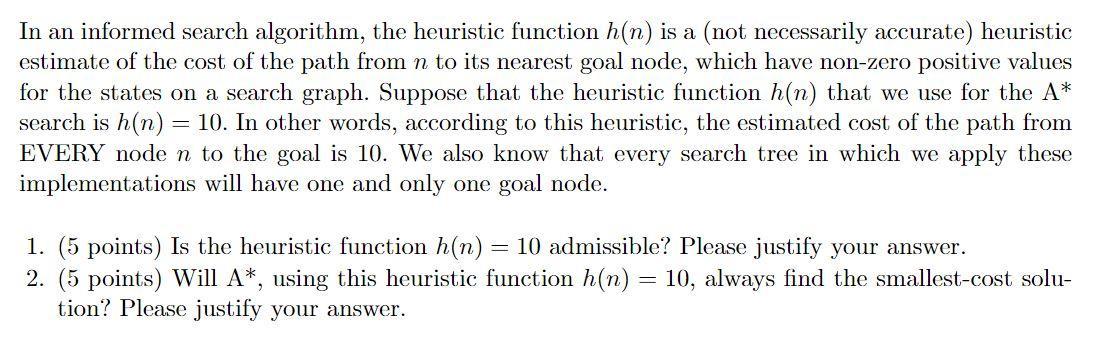
In an informed search algorithm, the heuristic function h(n) is a (not necessarily accurate) heuristic estimate of the cost of the path from n to its nearest goal node, which have non-zero positive values for the states on a search graph. Suppose that the heuristic function h(n) that we use for the A* search is h(n) = 10. In other words, according to this heuristic, the estimated cost of the path from EVERY node n to the goal is 10. We also know that every search tree in which we apply these implementations will have one and only one goal node. 1. (5 points) Is the heuristic function h(n) = 10 admissible? Please justify your answer. 2. (5 points) Will A*, using this heuristic function h(n) = 10, always find the smallest-cost solu- tion? Please justify your answer.
Step by Step Solution
There are 3 Steps involved in it
1 An admissible heuristic is one that never overestimates the cost to reach the goal nod... View full answer

Get step-by-step solutions from verified subject matter experts
 Study Help